Haitians Use West Indian American Day Carnival Parade To Spotlight On TPS Crisis
 07 September 2026
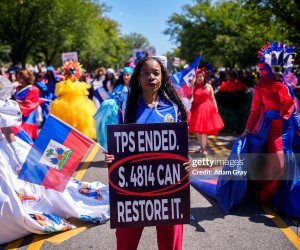


News Americas, BROOKLYN, NY, Mon. Sept. 7, 2026: Hundreds of thousands turned out for Brooklyn’s annual West Indian American Day Carnival Parade today but for many Haitian marchers, this year’s celebration doubled as a pointed message about the crisis facing their community following the loss of Temporary Protected Status.

Natalie Lafontant, who organizes Lespri Ayiti, the parade’s largest Haitian mas group, said the mood carried real weight this year. “There’s a somber cloud over it with everything that has happened from last year to this year with TPS… what’s happening in detention centers, and those who are being sent back with no valid way of living or supporting themselves,” she said. Still, she said the response to hardship wasn’t surrender. “If you know anything about the Caribbean, especially about Haiti, we use music, dance, art, to continue to strive and push through,” she said.
In June, the Supreme Court ruled that federal courts cannot review the Trump administration’s decision to end TPS for Haitian and Syrian immigrants, clearing the way for roughly 350,000 Haitians to lose the protection. A federal judge finalized the order in early August, and work permits tied to Haitian TPS expired July 27.

Lafontant’s group, about 180 artists, designers, musicians and residents, struggled to find float sponsors this year given the costs of insurance, costumes and care for marchers. “But we continue to do it because we love our country,” she said.
New York’s Haitian community, roughly 163,000 people in the metropolitan area, is the second-largest in the U.S. after Miami, with most settled in Brooklyn’s Flatbush, East Flatbush and Crown Heights neighborhoods. Many arrived during and after the Duvalier dictatorship of the 1970s and 80s, part of a broader history of resistance tracing back to the Haitian Revolution, when enslaved and free Black people overthrew French colonial rule in the only successful slave revolt in modern history.

That legacy shaped this year’s costumes. Fashion designer Clara Poteau created royal blue emperor robes honoring Jean-Jacques Dessalines, a revolutionary leader and Haiti’s first head of state after independence. Other designs featured miniature Haitian flags and the faces of national football stars Duckens Nazon and Emmanuel Sanon, while a “Freedom” T-shirt carried the flags of nations Haitian revolutionary leaders helped liberate, including Venezuela, Colombia, Ecuador, Peru, Bolivia, Panama, Mexico and Greece.

Edwina Paul, founder of the women’s coalition Fanm Se Poto Mitan, left Haiti in 1993 amid instability and said the parade reflects why so many made that same journey. “We don’t come here to sin, we don’t come here to kill. We come here to work, to have a better education,” she said.
The parade was briefly interrupted around 4 p.m., one and a half hour before the new 5:30 PM finish, when at least three people were shot in separate incidents near the route, according to police. A man was shot near Nostrand Avenue and St. John’s Place in Crown Heights, with a suspect quickly taken into custody; a woman was shot and a man grazed in the leg near Eastern Parkway and Kingston Avenue. The parade concluded at 5:30 p.m., earlier than in past years, as part of city officials’ effort to curb violence, with checkpoints and bag restrictions in place along the route.
NewsAmericasNow will continue covering the Haitian community’s response to TPS policy changes.
Related News
Caribbean Community Leader Criticizes NYC Govt. Decision To Shorten The West Indian Americ...

Trinidadian Immigrant Accuses Clark County, Nevada Of Discrimination In EEOC Filing

Guyana Magistrate Defers Ruling On Treaty Issue In Mohamed Extradition Case