India protest: How Modi’s refusal to sack education minister fits a pattern
 22 July 2026
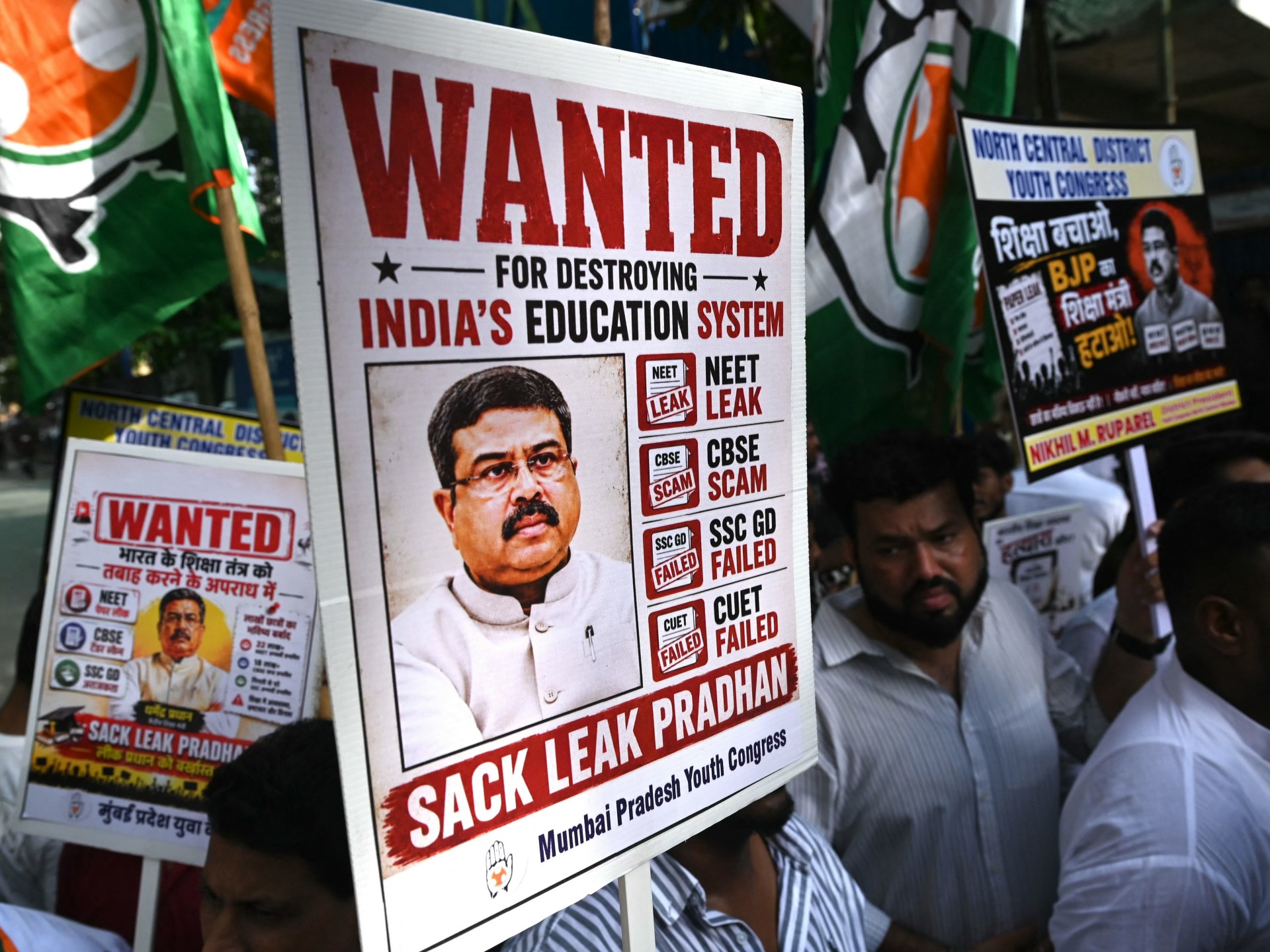

Thousands of supporters of India’s youth-led “cockroach” movement have been camping in the capital, New Delhi, for more than a month to demand the resignation of Education Minister Dharmendra Pradhan over a series of examination paper leaks.
The Gen Z-led protests, during which more than 100 people were severely wounded in baton and tear gas attacks by police on Monday, represent the biggest public challenge to Hindu majoritarian Prime Minister Narendra Modi’s rule so far in his third term.
- list 1 of 4India opposition leader Gandhi freed after detention at student-led protest
- list 2 of 4‘Won’t back down’: Indian student protesters return after police crackdown
- list 3 of 4‘Now or never’: Students defy Delhi lockdown to march on India’s parliament
- list 4 of 4Photos: Police fire tear gas at India’s Cockroach movement supporters
end of list
India’s main opposition parties have joined the daily street demonstrations and courted arrests, amplifying the protesters’ demand for Pradhan’s sacking.
But at a time when unpopular governments and controversial ministers routinely resign or are sacked in other democracies — Britain’s Andy Burnham became his country’s seventh prime minister in 10 years — Pradhan has stayed in his office.
And to followers of Indian politics, that’s no surprise. To the contrary, it fits a pattern seen in 12 years of Modi’s rule, in which he has repeatedly defied widespread calls for the resignation of multiple ministers, despite major controversies surrounding them.
Mahesh Sharma
A year after Modi came to power in the summer of 2014, a 50-year-old Muslim ironsmith was dragged from his home and lynched over suspicions that he had stolen a cow and stored its meat in his refrigerator. Many Hindus consider the cow holy, and its slaughter is banned in most Indian states.
Mohammad Akhlaq’s killing on the night of September 16, 2015, in Bishada, a village in the industrial district of Dadri in Uttar Pradesh state, was the first in a series of cow-related lynchings by Hindu mobs and had triggered nationwide protests.
Advertisement
But the then-Minister of Culture and Tourism Mahesh Sharma, who represented the Gautam Budh Nagar constituency under which Dadri falls, called the killing “an accident”, forcing Muslim groups and opposition parties to call for his resignation. But he refused to step down, and stayed part of Modi’s council of ministers.
A year later, Sharma even visited Bishada to meet the family of Ravi Sisodia, one of the 18 accused in the Akhlaq lynching case, who had died of renal and respiratory failure. In images that shocked the nation and renewed calls for his sacking, Sharma was seen bowing before Sisodia’s coffin draped in the national flag.
Sharma, who owns a series of hospitals, was finally dropped as a minister only after Modi won a second term in 2019. He remains a BJP parliamentarian for a third term.
Smriti Irani and Bandaru Dattatreya
Months after Akhlaq’s lynching, a 26-year-old doctoral student, belonging to one of India’s most marginalised groups, was found dead inside a hostel room at the University of Hyderabad on January 17, 2016.
Earlier that month, Rohith Chakravarthi Vemula and four other students were thrown out of their hostel accommodation and their monthly stipend withheld for allegedly assaulting the head of a student group affiliated with the Rashtriya Swayamsevak Sangh (RSS), the far-right ideological mentor of Modi’s Bharatiya Janata Party (BJP).
All five students were Dalits, the ethnic community formerly referred to as “untouchables”, who fall at the bottom of India’s caste hierarchy and have faced persecution and discrimination by the privileged castes for centuries.
Lacking the means to afford private housing, the five students pitched a tent inside the university and started a hunger strike, protesting against the administrative move. They alleged that the university’s decision to ban them from hostels was heavily influenced by a series of letters written by the then-federal ministers, Smriti Irani and Bandaru Dattatreya.
As tensions within the university intensified, Vemula hanged himself inside a friend’s room, leaving behind a suicide note that galvanised student protests across the country and calls for Irani and Dattatreya to quit. Irani, a former TV actress, drew the most ire for allegedly lying in parliament about the circumstances leading to Vemula’s death and for defending the university administration.
But both ministers remained in Modi’s cabinet.

Irani was moved to the Textiles Ministry in July 2016 and awarded the crucial Information and Broadcasting Ministry the next year. Dattatreya resigned as Labour Minister in September 2017, only to be appointed governor of the northern states of Himachal Pradesh in 2019 and Haryana in 2021.
Advertisement
Ajay Mishra Teni
Also in 2021, Ashish Mishra, the son of junior Home Minister Ajay Mishra Teni, was accused of running his car over a group of farmers protesting against a set of farm laws passed by the Modi government in Uttar Pradesh’s Lakhimpur Kheri. Four farmers and a journalist were killed, while three BJP members and one of Mishra’s drivers were beaten to death in retaliatory violence.
The incident triggered massive calls for Teni to resign, but he remained in his office for three years until he lost the 2024 election.
The only resignation of a Modi minister in response to a public demand for accountability was seen in the immediate aftermath of the coronavirus pandemic.
As India grappled with a deadlier second wave in 2021 and criticisms of the government’s response mounted, Health Minister Harsh Vardhan, himself a medical doctor, quit his position. He retired from active politics after the BJP did not field him as a candidate in the 2024 general election.
Modi’s critics also contrast his own party’s trend with the preceding government, led by the Indian National Congress, where several ministers, including those holding key portfolios such as home or foreign affairs, resigned or were sacked in response to calls for accountability.