Exxon To Recover $55 Billion From Guyana – The Median Guyanese Worker Earns $239 A Month
 17 June 2026
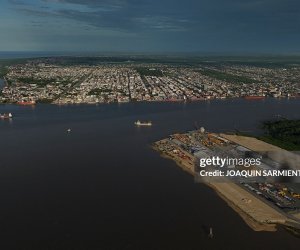


News Americas, GEORGETOWN, Guyana, Weds. June 17, 2026: ExxonMobil’s consortium operating Guyana’s Stabroek Block is on track to fully recover its entire $55 billion investment program by mid-2026 – years ahead of original projections – as oil production surges past 900,000 barrels per day and accelerates toward 1 million.
By any measure of national accounting, Guyana is one of the fastest growing economies on Earth. The International Monetary Fund projects 2026 GDP growth of 16.2 percent. GDP per capita has reached $33,167 – a staggering 22.9 percent increase from 2025. Nominal GDP now stands at $33.96 billion for a population of just 840,890 people.
By almost every other measure that matters to ordinary Guyanese families, the oil boom has not yet arrived at their kitchen tables.
As of the end of 2025, ExxonMobil’s Guyana operation had banked $55 billion in recoverable costs, of which $51 billion had already been recovered, according to John Colling, ExxonMobil Guyana’s Vice President and Business Services Manager, speaking to reporters as quoted by OilNOW.
“Recovery of those costs could occur sooner than originally anticipated, and that very well likely could be this year, sometime in the second half,” Colling said, as quoted by OilNOW.
Under Guyana’s Production Sharing Agreement, the ExxonMobil-led consortium – alongside partners Hess and CNOOC – can recover up to 75 percent of monthly oil production as cost oil before remaining production is classified as profit oil and split equally with the government. A 2 percent royalty on all production is additional. Once that cost recovery ceiling is exhausted, Guyana’s effective share of production revenue increases substantially – a structural shift that Vice President Bharrat Jagdeo has previously signaled the government expects.
The Stabroek Block currently produces over 900,000 barrels per day across four operating projects – Liza 1, Liza 2, Payara, and Yellowtail – with the Uaru project expected to commence production later in 2026, pushing total output above 1 million barrels per day.
ExxonMobil has also submitted for authorization a new exploration and appraisal program for the Stabroek Block that could result in drilling as many as 35 additional wells, according to Guyana’s Environmental Protection Agency. That drilling is slated to begin in 2028 and run through the end of 2033 – positioning Guyana’s oil sector for installed capacity expansion to 1.7 million barrels per day by 2030.
ExxonMobil operates the block with a 45 percent stake, alongside Chevron at 30 percent and China’s CNOOC at 25 percent.

Guyana’s fiscal windfall arrives as global refining fundamentals shift decisively in its favor. European and North American refiners have substantially increased imports of Guyanese crude, drawn by the light sweet characteristics of Stabroek production. Asian refiners have similarly pivoted toward Guyanese supply as an alternative to Persian Gulf constraints – with India increasing crude purchases to approximately 297,000 barrels per day in January, before Middle East tensions escalated further.
Guyana has positioned itself as a structural beneficiary of Western Hemisphere energy security strategy – a small Caribbean nation now central to global refining supply diversification.
But behind the extraordinary macroeconomic numbers lies a far more difficult reality for ordinary Guyanese families. Guyana’s national minimum wage in 2026 stands at G$60,146 monthly – approximately US$287. The median monthly income across the formal sector is roughly G$50,000 – approximately US$239. The average gross monthly salary is G$100,000, or roughly US$478.
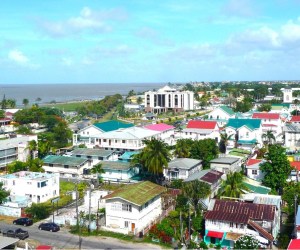
Meanwhile, the basic cost of living in Georgetown tells a starkly different story than the national GDP figures suggest. A single person requires approximately $900 to $1,200 USD per month to live in Georgetown, excluding rent – and a family of four needs $2,800 to $3,400 USD monthly. Rent alone for a standard one to two bedroom apartment runs $500 to $1,000 or more, with properties in expat neighborhoods exceeding $2,000.
In other words: the average Guyanese worker earning the median salary of roughly $239 a month is being asked to survive in a capital city where basic monthly expenses for a single person start at $900 – nearly four times their monthly income. Annual inflation has also been climbing – rising to 3.4 percent year-over-year in April 2026, the highest reading since January, driven primarily by elevated food costs. The IMF projects inflation to stabilize around 4.1 percent annually – adding further pressure to household budgets that are already stretched thin.
Guyana’s GDP per capita figure of $33,167 – while genuinely extraordinary on paper – obscures one of the most significant income inequality gaps in the Caribbean. The gap between Georgetown’s oil-driven economic boom and conditions in rural and hinterland regions remains stark, with poverty widespread despite headline GDP growth figures.
Teachers and public servants have received incremental relief – a 9 percent increase in 2026 as part of a multi-year collective bargaining agreement, achieving a compound increase of at least 57 percent over the 2021-2026 period. But for the majority of Guyanese workers in agriculture, mining, and services – sectors that remain the backbone of formal employment despite the oil sector’s dominance of GDP – wages have not kept pace with the cost of living increases driven by the oil boom itself.
The housing boom driven by oil wealth and foreign workers has pushed Georgetown rental costs to levels that price out ordinary Guyanese families – even as the country’s GDP figures suggest unprecedented national prosperity.
As ExxonMobil prepares to fully recover its $55 billion investment – years ahead of schedule – and as Guyana’s share of oil revenue is set to increase substantially in the back half of 2026, the central question facing the country’s leadership is whether that windfall will finally reach the Guyanese families currently living hand to mouth in the shadow of one of the most consequential oil discoveries in modern history.
The numbers say Guyana is booming. The lived experience of ordinary Guyanese workers earning $239 a month in a capital city where basic survival costs $900 says something very different.
RELATED:
Related News
From Flatbush To The Backdam: The Reality Check Of Moving “Back Home”

Marco Rubio Says America Has Taken Back Control Of The Western Hemisphere

When Grace Is Not Enough: Accountability in Faith Communities Across The Global South