Yemen government forces claim new advances as Houthi border attacks resume
 09 November 2026
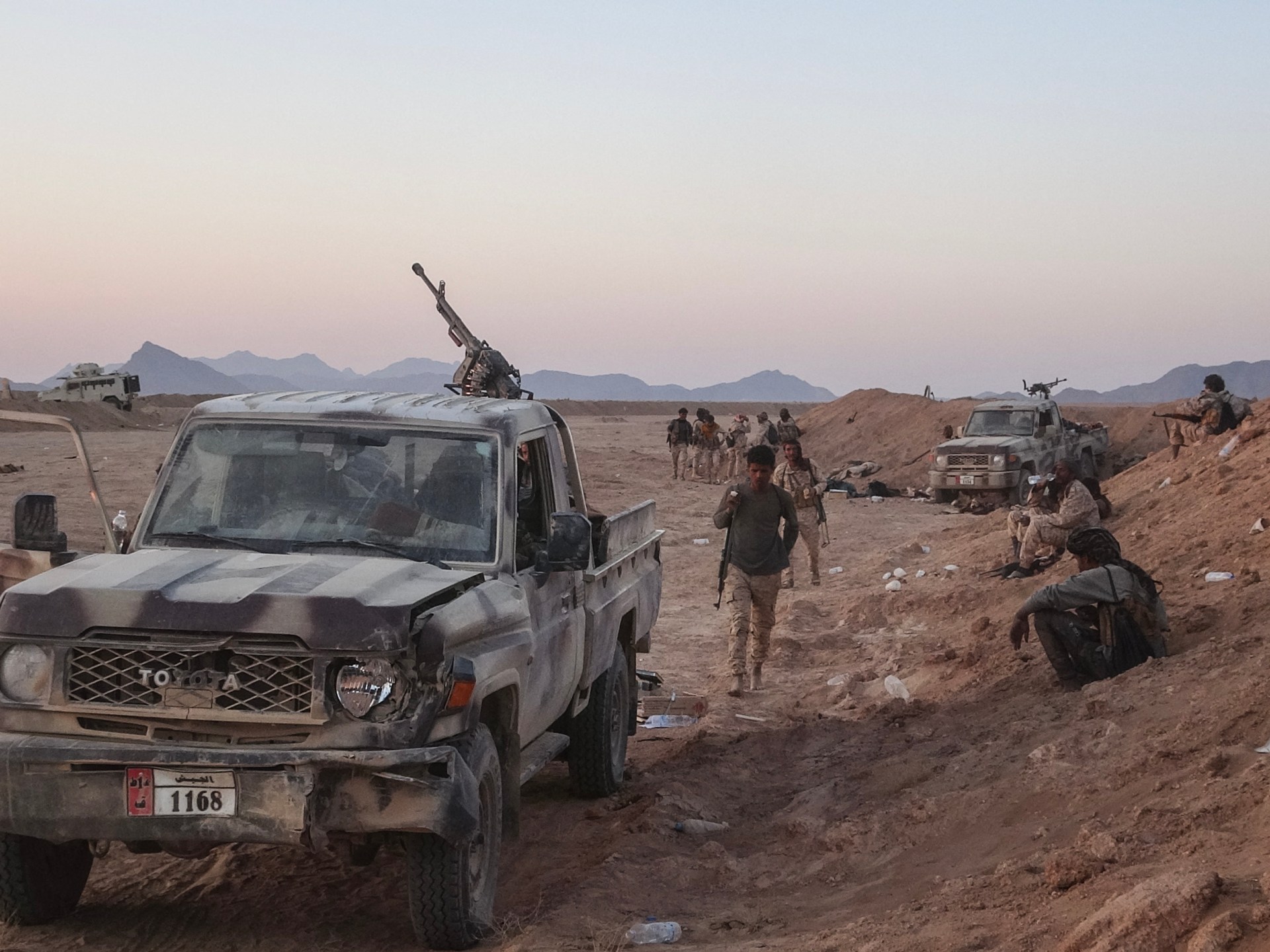

Yemen’s government forces have announced the capture of Houthi-held positions in the southern governorate of Lahj, amid fierce clashes with the Houthi rebels across multiple fronts in the country.
The government’s National Shield Forces said on Monday that they had seized positions on the al-Muhawala front in western Lahj after a large-scale assault on Houthi positions. The forces claimed that dozens of Houthi fighters had been killed or wounded in the attack.
- list 1 of 3Syria confirms sending troops to Saudi Arabia amid battle against Houthis
- list 2 of 3Saudi Aramco building in Riyadh damaged in ‘attempted’ attack
- list 3 of 3Yemeni gov’t forces report advances as Houthis say deadly strikes hit Sanaa
end of list
The latest announcement comes after several days of reported gains by government forces in the northern governorate of al-Jawf, east of the Houthi-held Yemeni capital Sanaa. Government forces in al-Jawf have advanced in recent days through mountain ranges east of the provincial capital al-Hazm.
Al Jazeera Arabic reporter Suhaib al-Miyahi visited the al-Jawf front line on November 6, documenting trenches and fortifications in positions that government commanders said had been captured from the Houthis, as battles continued nearby.
The Houthis are continuing their attacks in Taiz, where they have encircled the city, imposing a siege on it for more than a month. Government forces say they have repelled Houthi attacks across several fronts in the outskirts of the city over the previous day.
In his daily update, government military spokesperson Majed al-Nuzaili said on Monday that government forces had carried out almost 1,000 attacks in the previous hours, leaving more than 120 Houthi fighters dead or wounded. The claims could not be independently verified.
Advertisement
The recent clashes fall under the ongoing Operation Dawn of Yemen, which began on October 5 in an attempt to reverse Houthi gains made along the Red Sea coast the previous month, and eventually defeat the Iranian-backed rebel group.
However, Saudi-backed government forces have yet to make significant gains in what is proving to be a war of attrition, the latest phase of a more than decade-long war that began after the Houthi capture of Sanaa in September 2014.
Depleting Houthi capabilities
Tawfik al-Hamidi, political analyst and president of the SAM Organization for Rights and Liberties, told Al Jazeera that the government is having some success in depleting Houthi manpower, partly as a result of the support it gets from Saudi air strikes.
“I believe that what is happening reflects a real depletion of the Houthis’ capabilities, and not just a tactical retreat,” al-Hamidi said.
He claimed that the number of Houthi attacks had decreased in frequency.
“The Houthi group still possesses military capabilities, but its ability to continue broad attacks and retain positions is facing mounting pressures,” al-Hamidi said.
He emphasised the strategic importance of al-Jawf because of its proximity to Sanaa, arguing that further government advances there could prompt the Houthis to redistribute their forces.
“I see that Taiz may be the biggest beneficiary of these developments, because it opens a real opportunity to ease the siege, leading to lifting it,” al-Hamidi said.
Targeting medical workers
The escalation carries a severe humanitarian cost in Taiz, where nine civilians, including two children, were wounded in shelling and gunfire in several areas on Sunday, according to reports published on Monday by the state-run Saba news agency.
In a separate incident on Sunday, an ambulance came under fire in the al-Awat area, killing a wounded patient and his father and injuring a paramedic, according to local and medical sources cited by Saba.
The Joint Medical Emergency Committee in Taiz also said preliminary reports indicated that another ambulance had been targeted in the al-Shaqab area of Taiz.
Cross-border retaliation
The Houthis have meanwhile continued launching ballistic missiles and drones towards Saudi Arabia, including attacks targeting oil facilities.
The Saudi-led coalition said on Sunday that it had intercepted a drone and five missiles launched by the Houthis towards Riyadh and Saudi Arabia’s eastern and southern regions.
Houthi military spokesperson Yahya Saree said on Monday that Saudi forces had carried out more than 100 air strikes in the preceding 24 hours, targeting Marib, Sanaa, Hodeidah, Taiz, Lahj, and al-Jawf.
Advertisement
He alleged that the attacks had caused civilian casualties, but did not specify how many.
Al-Hamidi argued that the Houthis were using cross-border attacks to increase the security and economic costs of Saudi Arabia’s intervention, hoping to pressure Riyadh into halting the government offensive.
“The group realises that the continued advance of the government forces may weaken its military position, and therefore it uses missiles to raise the security and economic cost on Riyadh,” he explained.
But he warned that the strategy could backfire, prompting Saudi Arabia to instead intensify its military response rather than offering concessions.
Related News
Why Arab parties may not be the ‘kingmakers’ in this Israeli election
Why is Morocco celebrating the defeat of a UN resolution on Western Sahara?
What Vucic’s defeat means for Serbia’s foreign policy