Which aid groups is Israel banning from Gaza now – and what will it mean?
 31 December 2025

Israel said it will suspend permits for more than three dozen aid organisations for allegedly failing to meet new requirements for operating in war-devastated Gaza, a move likely to worsen already dire conditions for Palestinians in the enclave.
Organisations facing bans as of January 1, 2026 have failed to meet new requirements for sharing detailed information about their staff, funding and operations, Israeli authorities said on Tuesday.
- list 1 of 3‘A tough neighbourhood’’: Trump says Gaza rebuilding to start soon
- list 2 of 3A decimated Gaza marks the end of another year of Israeli bombs
- list 3 of 3“No withdrawal of the Israeli army” from Gaza unless Hamas disarms
end of list
The Israeli Diaspora Affairs Minister Amichai Chikli said that while humanitarian assistance was welcome, “exploitation of humanitarian frameworks for terrorism” was not.
The decision comes as a coalition of foreign ministers from countries including the United Kingdom, Canada, France, Japan and the Nordic states urged Israel to ensure nongovernmental organisations (NGOs) can operate “sustained and predictable” aid deliveries, while expressing serious concerns about the humanitarian situation in the Strip.
So, why is Israel suspending these aid groups, and how will it affect Palestinians in Gaza?
Why is Israel suspending these groups?
The Ministry for Diaspora Affairs and Combating Antisemitism said the measure was part of Israel’s decision to “strengthen and update” the rules overseeing the work of international NGOs in the war-torn Palestinian territory.
“Humanitarian organisations that fail to meet security and transparency requirements will have their licences suspended,” it said in a statement.
The ministry added that groups which had “failed to cooperate and refused to submit a list of their Palestinian employees in order to rule out any links to terrorism” had been formally notified that their licences would be revoked from January 1.
Advertisement
The aid groups were given 10 months to provide the requested information but “failed to comply with the requirements”, it claimed.

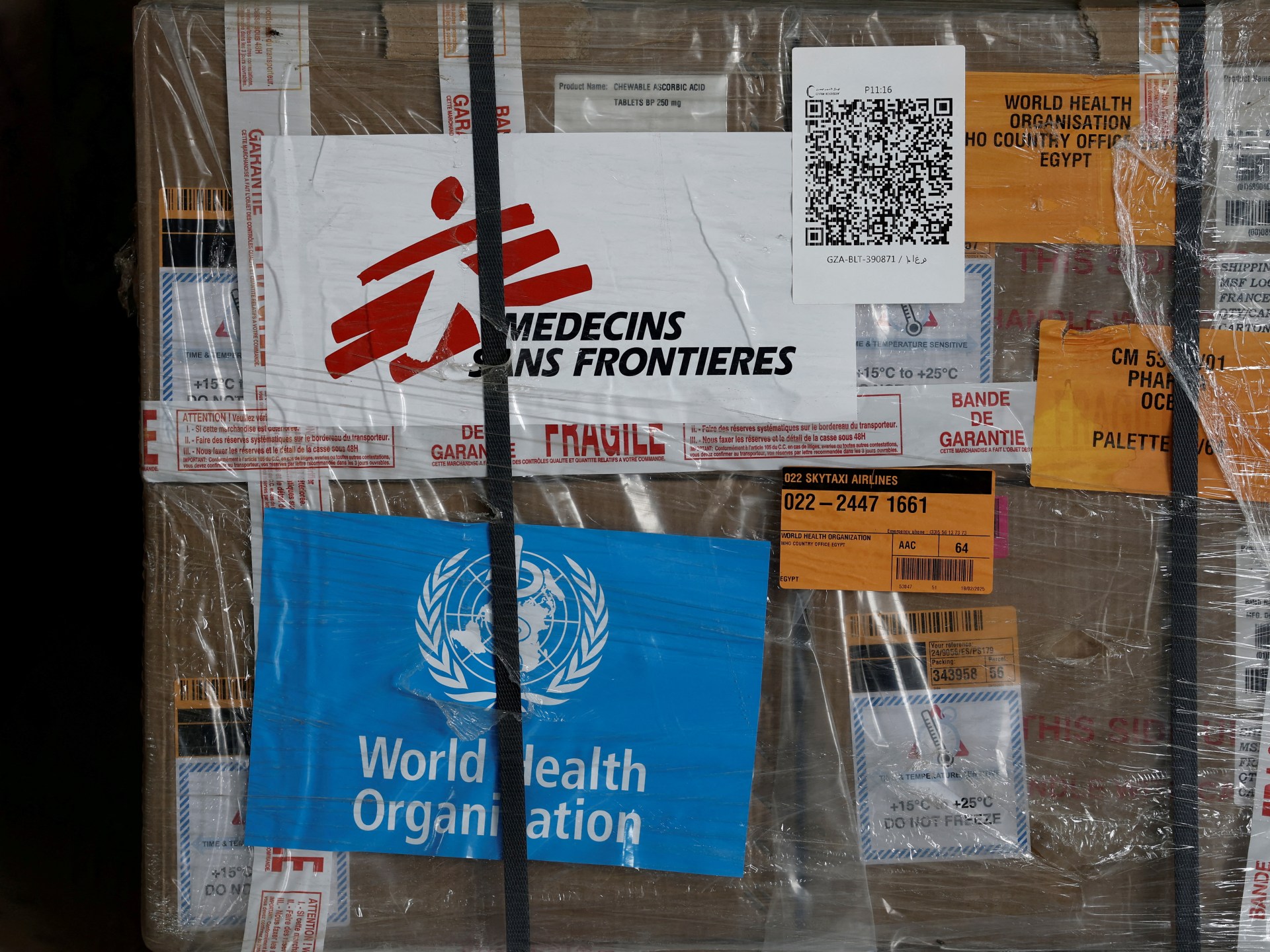
Among the banned organisations is medical charity Doctors Without Borders, known by its French initials MSF, which the ministry accused of employing two individuals with alleged links to Hamas and Palestinian Islamic Jihad, respectively, without providing any evidence for its claims.
“Despite repeated requests, the organisation failed to fully disclose the identities and roles of these individuals,” the statement added.
In a comment to the AFP news agency, MSF said it “would never knowingly employ people engaging in military activity” as they would “pose a danger to our staff and our patients”.
The charity further stated that it “continues to engage and discuss with Israeli authorities”, and that it has “not yet received a decision on re-registration”.
Earlier this year, more than 100 aid organisations accused Israel of blocking life-saving assistance from reaching Gaza and urged it to end its “weaponisation of aid” after it refused to allow aid trucks into the devastated territory.
Which major humanitarian organisations have been barred from Gaza?
The 37 organisations or their divisions facing suspension or loss of licences to operate in Gaza include several major international aid agencies:
- Action Against Hunger
- ActionAid
- Alianza por la Solidaridad
- Campaign for the Children of Palestine
- CARE
- DanChurchAid
- Danish Refugee Council
- Handicap International: Humanity & Inclusion
- Japan International Volunteer Center
- Medecins du Monde France
- Medecins du Monde Switzerland
- Medecins Sans Frontieres Belgium
- Medecins Sans Frontieres France
- Medecins Sans Frontieres Netherlands
- Medecins Sans Frontieres Spain
- Medicos del Mundo
- Mercy Corps
- Norwegian Refugee Council
- Oxfam Novib (Oxfam’s Dutch affiliate)
- Premiere Urgence Internationale
- Terre des hommes Lausanne
- International Rescue Committee
- WeWorld-GVC
- World Vision International
- Relief International
- Fondazione AVSI
- Movement for Peace-MPDL
- American Friends Service Committee
- Medico International
- Palestine Solidarity Association in Sweden
- Defense for Children International
- Medical Aid for Palestinians UK
- Caritas Internationalis
- Caritas Jerusalem
- Near East Council of Churches
- Oxfam Quebec
- War Child Holland
Advertisement
These organisations deliver a range of services including healthcare, food distribution, shelter, water and sanitation, education and psychological support.
Has Israel done this before?
This is not the first time that Israel has taken steps to suspend or ban the operations of international humanitarian agencies providing support to Palestinians.
In 2024, the Israeli parliament passed a law banning the United Nations Relief and Works Agency for Palestine Refugees (UNRWA) from operating within Israel, citing allegations that some of its locally engaged staff had participated in the Hamas-led October 7, 2023 attacks on southern Israel.
UNRWA – the principal provider of aid, education, health and social services to Palestinian refugees across Gaza, the occupied West Bank and neighbouring countries for decades – strongly denied these allegations. Since Israel controls access to Gaza and the occupied West Bank, the ban crushed UNRWA’s operations in the Palestinian territory.
In October, the International Court of Justice (ICJ) found that Israel’s allegations against UNRWA were unsubstantiated.
Nevertheless, Israel’s claims prompted the United States, historically UNRWA’s largest donor, to end funding. Other Western nations also suspended funding to the organisation, but many have since reinstated it.
The bans and restrictions on international and UN aid agencies are pillars of what Israel’s critics say are broader efforts by the country to make life in Gaza next to impossible for the Palestinian territory’s more than two million people, by destroying all elements of what any functional society needs.
For nearly two decades, Israel’s blockade of Gaza has stifled the entry and exit of people and materials needed to develop the social and economic infrastructure of the territory. But over the past two years, Israel’s genocidal war has demolished what Palestinians in Gaza painstakingly built, despite the odds.
According to the latest United Nations data, Israel has killed 579 aid workers – including nearly 400 from UNRWA – since October 7, 2023. It has killed more than 1,700 health workers, more than 140 civil defence staff and 256 journalists. In all, Israel’s genocidal war has killed more than 71,000 people in Gaza.
More than 80 percent of all buildings have been damaged or destroyed – including all 18 hospitals in Gaza, which have been hit by Israel; 93 percent of all school buildings and more than 63 university buildings. In excess of 77 percent of Gaza’s population face high levels of food shortages.
The UN has accused Israel of intentionally striking Gaza’s medical infrastructure and killing health workers in an effort to dismantle the enclave’s healthcare system.
Clean water is scarce, with desalination plants and sewage systems badly hit, increasing the risk of disease.
Gaza was already suffering a water crisis before Israel’s two-year genocidal war, with Israeli bombardment and ground operations damaging more than 80 percent of the territory’s water infrastructure.
Advertisement
Against that backdrop of war, some aid organisations have said their Palestinian employees worry that if their details are shared with Israel, they might be targeted.
The Palestinian Ministry of Foreign Affairs and Expatriates released a statement in which it “strongly” condemned Israel’s decision to introduce new registration requirements for relief organisations, warning the measures could halt life-saving aid for hundreds of thousands of people in Gaza.
“Israel has no sovereignty over the occupied Palestinian territory, including Jerusalem,” the ministry said, noting that Palestinians welcome the work carried out by humanitarian groups.

The European Union warned that suspension of aid groups in Gaza would block “life-saving” assistance from reaching the population.
“The EU has been clear: the NGO registration law cannot be implemented in its current form,” EU humanitarian chief Hadja Lahbib said in a post on X.
“IHL (international humanitarian law) leaves no room for doubt: aid must reach those in need.”
How will it affect Palestinians in Gaza?
Oxfam told Al Jazeera that it hoped that it would be allowed to continue to work in Gaza.
“We are aware of the potential risk of Israel refusing registration to various NGOs including Oxfam,” said Matt Grainger, head of media at Oxfam International. “We understand that any final decision would only follow a formal letter from Israel and thereafter an appeal process. We remain focused on continuing our humanitarian work in Gaza.”
MSF told the Reuters news agency that the effect would be devastating if it were barred from operating, as the humanitarian crisis deepens.
“If MSF is prevented from working in Gaza, it will deprive hundreds of thousands of people from accessing medical care,” the group said, highlighting the stakes for civilians already struggling to access health services.
Shaina Low, spokesperson for the Norwegian Refugee Council, told Reuters that “at a time when needs in Gaza far exceed the available aid and services, Israel has and will continue to block life-saving aid from entering.”
On Tuesday, the British Foreign Office published a statement alongside France, Canada and others saying Israel should allow NGOs to work in Israel in a sustained and predictable way.
They said deregistration of the organisations would have a “severe impact on access to essential services, including healthcare”.
“One in three healthcare facilities in Gaza will close if INGOs’ operations are stopped,” it added, referring to international NGOs. “As winter draws in, civilians in Gaza are facing appalling conditions with heavy rainfall and temperatures dropping.”
Related News
First Christmas in Gaza in two years: A story of hope and survival
Saudi coalition will counter Yemen separatists undermining de-escalation

Bangladesh holds state mourning, funeral for slain uprising activist