The Caribbean’s Middle Class Is Being Built —And Broken — At The Same Time
 22 January 2026

News Americas, NEW YORK, NY, Fri. Jan. 22, 2026: The Caribbean is doing two contradictory things at once: expanding its middle class while quietly undermining it.
That paradox sits at the heart of the Inter-American Development Bank (IDB)’s latest edition of the Caribbean Economics Quarterly, “How Are External Forces Impacting Trade, Growth, and Investment in the Caribbean?,” which examines how taxes, social spending, and public policy shape income distribution across the region.
The report’s core finding is deceptively simple: government intervention matters — but it is no longer enough.
According to the IDB, fiscal policy in the Caribbean has historically reduced poverty and inequality, but its impact is weakening. The study states plainly that “fiscal policy continues to play a significant role in reducing inequality and poverty”, yet warns that “the redistributive power of the state has diminished over time.”

That erosion is where the middle class becomes vulnerable.
Across much of the Caribbean, social transfers, public-sector employment, and subsidized services have helped lift millions out of poverty. Education access has improved. Health outcomes have stabilized. Basic consumption has expanded. In technical terms, the IDB’s authors note that “market income inequality in the Caribbean is high, but disposable income inequality is substantially lower after taxes and transfers.” That gap is the space where governments have historically operated – using redistribution to create stability.
This is how the Caribbean middle class was built: not through private-sector wage growth alone, but through state buffering. But buffers are only effective if they expand with costs. And that is where the system is cracking.
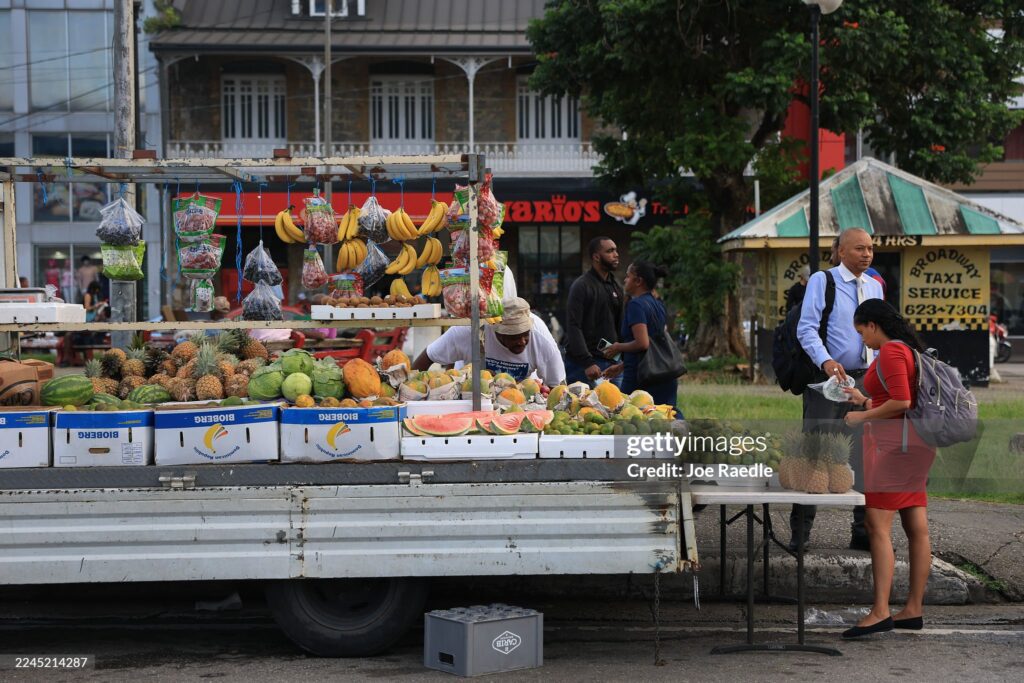
The report flags a growing disconnect between income security and cost-of-living pressure. While households may technically remain above the poverty line, they are increasingly exposed to shocks. The IDB cautions that “many households that are not poor remain highly vulnerable to falling back into poverty.” This vulnerability is most pronounced among middle-income earners who depend on fixed wages while absorbing rising food prices, housing costs, energy bills, and transport expenses.
In other words: the middle class exists – but it is fragile.
Tourism-dependent economies are especially exposed. The report highlights that employment-linked income is sensitive to external shocks, noting that “household income volatility remains a key risk factor, particularly in tourism-based economies.” That volatility turns the middle class into a revolving door rather than a destination.
Here is the structural problem the IDB surfaces, without spelling it out bluntly: Caribbean governments are being asked to do more redistribution with fewer resources.
Public debt is high. Fiscal space is tight. Social spending is increasingly targeted toward the poorest — leaving the middle class paying taxes without proportional protection. The study observes that “tax systems in the Caribbean rely heavily on indirect taxation,” which disproportionately affects middle-income households through consumption taxes rather than wealth or income taxes.
This creates a squeeze:
The poor receive targeted support;
The wealthy insulate themselves.
The middle absorbs the shock;
The result is political tension, declining trust, and social stagnation.
Stripped of technical language, the IDB’s message is clear: redistribution alone cannot sustain a middle class without growth, productivity, and wage expansion. The report emphasizes that fiscal tools must be paired with labor market reform, productivity gains, and economic diversification, warning that “without sustained growth, redistribution becomes increasingly constrained.”
That is the quiet warning policymakers cannot afford to ignore.
The Caribbean middle class is not disappearing – but it is thinning. It is being built statistically, through transfers and policy design, while being broken structurally by cost pressures, weak wage growth, and economic volatility.
The IDB’s CEQ report does not call this a crisis. But the data points in that direction. A middle class that cannot absorb shocks is not a middle class — it is a pause between poverty spells.
And that is the business story Caribbean leaders now have to confront.
Related News
Caribbean Remittances By Major Countries: A Lifeline Powering Economies Across The Region
Caribbean Competition – Weak Competition Is Holding Back Growth In The Caribbean And Lat...

How Caribbean Citizenship Programs Are Helping Families Plan A Better Future