
South Korean President Lee to visit Beijing for pivotal 2nd summit with Xi
 02 January 2026
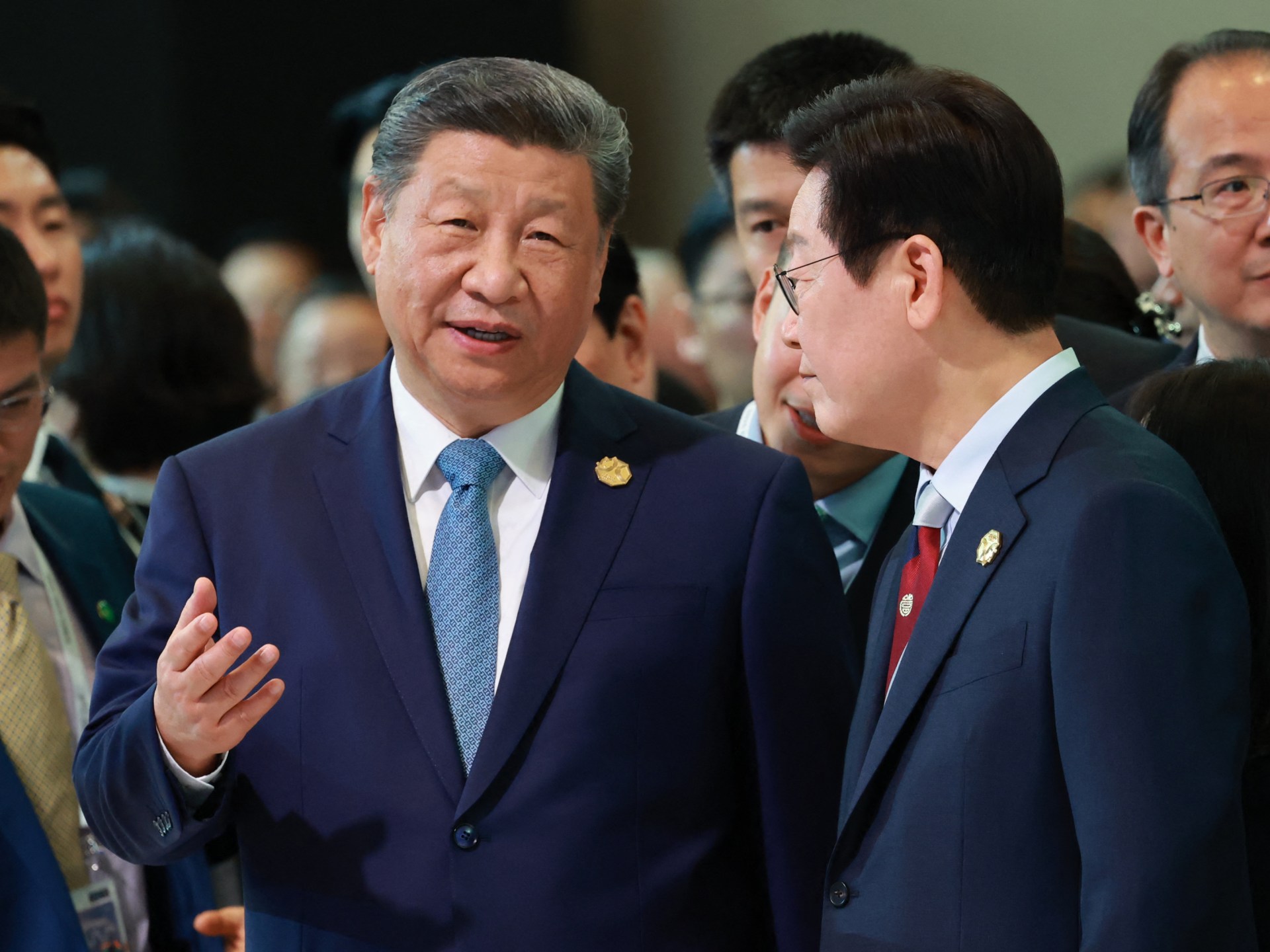

Chinese President Xi Jinping has invited South Korean President Lee Jae Myung to a state visit in Beijing, signalling China’s desire to reinforce relations with South Korea amid regional turbulence.
South Korea’s national security adviser, Wi Sung-lac, told reporters on Friday that Lee will meet Xi in Beijing on Monday before travelling to Shanghai to visit the historic site of South Korea’s provisional government during Japan’s 35-year colonial rule.
- list 1 of 4At least 17 dead as heavy rains trigger flash floods in Afghanistan
- list 2 of 4Turkmenistan legalises crypto mining and exchanges in shift for economy
- list 3 of 4‘We will not wait’: Mamdani kicks off housing plans after inaugural party
- list 4 of 4Flights from Aden airport in Yemen halted amid latest tensions
end of list
Wi said the leaders are expected to discuss “practical cooperation” in areas including supply-chain investment, tourism, and responses to transnational crime, according to Yonhap News Agency.
Lee is also expected to persuade China to take a “constructive” role in achieving “a breakthrough in resolving issues on the Korean Peninsula”, Wi added.
It will be the second meeting between Xi and Lee in just two months, in what analysts have described as an unusually short interval, reflecting Beijing’s interest in bolstering ties before the next meeting between the leaders of South Korea and Japan takes place.
Relations between China and Japan remain at a low point after Japanese Prime Minister Sanae Takaichi suggested in November that a hypothetical Chinese attack on Taiwan could provoke a military response from Tokyo.

On Friday, Wi reaffirmed South Korea’s position on Taiwan, saying the country does “respect the one China policy and act in accordance with that position”. The position acknowledges Beijing’s view that Taiwan remains part of its sovereign territory, while allowing for separate ties with the self-governing island.
Advertisement
Kang Jun-young, a professor of political economics at Hankuk University of Foreign Studies, said “China wants to emphasise South Korea’s importance slightly more than before.
“China appears to have strategically decided that it would be better to have [Lee] visit China before South Korea holds a summit with Japan again,” Kang told the Reuters news agency.
For its part, the Lee administration has stressed its goal of “restoring” ties with China, which remains South Korea’s largest trading partner. At the same time, it has said Lee’s approach of “practical diplomacy” aims to maintain strong ties with Japan and the United States, South Korea’s most important ally.
Under Lee’s predecessor, Yoon Suk Yeol, Seoul leaned closer to Washington and Tokyo and increased criticism of China’s stance on Taiwan.
Lee, in contrast, has said he will not take sides in the dispute between China and Japan, a position he maintains as tensions around the Taiwan Strait rise following Beijing’s recent large-scale military drills near Taiwan.
Security alliances, regional strategy
The two leaders may also address contentious issues such as efforts to modernise the South Korea-US alliance, which some see as a counterbalance to China’s dominance in the Asia Pacific region, according to Shin Beom-chul, a former South Korean vice defence minister and senior research fellow at the Sejong Institute.
Currently, roughly 28,500 US troops are stationed in South Korea to deter threats from North Korea. US officials have signalled plans to make those forces more flexible in responding to other regional challenges, including Taiwan and China’s growing military reach.
“Korea is not simply responding to threats on the peninsula,” General Xavier Brunson, commander of US Forces Korea, said at a forum on December 29. “Korea sits at the crossroads of broader regional dynamics that shape the balance of power across Northeast Asia.”
As China remains North Korea’s principal ally and economic lifeline, experts expect Lee to seek Beijing’s assistance in encouraging dialogue with Pyongyang.
North Korea dismissed Lee’s outreach last year, calling him a “hypocrite” and “confrontational maniac”.
China and North Korea have, in turn, continued closer coordination, with North Korean leader Kim Jong Un appearing alongside Xi at a major military parade in September.
Trade and culture
Lee’s visit is also expected to focus on cooperation in critical minerals, supply chains, and green industries, his office said.
Nearly half of South Korea’s rare earth minerals, which are essential for semiconductor production, come from China. The trading partner accounts for a third of Seoul’s annual chip exports, its largest market.
Advertisement
Last month, officials from both countries agreed to work towards stable rare earth supplies. The visit may also explore partnerships in AI and advanced technologies.
Huawei Technologies plans to launch its Ascend 950 AI chips in South Korea next year, providing an alternative to US-based Nvidia for Korean firms, Huawei’s South Korea CEO, Balian Wang, said at a news conference last month.
Another potential topic is Beijing’s effective ban on K-pop content, which stretches back to 2017 following the deployment of the US’s THAAD missile defence system in South Korea.
SM Entertainment’s chief executive, who heads one of the country’s leading K-pop agencies, will join Lee’s business delegation, according to local media.
Related News

Yemen’s separatist STC refuses to withdraw from provinces near Saudi Arabia
Why is the sale of Pakistan’s national airline stirring a political storm?
How Netanyahu’s push for another Iran war clashes with Trump’s agenda