OPINION: From DCash to Fast Payments. The ECCB’s Quiet Financial Reset
 13 May 2026




Written by Rochelle

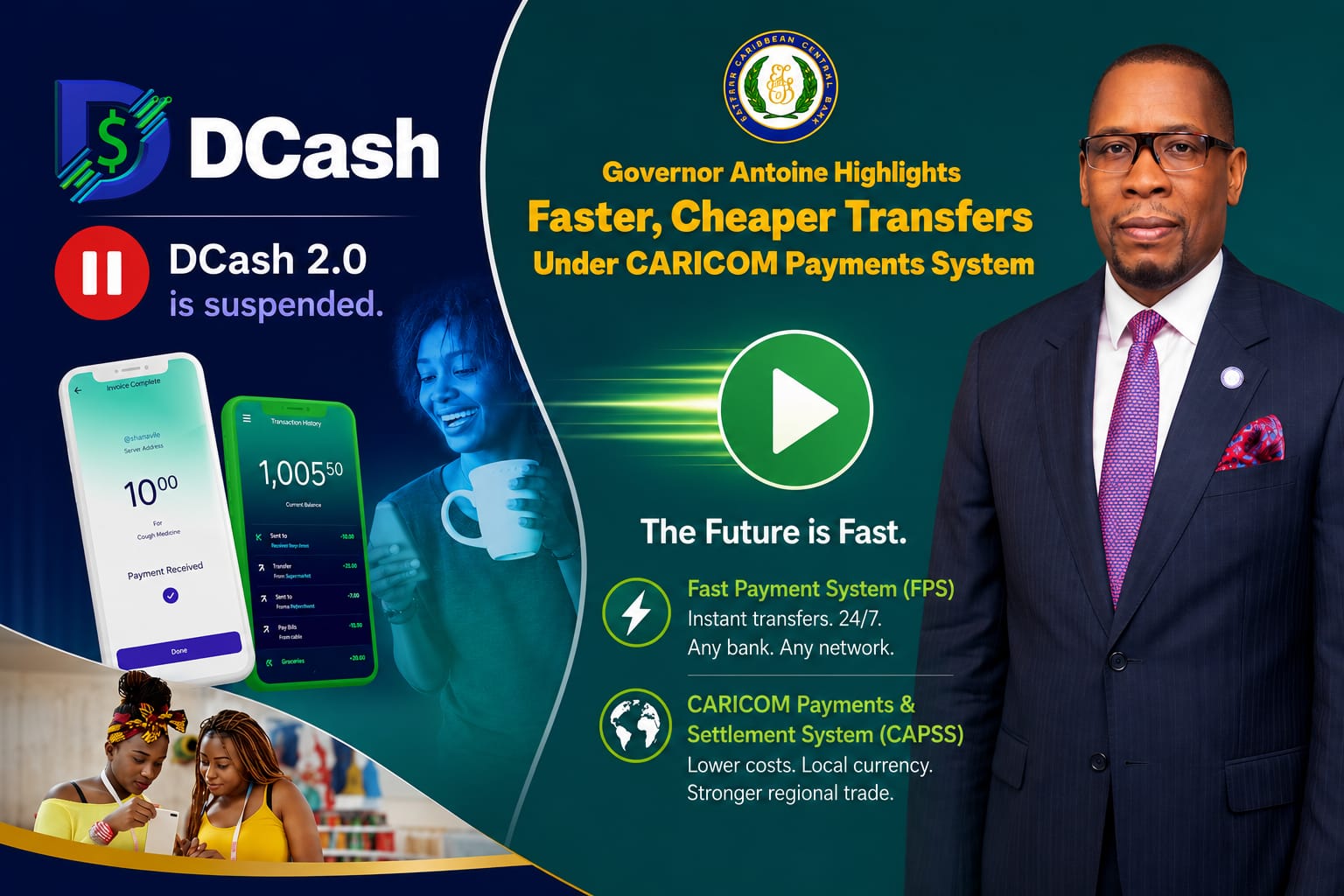
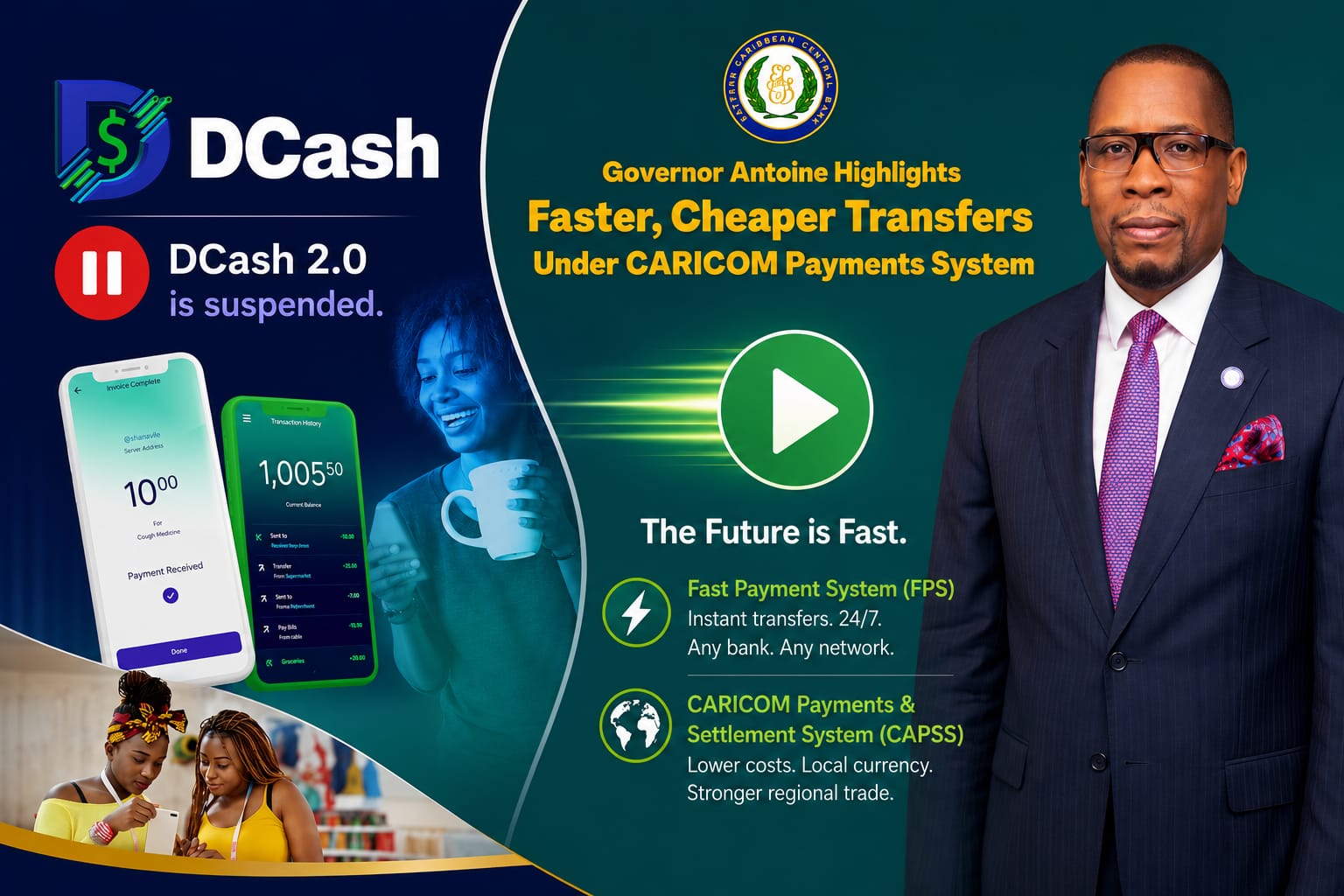
For years, we’ve been told that the future of Eastern Caribbean finance was a digital wallet called DCash. Launched publicly in 2021 across four pilot countries (Antigua & Barbuda, Grenada, St. Kitts & Nevis and St. Lucia), it was the high-tech promise of the ECCB; a “Retail Central Bank Digital Currency” (CBDC) designed to revolutionize how we pay for saltfish at the market or settle up with a neighbor.
But if you look closely at the ECCB Monetary Council’s 112th Meeting Communique released on 4th May 2026, you’ll notice a quiet, seismic shift in the regional strategy.

The Council has officially suspended the development of DCash 2.0. The experiment, it seems, is over. But the revolution is just getting started.
The “suspension” of DCash 2.0 is a tacit admission of a fundamental truth in finance: most people don’t want a new currency; they just want their current money to move faster.
Additionally in small island economies, trust matters more than novelty. People may experiment with apps, but they still want their salaries, savings, and grocery money anchored to systems they already understand.

The friction of DCash was always its greatest hurdle. It required users to adopt a brand-new digital ecosystem, separate from their traditional bank accounts.
Even beyond the technical disruptions and rollout challenges, mass adoption simply wasn’t there. Now, the ECCB is pivoting away from “retail” experiments and toward something much more practical: Market Depth.

The Central Bank isn’t giving up on digital; they are just changing the “pipes.” Instead of focusing on a proprietary wallet, the new priority is the Fast Payment System (FPS).
Unlike DCash, the FPS doesn’t require you to learn a new currency.
Instead, it upgrades the backbone of our existing banks. The goal is simple: to allow you to send regular EC dollars to anyone in the region instantly, 24/7, using just a phone number or a QR code.
It shouldn’t matter if you bank with Republic and your recipient banks with Grenada Co-operative; the money should arrive in seconds, not days.
This reflects broader “Open Banking” principles – improving interoperability between financial institutions across the region.
Perhaps even more significant is the ECCB’s commitment to the CARICOM Payments and Settlement System (CAPSS) pilot.
For those of us tracking regional trade, the “Cross-Border Tax” has always been a nightmare. Paying a supplier in Trinidad or Barbados usually involves a dance with US dollar conversions and exorbitant wire fees.
By joining CAPSS, the ECCB is helping build a regional settlement layer.
This would allow a business in St. George’s to pay a supplier in Port of Spain in local currency, with participating central banks handling settlement behind the scenes.
Governor Timothy Antoine often speaks of “The Big Push” – the Herculean effort to double the size of the ECCU economy by 2035.
The pause of DCash 2.0 may look like a setback, but it’s really a strategic course correction. By pivoting toward the Fast Payment System and CARICOM integration, the ECCB is prioritizing utility over optics.
They are moving away from the “crypto-adjacent” hype of digital tokens and toward the hard work of fixing the region’s fragmented banking infrastructure.
In the world of finance, the most powerful changes are often the ones you can’t “see” in a flashy app. They are the ones happening deep in the plumbing of the system. This month, those pipes just got a lot more interesting.
Advertise with the mоѕt vіѕіtеd nеwѕ ѕіtе іn Antigua!
We offer fully customizable and flexible digital marketing packages.
Contact us at [email protected]

Related News

Top-Level Sailing and Caribbean Spirit Cement Modernised Antigua Sailing Week as Instant C...

Prime Minister Hon. Gaston Browne expresses his sympathy to the Mason family on the passin...

Antigua and Barbuda delegation participates in Transforming Global Education Summit at the...