Media groups challenge India’s privacy law at top court
 27 October 2026
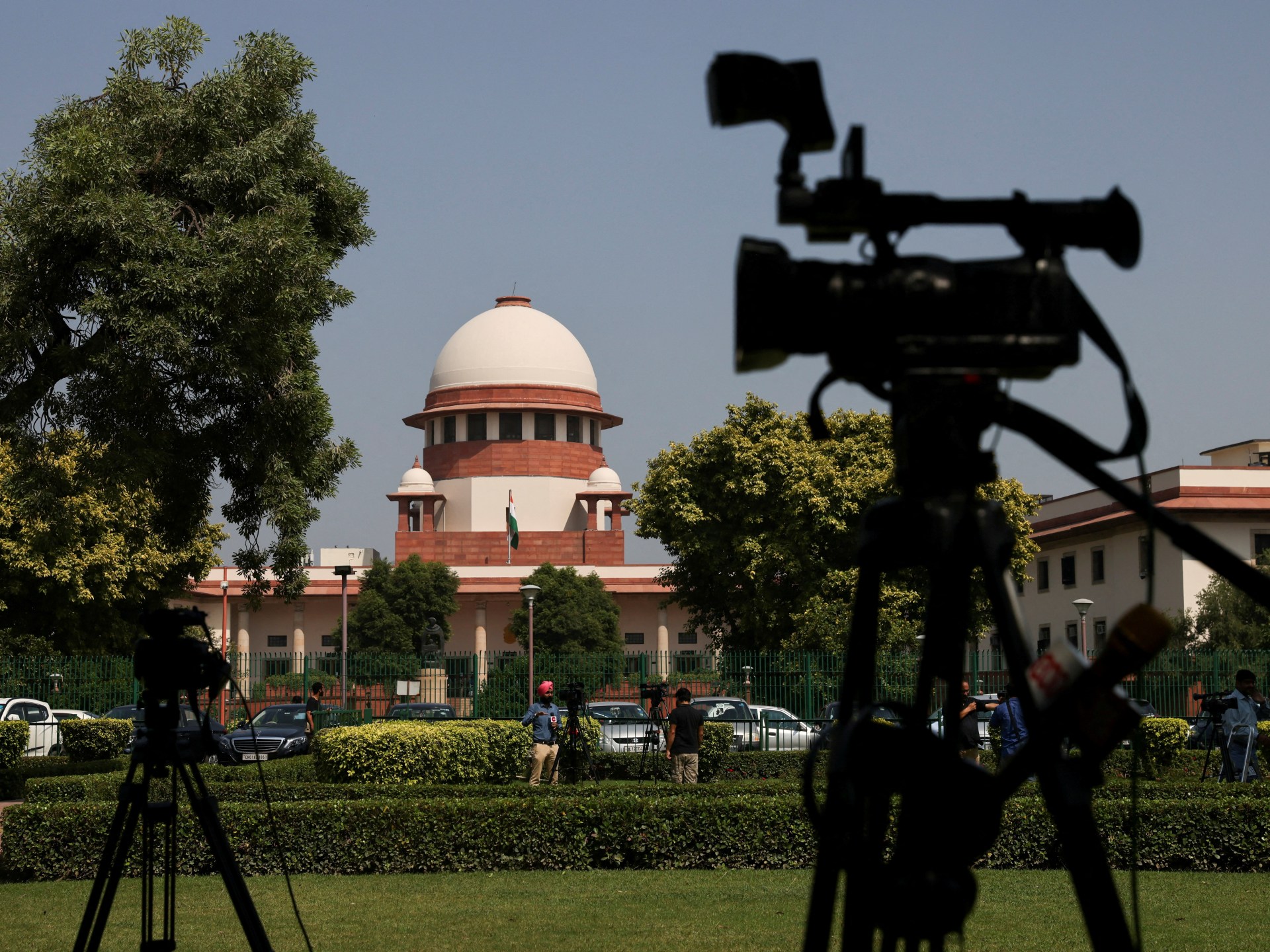

The Indian government’s privacy law, which would require journalists to seek consent from people they write about, amounts to pre-censorship and could lead to newsrooms shutting down, media groups have told the Supreme Court.
A group of 21 news publishers, including companies owned by billionaires Mukesh Ambani and Gautam Adani, challenged Prime Minister Narendra Modi’s law on Tuesday, arguing it would trample upon investigative work and allow the government to identify journalists’ sources, according to The Indian Express newspaper.
- list 1 of 4‘Deeply concerned’ over India press censorship, says X as accounts blocked
- list 2 of 4AR Rahman: Indian composer faces backlash for ‘bias’ in Bollywood remarks
- list 3 of 4Satire silenced: Indian artists face censorship as anti-Modi protests grow
- list 4 of 4Modi avoids Norway media: How that led to storm over India’s press freedom
end of list
“It is changing the whole concept of what is news,” Madhavi Goradia Divan, the lawyer for the Digital News Publishers Association (DNPA), told judges.
“Newsrooms will shut down, if we have to ask for permission … it’s then a complete regime of pre-censorship.”
The Supreme Court said it would hear the case next month.
Media companies received assurances in an August meeting with the government that the law would protect press freedom, but not having a written exemption for journalists as in the European Union, Singapore and Britain was alarming, the news publishers said in a filing earlier this month.
The DNPA’s members include Ambani’s Network18, which has seven digital news platforms, Adani’s NDTV and other high-profile media groups including the Indian Express and Times Internet, which is part of the Times of India group, publisher of India’s largest-selling English-language daily.
A key concern in the law is the requirement of consent, says the group’s filing, cited by the Reuters news agency.
Advertisement
A social media platform or online retailer can seek consent from users when they sign up, but the DNPA has argued that requiring a journalist to notify the subject of an investigation and seek consent “would allow that subject to destroy evidence, intimidate witnesses”.
The law also lets people withdraw consent at any time and demand that their data be erased, without any public-interest safeguard, which the DNPA says could force its members to unpublish or heavily redact a factual news report.
News publishers are concerned that a federal authority created under the law can impose fines for noncompliance, and grants powers to New Delhi to block access to any information in the “interests of the general public”, which would curtail press freedom, the DNPA said.
From next year, the law will also let New Delhi order any organisation handling personal data “to furnish such information as it may call for”, putting newsrooms at risk of having to divulge sources, the filing said.
It can also deter whistleblowers from sharing information on corruption, corporate wrongdoing or electoral malpractice with reporters, the DNPA argued.
The “nakedly unguided” provision must be quashed, the DNPA said, adding that the power “can extend to privileged communications in possession of a reporter or the informant.”
Related News

Photos: Community unites in Senegal’s Dakar to clean dilapidated school
How has the cost of living changed in France, Italy, Spain and Portugal?

Brazilian government calls for probe into US funding of far-right causes