Mali rattled by ongoing armed attacks: What to know
 26 April 2026
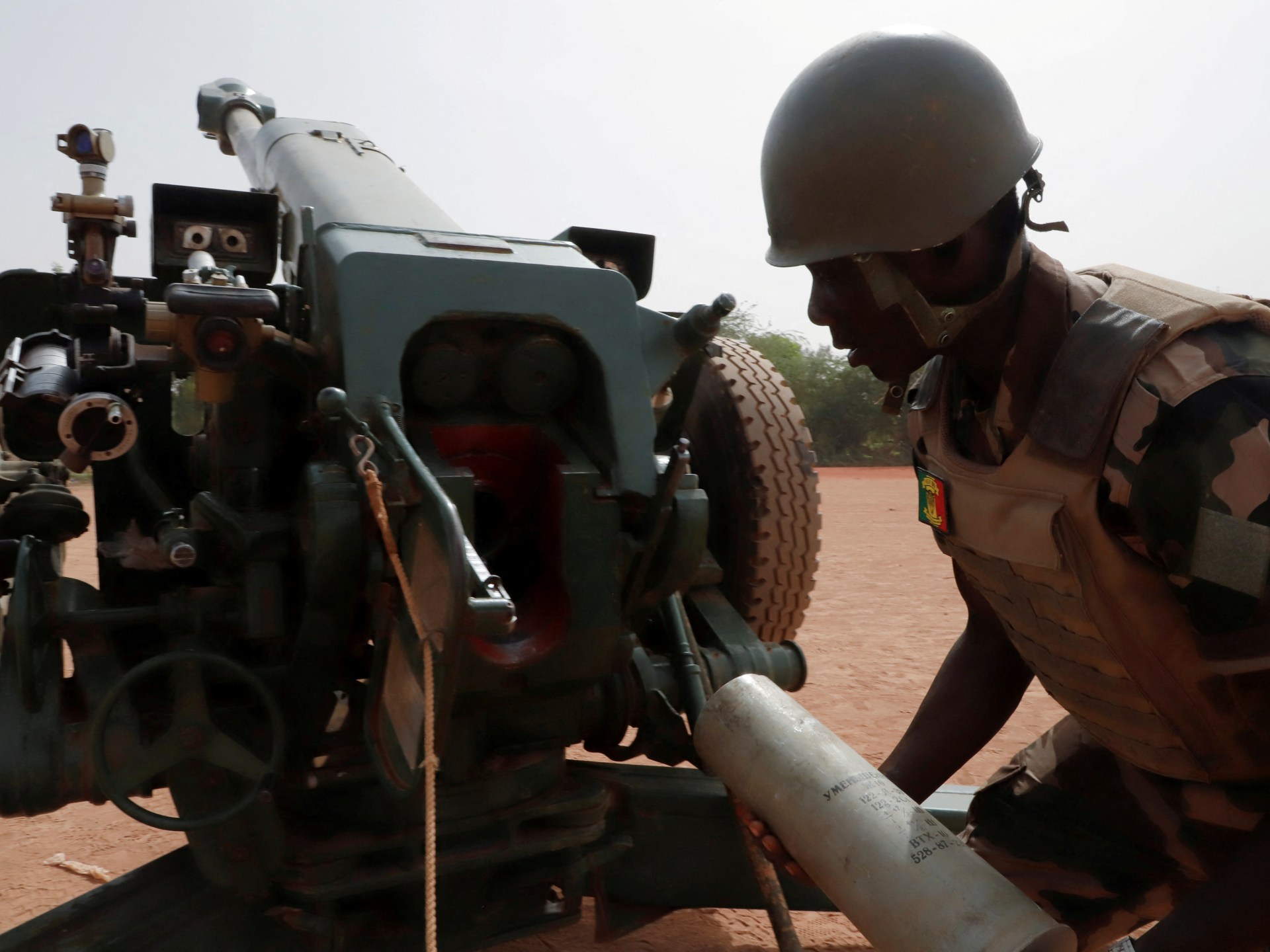

Mali has been rattled by coordinated attacks carried out by several unidentified armed groups beginning on Saturday, escalating the political and security crisis in the country, which has been under military rule for most of the past 14 years.
On Sunday, a military source told Al Jazeera that Mali’s Defence Minister Sadio Camara had been killed amid coordinated attacks on military sites across the country, including the capital, Bamako. His residence in Kati was attacked on Saturday.
- list 1 of 3West African regional army: Why thousands of soldiers are deploying
- list 2 of 3‘Forget democracy’ says Burkina Faso’s military leader Ibrahim Traore
- list 3 of 3Benin’s Wadagni wins presidential election with landslide 94% of votes
end of list
“The General Staff of the Armed Forces informs the public that unidentified armed terrorist groups targeted certain locations and barracks in the capital and the interior early this morning, April 25, 2026. Fighting is ongoing,” Mali’s military said in a statement on Saturday.
Al-Qaeda-linked group Jama’at Nusrat al-Islam wal-Muslimin (JNIM) has claimed responsibility for attacks in Kati, near the capital, as well as the Bamako airport and other locations further north, including Mopti, Sevare and Gao. Tuareg rebels also claimed participation in the latest assaults.
The current military ruler, Assimi Goita, came to power in the 2021 coup on the promise to boost security amid the growing influence of armed groups in one of the most impoverished nations in the world. Goita has yet to make a public statement.
So, what is the latest situation in the country and have the armed attacks been contained?
Here’s what we know:
What happened?
On Saturday morning, Mali’s army said unidentified “terrorist” groups had attacked several military positions in Bamako and the country’s interior.
Advertisement
Two loud explosions and sustained gunfire were heard shortly before 6am (06:00 GMT) near Mali’s main military base, Kati, just north of the capital. Soldiers were deployed to block roads, witnesses said.
There was similar unrest at around the same time in the central town of Sevare, and Kidal and Gao in the north.
Gunfire could be heard near a military camp close to the Bamako airport, where Russian mercenary forces are based, a resident told the Reuters news agency.
Heavy gunfire was also reported in Kati, where Goita also has his residence, witnesses told the AFP news agency.
AFP reported that Kati residents uploaded images on social media showing their homes destroyed. “We are holed up in Kati,” one resident said.
The military said in a statement it had killed “several hundred” assailants and repelled the assault, which hit multiple sites in or near Bamako. It is unclear how many assailants were killed.
It said the situation was under control, adding that a large-scale sweep operation was also under way in Bamako, the nearby barracks town of Kati and elsewhere in the gold-producing country.
Reporting from Dakar, Senegal, on Saturday, Al Jazeera’s Nicolas Haque said the scale and coordination of the attack appeared to be unprecedented.
He said, despite the situation having come under control, “there’s an unprecedented level of panic in the military ranks”.
The African Union, the secretary-general of the Organisation of Islamic Cooperation and the United States Bureau of African Affairs have condemned the attacks.
Indications that different armed groups launched a coordinated attack in Mali signal a “very dangerous development”, according to Ulf Laessing, Sahel analyst at the German think tank Konrad Adenauer Stiftung.
He told Al Jazeera on Saturday that since the crisis began in 2012, security has been “degrading” every year, and the government has little control over large areas of the country.
Mali’s democratically elected President Amadou Toumani Toure was deposed in a coup led by soldiers in May 2012. His government was accused of failing to handle a Tuareg-led rebellion in the north.
Since then, the country has been experiencing a severe security and political crisis, armed rebellions and two military coups.
Mali is “a vast territory, twice the size of France. Most people live in the south, the north is desert and mountains … it’s impossible to control it, not even the French could do it, let alone the Russians”, Laessing said.
“There’s no military solution”, and armed groups are “entrenched” in the countryside.
Advertisement
“The only good news is, so far, they [armed groups] haven’t been able to control … larger cities,” he added.
Who is behind Saturday’s attack?
The JNIM and Tuareg rebels have claimed responsibility for the attacks.
In a statement published by SITE Intelligence Group, JNIM claimed attacks in Kati, Bamako and in localities further north, including Mopti, Sevare and Gao.
JNIM is the Sahel affiliate of al-Qaeda and the most active armed group in the region, according to conflict monitor ACLED. Since September, JNIM fighters have been attacking fuel tankers, bringing Bamako to a standstill in October 2025.
It also imposed an economic and fuel blockade by sealing off major highways used by tankers transporting fuel from neighbouring Senegal and the Ivory Coast to the landlocked Sahel country.
For weeks, most of Bamako’s residents were unable to buy any fuel for cars or motorcycles as supplies dried up, bringing the normally bustling capital to a standstill.
Despite several months of calm, Bamako residents faced a diesel shortage in March, with fuel prioritised for use in the energy sector.
On Saturday, the JNIM said the city of Kidal was “captured” in an operation coordinated with the Azawad Liberation Front (FLA), a Tuareg-dominated rebel group.
Mohamed Elmaouloud Ramadane, a spokesperson for FLA, said on social media that the group had taken control of multiple positions in Kidal and Gao. Al Jazeera could not independently verify the claim.
Videos posted online and verified by Al Jazeera showed armed men entering the National Youth Camp of Kidal on Saturday.
Al Jazeera’s Haque noted that it seems the FLA is gaining ground in the north of the country.
“There’s video footage circulating on social media showing some of these fighters entering the residence of the governor of Kidal,” he said.
“Kidal is not the biggest town in the north, but it’s high in symbolism because whoever holds the town of Kidal controls the north,” he added.
Ibrahim Yahaya Ibrahim, deputy director for the Sahel at the International Crisis Group, says Malian authorities appear to have been caught off-guard by the latest wave of attacks.
Speaking to Al Jazeera from Dakar on Saturday, Ibrahim said the offensive fits into a broader pattern of escalating violence.
“Even though it is hard to say that it is totally a surprise, I think it is just another dramatic episode in a series of spectacular attacks that we have witnessed in recent years by JNIM attacking the government,” he said.
What role did Russian mercenaries play during the attacks?
Witnesses told Al Jazeera’s Haque that Russian mercenaries were involved in fighting in Bamako, around the airport, where they have one of their headquarters.
“But because there’s been so much pressure on the Russia-Ukraine front, some of these Russian mercenaries are being pulled out from Mali, which is affecting the security situation in Mali now,” Haque said.
Al Jazeera’s Haque said that “the Russian mercenaries seem to have surrendered the town of Kidal or at least the military camp where they were with the Malian forces”.
Advertisement
“The Tuareg fighters had asked them to surrender weapons. It is unclear whether they did that or not but what’s clear is that the Russians are stepping out of the town of Kidal,” he said, adding that “Russian mercenaries not fighting against armed fighters “is something significant”.
In June last year, Russia’s Wagner group said it would withdraw from Mali after more than three and a half years on the ground. The paramilitary force said it had completed its mission against armed groups in the country.
But Wagner’s withdrawal from Mali did not mean the departure of Russian fighters. Russian mercenaries have remained under the banner of the Africa Corps, a separate Kremlin-backed paramilitary group created after Wagner founder Yevgeny Prigozhin led a failed mutiny against the Russian military in June 2023.
Besides Mali, Africa Corps is also active in other African countries, including Equatorial Guinea and the Central African Republic.
What does all this mean for Mali’s and the Sahel’s security?
Since gaining independence in 1960, the West African country has experienced alternating cycles of political stability and instability, punctuated by rebellions, financial woes and military coups.
In 2012, ethnic Tuareg separatists, allied with fighters from an al-Qaeda offshoot, launched a rebellion that took control of the country’s north.
But fighters from the armed group Ansar Dine swiftly pushed out the Tuareg rebels and seized key northern cities, triggering French military intervention in early 2013 at the request of the government. Ansar Dine and several other groups later merged to form the JNIM.
In September 2013, Ibrahim Boubacar Keita was elected as president. His fragile democratic rule ended in 2020. Under his government, the United Nations brokered a peace deal between the government and northern Tuareg groups fighting for an independent Azawad in 2015.
President Keita was deposed in a military coup in August 2020 following months of mass protests over severe economic woes in the country and the advance of armed groups in the north. In September that year, Bah Ndaw, a retired colonel, was sworn in as interim president, with Goita as vice president, to lead a transitional government.
In May 2021, Goita, the leader of the previous year’s power grab and vice president of the interim government, seized power in a second coup. Mali is currently being run by Goita’s military government. Initially, the military government pledged to return to civilian rule in March 2024, but it has not kept the promise.
Goita invited Russian mercenaries to support the military administration in its fight against armed groups in December 2021 after asking the French troops to leave the country. This created a security vacuum. In January 2024, Mali’s rulers also terminated the 2015 peace deal with Tuareg rebels, accusing them of not complying with the agreement. This led to a breakdown in the country’s security situation once again.
In September 2025, the JNIM began a fuel import blockade, crippling life in Bamako.
Mali, along with Niger and Burkina Faso, formally split last year from the West African regional bloc ECOWAS to form the Alliance of Sahel States (AES).
However, earlier this week, Malian Foreign Minister Abdoulaye Diop attended a security forum in Senegal where he said the withdrawal was “final”, but added that the AES could maintain a constructive dialogue with ECOWAS on freedom of movement and preserving a common market.
“Even for the Malian minister to come to this conference signals that they are afraid for themselves and they need to open up,” Adama Gaye, political commentator on the Sahel and West Africa, told Al Jazeera. “It is also an indication that they want to reach out to ECOWAS.”
Advertisement
Gaye added that the Goita-led military government “cannot have legitimacy in their own country”.
“They have been terrible in economic progress, peace and stability,” he added, describing the ongoing situation in Mali as “very dire”.
“These attacks will be another negative aspect to their claims that they can control Mali,” he said.
Related News
China’s Xi meets Russian FM Lavrov, calls relations with Moscow ‘precious’
Trump announces extending Iran ceasefire but says blockade remains
Polls open in Gaza area in first municipal election in 20 years