
LETTER: Towards Constitutionalized AI Governance in the Commonwealth Caribbean
 13 January 2026
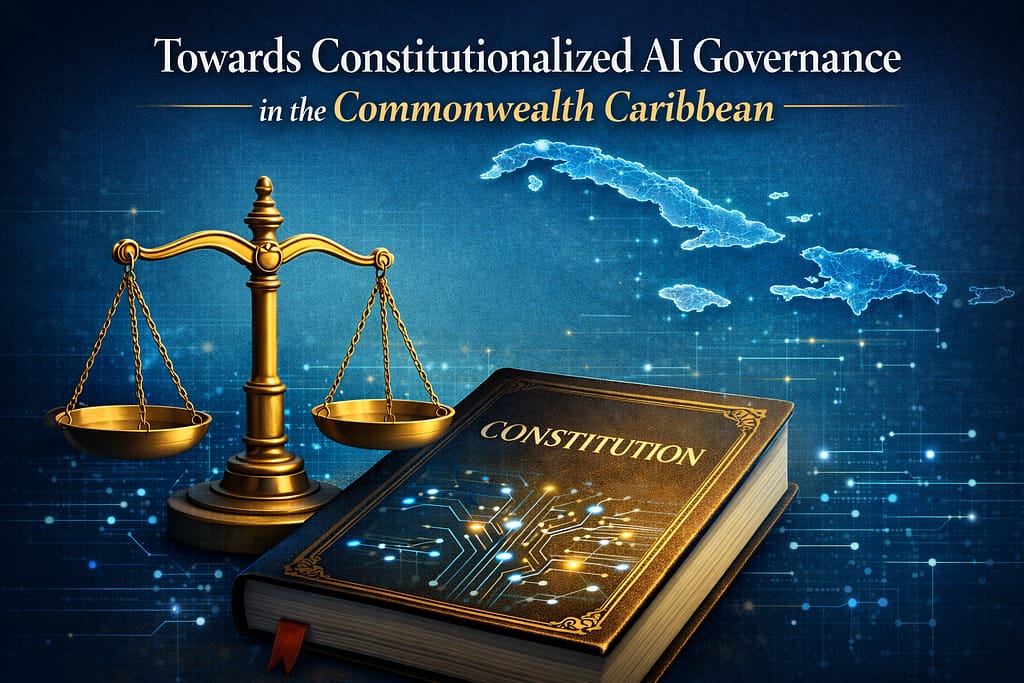




Towards Constitutionalized AI Governance in the Commonwealth Caribbean

Dear Editor,
With the AI-driven Fourth Industrial Revolution now in full swing, artificial intelligence (AI) is rapidly becoming embedded in policing, healthcare, employment, and other critical areas of social life. While the Commonwealth Caribbean lags behind more technologically developed regions in AI uptake and deployment, there have been discernible movements toward a measured socio-technical integration of AI across the region.
Thus far, at least one Commonwealth Caribbean constabulary force has publicly stated its intentions to deploy facial recognition technologies (FRTs) in the fulfilment of its mandate to “serve and protect”. Despite this commendable thrust towards modernising crime-fighting strategies, commercial FRTs have unfortunately gained notoriety due to their propensity for misidentifying people of color and women at markedly higher rates, which has led to multiple wrongful arrests and detentions overseas. In small Commonwealth Caribbean states, even wrongful arrests and detentions can occasion significant stigmatisation and ostracism within the wider society.

Given the stakes involved when high-risk AI systems such as FRTs are deployed by institutional actors, the necessity of centring human rights standards and AI ethics principles in AI governance has never been more crucial. At present, the Commonwealth Caribbean notably lacks dedicated human rights-centred AI governance regimes, which can take years to develop and promulgate through regional legislatures. This deficiency has produced a glaring AI governance gap that renders fundamental rights acutely vulnerable to algorithmic violation, especially where high-risk AI systems are deployed in sensitive contexts. It is therefore imperative that our region conceptualises creative, yet pragmatic, approaches to AI governance. To this end, I propose a reimagining of our Commonwealth Caribbean Independence Constitutions—the supreme law and central organizing bedrock of all Commonwealth Caribbean polities—as localized human rights-grounded AI governance regimes that can be repurposed and tailored, through interpretive ingenuity, to safeguard constitutional rights from algorithmic violations in an increasingly digitalised era.
Such a reimagining presents what I have termed “constitutionalized AI governance” as a modest interpretive response to regulatory gaps produced by rapid technological advancement, which neither seeks to supplant legislative action nor promote judicial activism. My forthcoming article titled “AI Ethics as a Human Rights Imperative in the Digital Age: Prospects for Constitutionalized AI Governance in the Commonwealth Caribbean” explores in more detail the premise and prospects for constitutionalized AI governance in the Commonwealth Caribbean.

As presciently articulated by former president of the Caribbean Court of Justice, Justice Adrian Saunders, “if the Emancipation Proclamation was our birth certificate, then our Independence Constitutions can be likened to the document that marks our coming of age, but with Independence, with adulthood, our Independence Constitutions have not only enhanced rights but also new responsibilities…” By reimagining our Independence Constitutions as localized human rights-grounded AI governance frameworks to address our region’s unique challenges, we are endeavouring to mark our “coming of age” within the AI governance arena.
Sincerely,

Amanda Janell DeAmor Quest
Commonwealth Caribbean Lawyer, LLB (1st Class Hons), LEC
Advertise with the mоѕt vіѕіtеd nеwѕ ѕіtе іn Antigua!
We offer fully customizable and flexible digital marketing packages.
Contact us at [email protected]

Related News
VIDEO: PM hails the USA as Antigua and Barbuda's most important development partner

UWI Graduation Ceremonies Resume After Hurricane Disruption

Rubio says no further US military action planned in Venezuela after Maduro arrest