Lebanon’s Joseph Aoun to meet Trump: What to expect
 21 July 2026

Lebanon’s President Joseph Aoun is set for talks with his United States counterpart Donald Trump at the White House on Tuesday, as the government in Beirut pushes for Israeli withdrawal from the south and grapples with internal divisions.
The meeting comes at a perilous time for the region amid renewed fighting between the United States and Iran that risks reigniting the front between Hezbollah and Israel in Lebanon. Relations between Lebanon and Israel, as well as Aoun’s government’s efforts to disarm Hezbollah, will be at the top of the agenda.
Here’s what you need to know.
Why is Aoun visiting Washington?
The Lebanese president has been touting US support for Beirut in his push to secure Israel’s withdrawal through negotiations, while also ensuring that Hezbollah is stripped of its weapons.
While Aoun’s critics argue that the Lebanese government has no leverage to bring to the negotiation table, the Lebanese government has been relying on Trump’s goodwill as the guarantor of any agreement.
Aoun’s office has said it seeks to translate Washington’s interest in Lebanon into concrete support for the Lebanese military and economy. So, Aoun will be looking to enlist the staunchly pro-Israel Trump administration as a backer for his agenda.
At the heart of Aoun’s approach is the trilateral framework between Lebanon, Israel and the US, which has been fiercely rejected by Hezbollah.
When did Aoun arrive in the US?
Aoun flew from Beirut to the Washington, DC, area on Saturday, where he was greeted by the US chief of protocol, according to his office.
Advertisement
Who has he met so far?
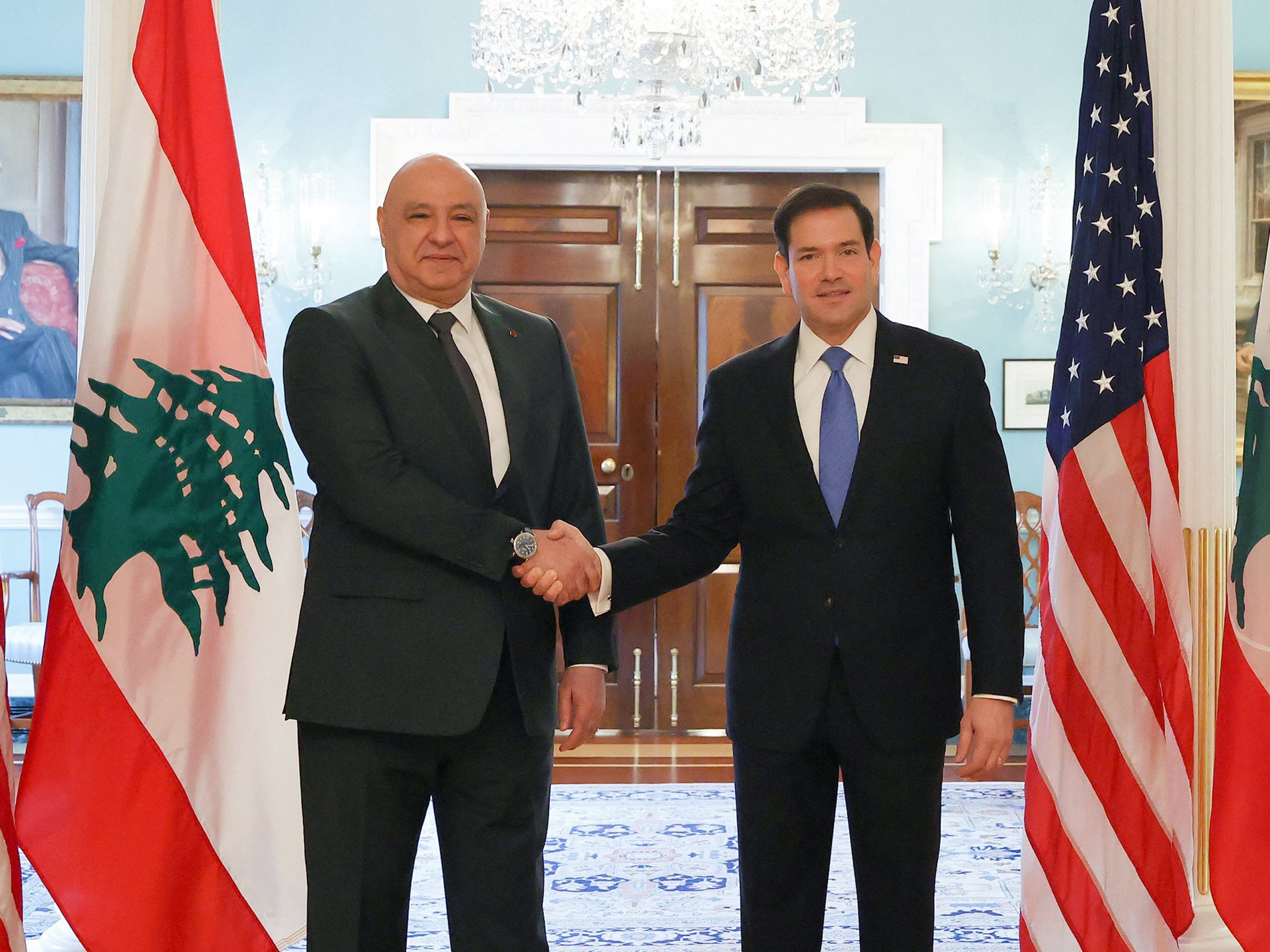
Aoun met US Secretary of State Marco Rubio on Sunday, where he stressed the need to align the Lebanese and American positions over the framework “through the achievement of an initial Israeli withdrawal from the first pilot zone”. The Lebanese presidency said Aoun also called on Washington to support Lebanese institutions.
What did Rubio say?
Rubio argued that support for the Lebanese government is the best way to defeat Hezbollah, which is aligned with Iran.
“President Aoun will be able to return to Lebanon and say to the people of Lebanon that he is the one that’s getting positive results for the people – all Lebanese, including Christians, Sunni, and Shia, and Bedouin and Druze – all the people of a very diverse country – not Hezbollah, not Iran,” Rubio told reporters.
“He is the legitimate government, he is who we’re going to work with and that government is the government that should be in charge of that country.”
What does the framework say?
The agreement sets a new security and political reality for Lebanon. In it, Lebanon recognises Israel and agrees to condition its withdrawal from the country on the disarmament of Hezbollah.
The framework appeared to contradict the memorandum of understanding between Lebanon and Iran, which called for an unconditional ceasefire in Lebanon, as well as respecting the country’s sovereignty and territorial integrity.
The US-Lebanon-Israel deal aims to remove conflict in Lebanon from the regional equation and treat it as its own issue.
It mandates the creation of “pilot zones” in south Lebanon, where the Lebanese Armed Forces (LAF) would deploy as Israel withdraws to assert that there is no Hezbollah presence and enable construction in the area.
Why was the framework criticised?
The Lebanon-US-Israel deal is widely criticised in Lebanon. Even some supporters of Aoun and Prime Minister Nawaf Salam have recognised its shortcomings, while Hezbollah has said that it will not abide by it.
Critics of the framework say that it abandons Lebanese sovereignty, legitimises the occupation and makes Israeli withdrawal – a Lebanese right affirmed by the United Nations Charter – contingent on conditions set out by the occupying power and Washington.
Rights advocates have also voiced alarm over a section of the deal in which Lebanon commits not to pursue accountability for Israeli abuses at international courts or the UN.
“Israel and Lebanon commit to take good faith measures that demonstrate positive intent, including the cessation of all hostile or adverse actions in international political or legal fora,” the framework said.
Advertisement
What are pilot zones?
Coinciding with Aoun’s visit, the US State Department announced the establishment of the first pilot zones in South Lebanon. The framework envisions such areas as a trial for towns free of Hezbollah military presence, where the LAF can ensure that it is the sole military force there. In return, Israel would withdraw from the zone and allow residents to return and construction to begin.
But there are many issues and questions that come with this approach, including the rights of citizens not to have their properties searched by the Lebanese military at Israel’s request. The right of return for Hezbollah members to their own homes has also been in question.
The first pilot zone that Washington declared on Monday will not lead to any Israeli withdrawal. It is located in three towns that Israel did not occupy during the war, which practically cancels the benefit that Lebanon would get from such areas.
What is Israel doing in Lebanon?
Israeli officials have openly said that their aim in Lebanon is to erase border towns as they did in large parts of Gaza. “It was clear … that the Shia villages on the contact line had to disappear,” Israeli Defence Minister Israel Katz said last month, hailing the progress Israel’s military has made in annihilating the towns. Israeli officials have repeatedly stressed that they will stay in Lebanon as long as necessary.
Still, Israel declares in the framework that “it has no territorial ambitions in Lebanon”.
What has Trump said?
Trump has generally voiced support for Lebanon. He rejected the Israeli attack on Beirut in June, and earlier this month, saying Israel should withdraw its forces from the country. But it remains unclear whether he will apply the necessary pressure on Israeli Prime Minister Benjamin Netanyahu to end the occupation of Lebanon.
How did the Lebanon-Israel conflict start?
The latest round of fighting began in March after Hezbollah fired rockets at Israel in response to its daily violations of the November 2024 ceasefire, as well as the killing of Iran’s Supreme Leader, Ali Khamenei. But Israeli attacks in Lebanon predate Hezbollah’s inception by a decade.
Shortly after Israel was established in 1948, its forces killed dozens of civilians in the border town of Houla in a spillover of Nakba – the mass displacement of the Palestinian people that year.
Lebanon and Israel do not have diplomatic relations and their ties have been defined by bloodshed and repeated Israeli invasions.
Hezbollah was established in 1982 with the help of Iran to fend off Israeli forces that had reached Beirut that year in a push to expel the Palestinian Liberation Organisation (PLO) from the country.
The group argues that it has legitimacy in its fight with Israel without Beirut’s approval under the UN Charter, which grants the right of self-defence to individuals as well as countries.
Related News
Syrian official says ‘no plans’ to establish Turkish military presence
US aid cuts threaten Ghana’s child immunisation gains

ICE agent behind fatal shooting in Maine reportedly had troubled history