King Charles Arrives In The Bahamas As Reparations Protesters Demand Apology
 28 October 2026


News Americas Now, NASSAU, The Bahamas, Tues. October 27, 2026: King Charles III arrived in The Bahamas today at the start of a nine-day Caribbean tour, stepping into a region where calls for an apology and reparations for slavery are growing louder.
It is Charles’ first official visit to The Bahamas as monarch, and the arrival came with all the ceremony of a royal tour: public schools on New Providence were closed, security was tightened, and members of the Royal Bahamas Police Force and Royal Bahamas Defence Force formed a guard of honor at Lynden Pindling International Airport.

Charles, wearing a light grey suit and sunglasses, was greeted by Governor-General Dame Cynthia Pratt and Prime Minister Philip Davis before travelling to Clifford Park, a site steeped in Bahamian history. The King last visited the park as Prince of Wales in 1973, when The Bahamas marked its independence from Britain after more than 300 years of colonial rule.

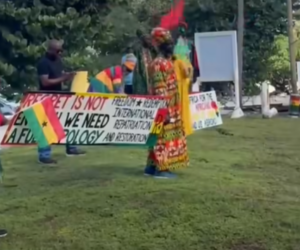
This time, however, the royal pageantry was met by a very different message. Members of the Rastafari community and other reparations advocates gathered near Clifford Park holding placards and calling for Britain to account for the legacy of slavery and colonialism.

“Pay us what you owe us!” one protester shouted as Charles arrived. Another said she stood in memory of the “horrors and atrocities” committed against Black people during slavery. Demonstrators held signs reading “Pay us what you owe us!” and “Reparations now,” calling on Britain to account for the historical atrocities of the transatlantic slave trade. The protest followed calls ahead of the visit from the Ethiopia Africa Black International Congress and other reparations advocates for a formal apology and meaningful dialogue over reparations. Protesters reported that the Royal Bahamas Police Force attempted to relocate them out of sight of the royal route, though the group refused to move.

At Clifford Park, Charles addressed young people gathered for a cultural rally, where students waved Bahamian flags and performed music and other cultural presentations.
The King acknowledged the painful history behind modern Bahamian society, saying it was right to recognize “the great suffering and injustices of the past” while also celebrating the country’s achievements today. He stopped short, however, of offering a formal apology.

Buckingham Palace has indicated that Charles will not issue one during the tour, in line with the British government’s longstanding position rejecting both a formal apology and financial reparations. acknowledgmentThat gap between acknowledgement and apology has become increasingly significant as Caribbean governments and reparations advocates intensify pressure on Britain and the monarchy.
Several former British colonies have called for reparatory justice over slavery and colonialism, including formal apologies, financial compensation, development support and the return of cultural artefacts. Jamaica recently advanced its own reparations push through the British legal system, while Guyana’s President Irfaan Ali has publicly said acknowledgement of slavery’s horrors should be followed by a formal apology.
Charles is scheduled to travel to Guyana on Thursday, October 29 before heading to Antigua and Barbuda for the Commonwealth Heads of Government Meeting, where reparations are expected to be among the issues raised by Caribbean leaders.

While reparations advocates focused on history, Charles used much of his first Bahamian appearance to emphasize climate change and environmental vulnerability. At the youth rally, he warned of the particular risks facing low-lying island states and said The Bahamas was among the places where the reality of climate change could be seen most clearly.
The Bahamas is particularly vulnerable to sea-level rise, with much of its land sitting only a few metres above sea level.
Charles urged young people to take responsibility for protecting the planet, describing environmental stewardship as a defining challenge for future generations. The King is also expected to visit environmental sites and meet government officials, civil society representatives and members of the Royal Bahamas Defence Force during his three-day stay.
Environmental advocates have said they hope his visit will also draw attention to development concerns in the Exuma Cays, including a controversial project on Sampson Cay that opponents say could damage seagrass beds and coral reefs. But even as climate change dominates the formal program, the question hanging over the royal visit is one Charles is likely to confront at every stop: How far can Britain and the monarchy speak about partnership and a shared Caribbean future without fully confronting the unresolved legacy of the past?
Related News
Is U.S. ICE Fighting A War Or Enforcing Immigration Laws?
CCJ Crisis Deepens: Another Judge Accuses The President Of Abusing Authority
That Diddy-Dudus Prison Fight Story May Be False – But Here’s Who Christopher Dudus Co...