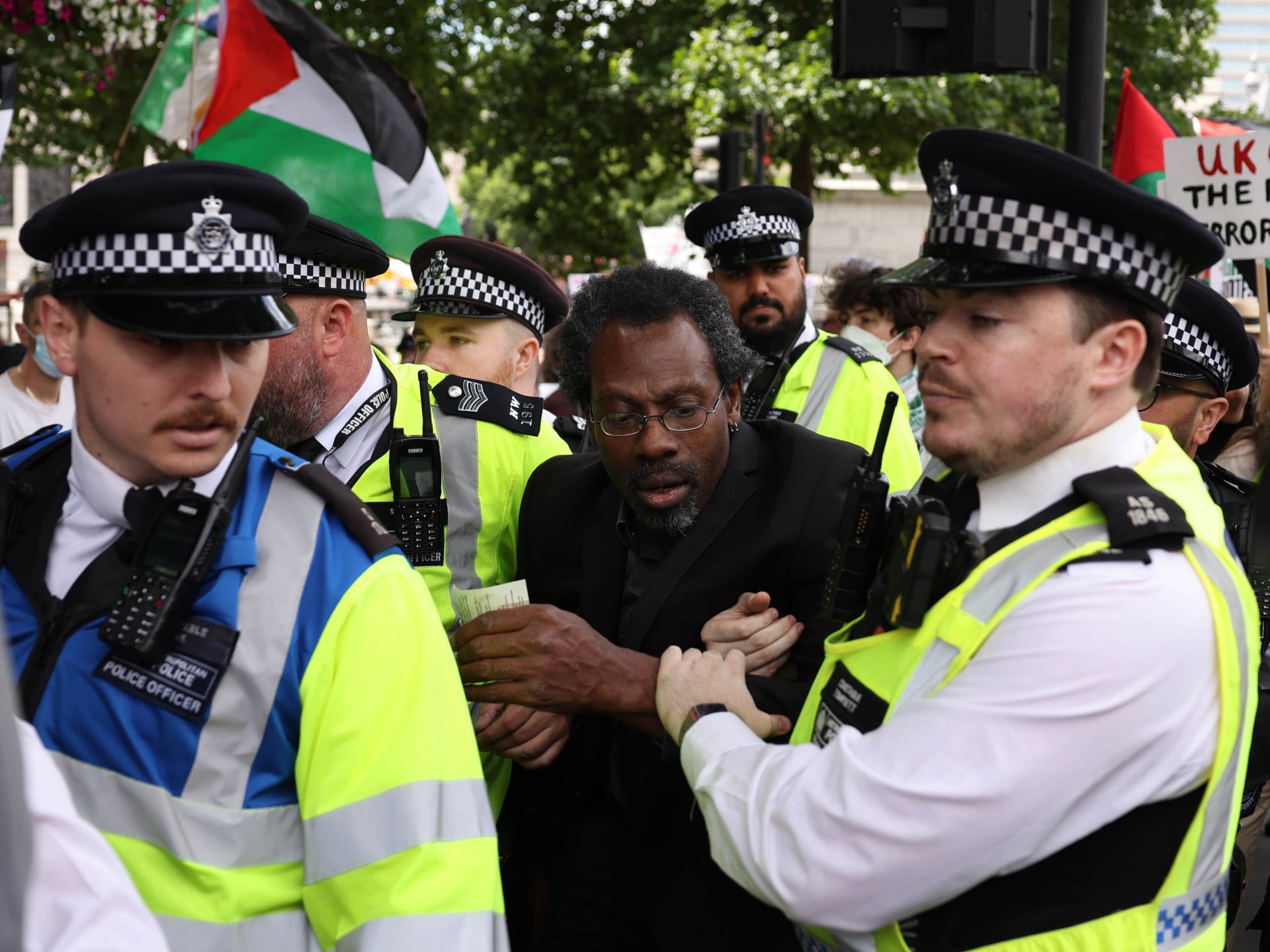
Hamas says won’t surrender arms but only police will carry weapons in Gaza
 05 June 2026
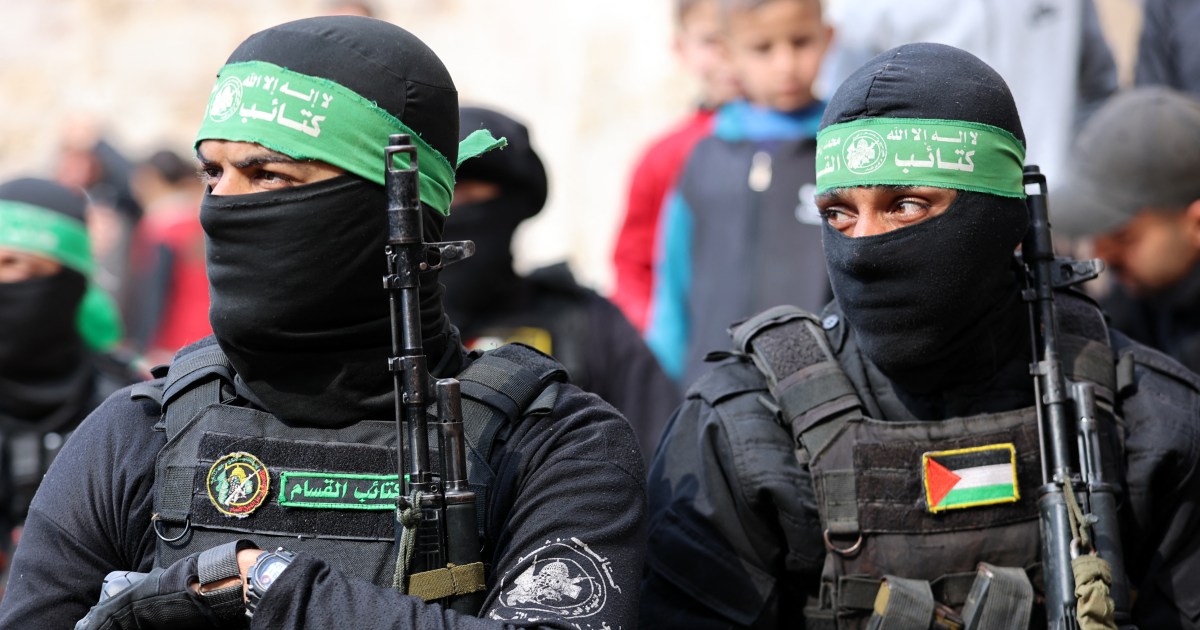

Hamas says it will not hand over its weapons right now, resisting ongoing disarmament demands and stating that the ultimate fate of its military arsenal will be decided following comprehensive discussions with other Palestinian factions.
![Hossam Badran, a member of the Hamas Political Bureau, spoke exclusively to Al Jazeera about the group's vision for a long-term Hudna in Gaza. [Mohammad Mansour/Al Jazeera]](https://www.aljazeera.com/wp-content/uploads/2026/06/IMG_7408-1780572254.jpg?resize=770%2C513&quality=80)
In an exclusive interview with Al Jazeera, Husam Badran, a member of the Hamas political bureau, offered an inside look into the group’s proposed solutions to the stalled negotiations, introducing the concept of a long-term hudna (truce).
“When this Palestinian committee [the National Committee for the Administration of Gaza (NCAG)] comes to take over the Gaza Strip, there will be no visible weapons in the streets and alleys of Gaza except the official weapons belonging to this committee, which is the official Palestinian police, ” Badran told Al Jazeera. “There will be no armed manifestations like the ones we were accustomed to in the Gaza Strip.”
But he clarified that this did not mean a formal surrender of arms.
“We are not talking about handing them over; we are talking about, at least, weapons not being visible except for the official weapons of the Palestinian police,” he said. “The details of this matter will be discussed within a national framework.”
The Hamas stance comes as an informed source told Al Jazeera that the group is preparing to send its delegation to Cairo for renewed talks, which are set to begin this weekend. Hamas had briefly delayed its participation to demand a halt to ongoing Israeli assassinations—such as the recent killings of military commanders Izz al-Din al-Haddad and Mohammed Odeh—to ensure a more favourable negotiating environment.
Advertisement
The disarmament of Hamas and the withdrawal of Israeli troops from Gaza remain the biggest sticking points in the United States-brokered October 2025 ceasefire plan.
Factional consensus in Cairo
The upcoming Cairo meetings will gather eight key Palestinian factions to form a unified national stance. Badran confirmed the attendance of representatives from Hamas, Palestinian Islamic Jihad (PIJ), the Popular Front for the Liberation of Palestine (PFLP), the Democratic Front for the Liberation of Palestine (DFLP), the PFLP-GC, the National Initiative, the Popular Resistance Committees (PRC), and the Democratic Reform Current affiliated with the Fatah movement.
These talks aim to salvage the ceasefire originally proposed by United States President Donald Trump. However, Badran noted that Israel has failed to implement even 30 percent of its phase one obligations, making any transition to subsequent phases impossible.
“We are talking about humanitarian aid … the Rafah crossing mechanism, the infrastructure, and the assassinations,” Badran explained. “The idea was a comprehensive ceasefire, but around 1,000 people have been killed. Saying Israel implemented even 30 percent is an overstatement.”
Only 150 to 250 aid trucks are entering the Gaza Strip daily instead of the agreed-upon 600, while the critical infrastructure for electricity, hospitals and fuel remains completely decimated.
The ‘disarmament’ deadlock
While Palestinian factions demand the fulfilment of these phase one survival metrics, Israeli officials and Nickolay Mladenov, the high representative for Gaza on Trump’s “Board of Peace”, are conditioning the transition to phase two on the disarmament of armed groups.
To break the deadlock, Mladenov recently presented a 15-point “roadmap” built by the ceasefire guarantors. In a May 2026 briefing to the United Nations Security Council, Mladenov defended the plan, emphasising that its architecture rests on a strict principle of reciprocity and verification. Addressing Palestinian concerns, Mladenov clarified that the roadmap explicitly dictates that “no Palestinian armed group will be required to transfer its weapons to Israel”. Instead, the decommissioning of weapons would be gradual, sequenced, and Palestinian-led, with all arms transferred to the NCAG.
Mladenov outlined that this disarmament process is tied directly to an Israeli military pullback. The plan commits Israel to a phased withdrawal of its forces to Gaza’s perimeter on an agreed timetable, conditional upon verified progress on decommissioning and the deployment of an International Stabilization Force (ISF) to act as a buffer.
Advertisement
Mladenov warned the UNSC of the severe consequences of rejecting the roadmap. With 85 percent of Gaza’s buildings damaged or destroyed, he stressed that “reconstruction financing will not follow where weapons have not been laid down”. Without an agreement, he cautioned, Gaza will remain divided, with Hamas holding administrative control over less than half the territory.
However, Palestinians view this 15-point framework as a stalling tactic designed to extract concessions while Israel deepens its occupation. Palestinian political analyst Wissam Afifa told Al Jazeera that Israel is exploiting “negotiation time” to exhaust the population through continuous escalation.
“They shifted from Trump’s 20 points to a new square, the 15-point square, which revolves entirely around one single clause: disarmament,” Afifa explained. He noted that the Palestinian resistance has been cornered and asked to make major concessions without real guarantees, while the Israeli government uses the talks to advance its territorial goals.
According to Afifa, Prime Minister Benjamin Netanyahu is weaponising the negotiations for domestic electoral gains, expanding Israel’s control from 60 percent of Gaza to 70 percent or more. This expansion is happening while oversight mechanisms, such as the Civil-Military Coordination Center (CMCC), have completely failed and paralysed the monitoring process.
“We are facing a scenario where the occupation has reshaped the ceasefire on its own terms,” Afifa said, adding that Mladenov has in effect adopted the Israeli and American vision by demanding disarmament without offering a clear political horizon for “the day after”.
The National Committee hurdle
This ongoing expansion complicates the transition of power. Amid accusations that Hamas is clinging to power, the group’s spokesperson, Hazem Qassem, reiterated that Hamas is fully prepared to hand over all governance and security responsibilities to the Cairo-based National Committee. Badran confirmed that Hamas has prepared all necessary administrative and security files for the transfer.
However, the NCAG itself faces massive operational barriers and has become, as Afifa described, a “hostage” to Israeli pressure.
A member of the committee, speaking to Al Jazeera on condition of anonymity, firmly denied reports that the body would enter Gaza soon, outlining strict conditions for assuming power. The committee categorically refuses to operate behind the Israeli-controlled “Yellow Line” or to cooperate with Israeli-backed armed militias currently operating in the Strip, the source said.
Furthermore, the source stressed that the committee will not enter Gaza until the International Stabilization Force is deployed in the buffer zones separating Israeli forces from Palestinian areas.
While the political deadlock continues, the human toll mounts. Mladenov acknowledged in his UN briefing that ceasefire violations continue to kill civilians and obstruct humanitarian access.
Advertisement
Since the ceasefire took effect, ongoing Israeli military actions have killed 933 Palestinians and injured 2,868, raising the total death toll since October 2023 to 72,942, with 172,967 people injured.
Related News
Denmark gets new government as Greenland crisis persists
Egypt warns Israel that dangerous Gaza escalations threaten ceasefire
FIFA World Cup 2026 talking points: NFL-style half-time show, kits and more