
Gaza’s unequal dead: 10,000 Palestinians under rubble, one Israeli captive
 27 January 2026
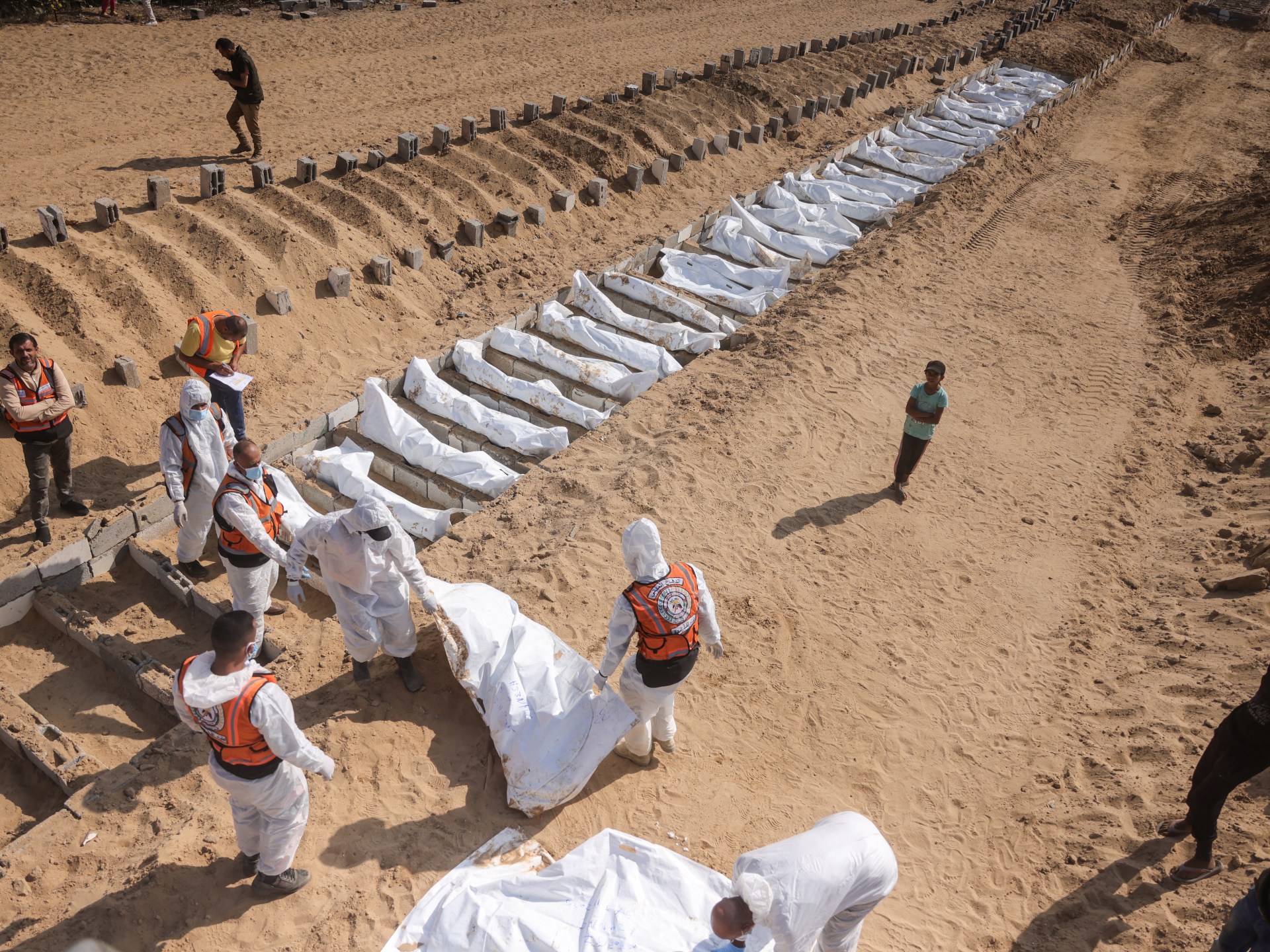

To retrieve one body, the Israeli military mobilised a fleet of tanks, drones, and what locals described as “explosive robots”.
They turned a neighbourhood into a “kill zone”, dug up approximately 200 Palestinian graves, and left four civilians dead in their wake.
The focus of this overwhelming force was Ran Gvili, an Israeli policeman killed more than two years ago, the last Israeli captive in Gaza after more than two years of Israel’s genocidal war on the besieged enclave.
His successful recovery on Monday was hailed by Israeli Prime Minister Benjamin Netanyahu as a triumph of commitment. But just metres (yards) away from where Gvili’s remains were carefully extracted, a very different, gruesome reality persists.
According to the National Committee for Missing Persons, more than 10,000 Palestinians remain entombed under the rubble of Gaza, decomposing in silence, lost and without identity.
Families grieve without closure for their missing, presumed dead loved ones.
There are no explosive robots clearing the way for them, no forensic teams flying in to identify them, and no global outcry demanding their recovery.
International media do not rush to break news about them.
The digging up of the al-Batsh cemetery in Gaza City’s Tuffah neighbourhood has become a visceral symbol of a deadly double standard: A world where one Israeli corpse commands the attention of an army, while thousands of Palestinian bodies are treated as part of the decimated, apocalyptic landscape.

A ‘kill zone’ around the graves
Khamis al-Rifi, a journalist in Gaza who reported from the vicinity of the incursion, detailed the sheer scale of force used to isolate the area.
Advertisement
“It started with exploding robots and air strikes … clearing the path for the tanks,” al-Rifi told Al Jazeera. He explained that approaching the cemetery was impossible, as tanks enforced a deadly perimeter, firing at anything that moved.
From his position near the “Yellow Line”, Israel’s self-proclaimed buffer zone inside Gaza, al-Rifi described a “wall of fire” created by artillery and helicopters to protect the engineering units. Inside this sealed zone, witnesses and video footage obtained later revealed that the forces spent two days churning up the earth.
“They dug up about 200 graves,” al-Rifi said. “They pulled the martyrs out, tested them one by one until they found the [Israeli] body.”
The disparity was most evident in the aftermath. Gvili’s remains were airlifted for dignified burial in Israel. The Palestinian bodies, however, were left to the mercy of bulldozers.
“When citizens went to the area [after the withdrawal], they found the martyrs put back randomly … covered with sand by the bulldozers,” al-Rifi said. “Some bodies were still visible on the surface.”
‘The world’s largest graveyard’
While Israel used satellite technology and DNA labs to close the chapter on its missing policeman, Palestinian families are denied even the basic machinery to dig.
Alaa al-Din al-Aklouk, spokesperson for the National Committee for Missing Persons, stated last November that Gaza has become “the world’s largest graveyard”.
“These martyrs are buried under the rubble of their homes … without their last dignity being preserved,” al-Aklouk said. He highlighted the “fatal injustice” of an international community that mobilised resources for Israeli captives while blocking the entry of heavy civil defence equipment needed to recover Palestinian victims.
Mustafa Barghouti, secretary-general of the Palestinian National Initiative, told Al Jazeera on Monday that while he respects the right of any family to bury their dead, the contrast is inescapable. “The lack of equal treatment, the lack of respect to Palestinians as equal human beings, is really astonishing,” he noted.
A cost paid in blood
The dark irony of this Israeli mission is that it created new victims. On Tuesday morning, as residents approached the desecrated cemetery to check on the graves of their loved ones, Israeli fire struck again.
“Four martyrs fell in the area this morning,” al-Rifi said, noting that one of them, his relative Youssef al-Rifi, had simply gone to inspect the destruction left behind.
In its quest to close a raw chapter that has shaken its national psyche since October 2023, Israel opened new graves in 2026. The operation serves as a grim microcosm of the entire war: The sanctity of one side’s life and death is upheld at the absolute expense of the other’s.
Related News
Lives on hold for two years: Some hope stuck behind Gaza’s Rafah crossing
US-brokered Russia-Ukraine talks close with no breakthrough
Week in Pictures: From Minneapolis turmoil to Israeli attacks on Gaza