Follow the vote: Bangladesh election live results 2026
 12 February 2026

Vote counting is under way in Bangladesh, where 127 million eligible voters are electing a new government, 18 months after a student-led movement ended Sheikh Hasina’s two-decade rule.
Alliances led by the Bangladesh Nationalist Party (BNP) and the Jamaat-e-Islami (JI) are vying for the most seats in the national assembly.
- list 1 of 4Nahid Islam and the uneasy alliance that could shape Bangladesh’s vote
- list 2 of 4Prapti in Bangladesh
- list 3 of 4Bangladesh tightens security ahead of first election since 2024 uprising
- list 4 of 4Bangladesh’s vote for dignity
end of list
Polls opened at 7:30am (1:30 GMT) and closed at 4:30pm (10:30 GMT).
Here are the latest updates from the Bangladesh Election Commission:
When will the results be known?
In previous elections, unofficial results have typically begun to emerge early the following morning.
Bangladesh Election Commission (EC) officials have told local media, however, that the vote count may take longer this time as it will involve both the white parliamentary voting ballot and the pink ballots for the referendum on the July National Charter.
There are also more parties and candidates this time.
Past election results
Bangladesh’s electoral history over the past two decades has been predominantly shaped by the Awami League, which came to power in 2009 after a significant defeat of the Bangladesh Nationalist Party (BNP), which had ruled from 2001 to 2006.

In the 2001 election, the Awami League suffered a major defeat, winning just 62 seats, while the BNP secured a commanding majority with 193 seats. That election marked the last clear transfer of power between the two main parties.
The balance shifted decisively in 2008, when the Awami League-led Grand Alliance returned to power in a landslide. Since then, the party has consolidated its dominance.
Advertisement
In 2014, with the BNP absent from the contest, Hasina’s Awami League again won in a landslide.
The party further strengthened its grip in the 2018 election, securing 300 seats, while the BNP was reduced to just seven seats, its weakest performance on record. Thousands of BNP leaders were arrested in the lead-up to the elections. The Jamaat was banned in 2015, and so it couldn’t contest. International observers and opposition groups described the election as neither free nor fair.
In the most recent 2024 election, the Awami League won 272 seats, maintaining a parliamentary majority. The BNP again boycotted, amid deepening repression of opposition leaders. The Jamaat was still banned.
How does voting work in Bangladesh?
Votes are being cast across 42,761 polling centres in 64 districts for 300 parliamentary constituencies, according to the ECB. There are 50 seats allotted for women’s representation which are distributed based on proportional representation.
According to the final voter list released by the EC in November 2025, there are 127,711,793 registered voters including 64,825,361 men, 62,885,200 women and 1,232 third-gender voters, all aged 18 and above.
This is the first time postal voting has been facilitated, benefitting about 15 million overseas workers whose remittances form a vital part of the Bangladeshi economy.

Bangladesh has a “unicameral” legislature – a single legislative chamber which makes laws – the Jatiyo Shangsad or the House of the Nation, with 350 constituencies. Each constituency has a single-member seat.
The voting age is 18 years and older. Voting through the first-past-the-post (FPTP) electoral system is used to elect 300 members, while the remaining 50 seats are reserved for women and are allocated to parties proportionally after the election results. So, for example, if a party wins 60 seats, it receives 10 reserved seats to be allocated to female politicians.
Who are the key players?
There are 59 registered political parties in Bangladesh, excluding ousted PM Sheikh Hasina’s Awami League, whose registration was suspended by the election commission last year, nullifying its ability to field candidates in the polls.
Of these, 51 parties are participating in this year’s elections. In total, 1,981 candidates are contesting, including 249 independent ones.

Bangladesh Nationalist Party (BNP)
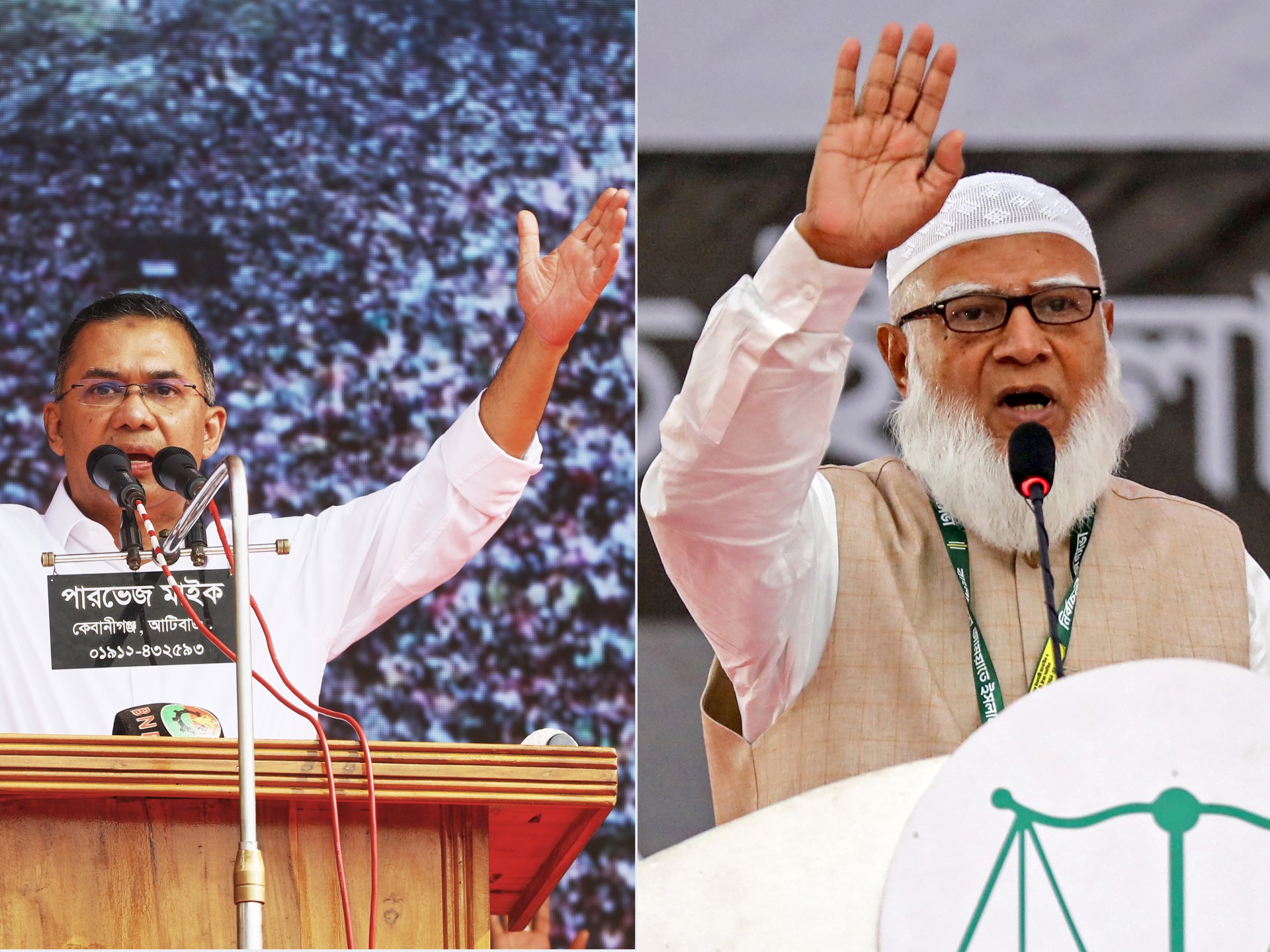
The centre-right BNP is leading a coalition of 10 parties.
It is led by Tarique Rahman, the son of the late former Prime Minister Khaleda Zia. In December, Rahman, 60, returned to Bangladesh after nearly 17 years of exile in London. He had escaped the country in 2008 amid what he deemed a politically motivated persecution.
Advertisement
The BNP was founded by Rahman’s father, Ziaur Rahman, a prominent military figure in the country’s independence war against Pakistan in 1971, in 1978.
The party, based on Bangladeshi nationalism, has traditionally swapped positions as governing and opposition party with the Awami League since independence.
After Ziaur Rahman’s assassination in 1981, his wife Khaleda Zia led the BNP, serving twice as prime minister, from 1991 to 1996 and from 2001 to 2006.
After Hasina returned to power in 2009, the BNP came under intense pressure; Khaleda was placed under house arrest following a conviction in 2018 on corruption charges, but was acquitted and freed after Hasina was ousted in 2024.
Since Hasina’s departure, the BNP has re-emerged as a leading political force.

Jamaat-e-Islami
The JIB, commonly known as Jamaat, spearheads an 11-party alliance, including the National Citizen Party (NCP), a group formed by students who led the protests against Hasina in 2024. The party is led by 67-year-old Shafiqur Rahman.
Jamaat was founded in 1941 by Abul Ala Maududi when India was still under British colonial rule.
In 1971, Jamaat opposed Bangladesh’s independence from Pakistan and was banned after the liberation. However, the BNP government lifted the ban in 1979.
Jamaat burgeoned into a significant political force over the next two decades, backing BNP-led coalitions in 1991 and 2001.

National Citizen Party (NCP)
Formed by student leaders of the 2024 uprising, it is a centrist party focused on citizen-led governance and political reform. It has garnered attention from younger voters and civil society groups due to increasing dissatisfaction with established parties.

Related News
‘Melania’: What to know about the US first lady’s new documentary
Bangladesh election: Who are the key players and parties?

How does the cutoff of Starlink terminals affect Russia’s moves in Ukraine?