COMMENTARY: What Happens When You Get a Poor Report Card?
 14 April 2026




By : Yves Ephraim
If you are able to read this, it most likely means that you had already journeyed from kindergarten, to primary school, to secondary school to State College and for some of you, perhaps to university.
Your journey through the educational system was fraught with exams, tests, quizzes, assessments of all types.
You have been through quizzes at the end of new topics; you have waded through mid term exams; you have been through the 11+ exams; you struggled through CXC exams. You finally made it.

Most people dread having to take exams and tests, but it is the only way to determine if you are making real academic progress. It is one of those necessary evils!
Having ventured through these meandering forests of tests, exams, quizzes and assessments, you learned that this journey was necessary to ensure that you were building the requisite skills to become an independent, model citizen: fully capable of contributing positively to your community.

One thing that is true about your academic journey, is that, there are numerous report cards that have paved your path to where you are today.
Report cards, all throughout your schooling, kept score of your performance along the way, regardless of whether you thought your report cards were fair or not.

The one significant thing about report cards is that you are not allowed to supply the grades yourself.
Your very independent teachers were the ones marking your papers and posting your grades, based on how they felt you performed in their classes.
The day of collection of your report card was your day of reckoning.
On that day your parents would learn if you are being a fool all year or making them proud.
The results of your report card determined whether you qualified to graduate to the next level or “stopped down”.
When you “stopped down”, you became the laughing stock of the whole school. You might as well walk around with a dunce cap.
A certain person I know would most likely call you a “loser”!
General elections are like the end of the school year, in that politicians were given a period of time to perform and it is now time for the report card.
The proverbial cock has come home to roost, if you will!
Like school, politicians are not allowed to create their own grades!
I think that most people view general elections incorrectly.
Most people view general elections as random nominated individuals putting themselves up for a chance to lead. That might be true technically but that view loses the essence.
I see general elections as the time to assess the incumbent administration in order to determine whether that administration deserves another term at the helm.
Other contenders provide a pool of alternatives for which to replace those currently leading who have produced poor report cards.
It is worth noting that you cannot truly assess someone who is offering himself for office until he has been given a chance to serve.
I therefore do not see any value in attempting to assess those outside of the incumbent administration who have not had a chance to prove themselves at the helm. This would not be comparing apples to apples.
Once you are given a chance to serve, then at the next election cycle, your report card should be prepared and studied to determine if you deserve another chance at the helm.
Truth be told, EVERY politician who has had a chance to lead, would have had NO prior experience before being elected.
Even though general elections provide an opportunity for others to ask to be given a chance to serve, the real reason for general elections is to evaluate those that currently hold the reins of power in order to determine whether they did a good job and deserve another term.
What is at stake here, is whether the current ruling administration has kept a good report card that validates graduating that administration to a next term.
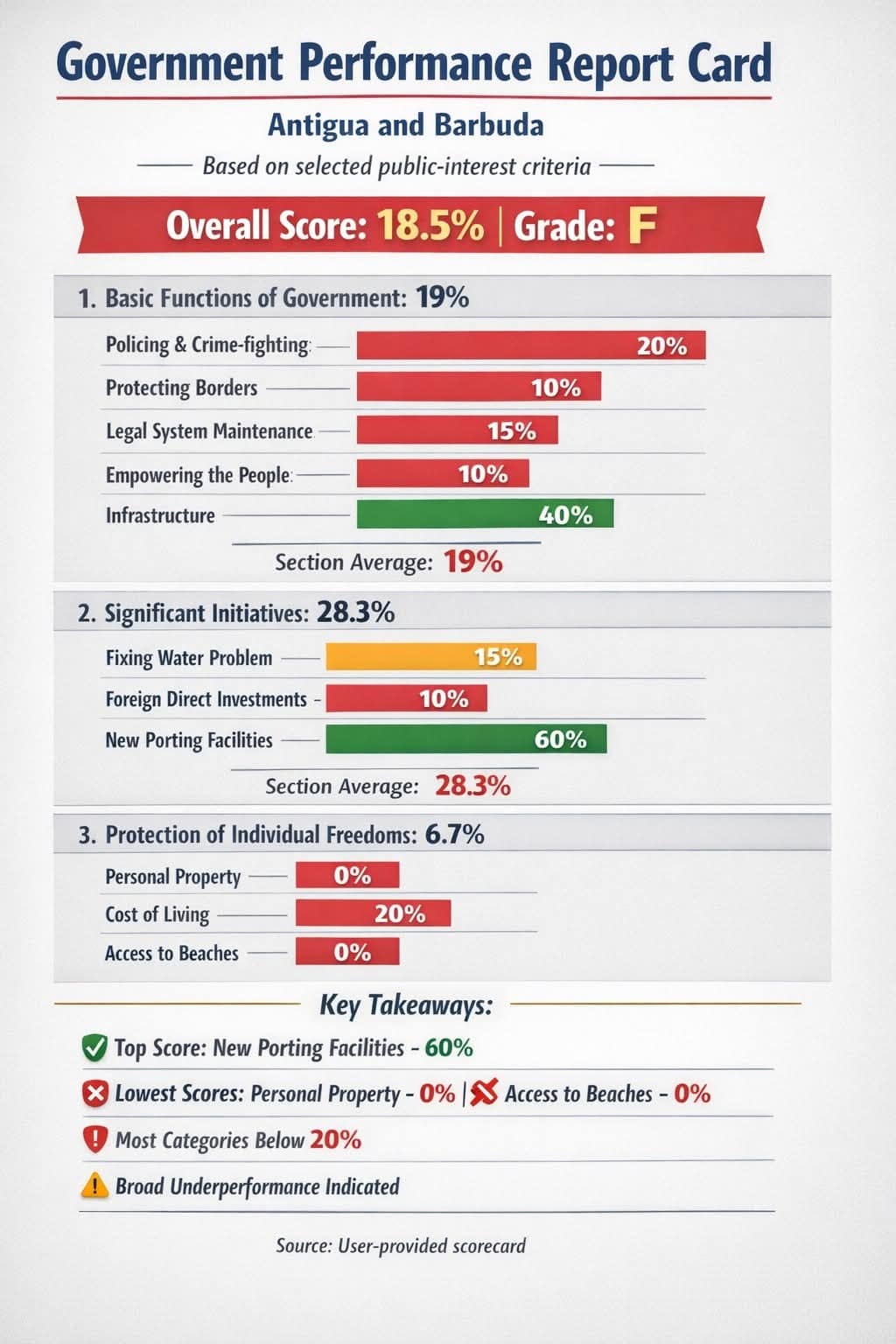
To that end I will attempt to construct a 12-year report card based on:
1) An evaluation of how the incumbent maintained the basic functions of government;
2) What SIGNIFICANT initiatives were introduced that has made this nation more sovereign, sustainable and self-sufficient; and
3) The effort of the administration to protect individual freedoms.
BASIC FUNCTIONS OF GOVERNMENT:
Policing and Crime-fighting: 20%
Protecting Borders: 10%
Maintenance of Legal System: 15%
Empowering the People: 10%
Infrastructure: 40%
The police force is not independent and unable to solve most of the non-obvious crimes. The force appears powerless to curb the number of robberies and is grossly under resourced in material and expertise.
The Antigua Airways saga exposed the porousness of our borders both incoming and outgoing. The Cameroon refugees clearly demonstrated that.
Even after granting the Cameroons the opportunity to stay in Antigua and Barbuda, they were able to slip out of Antigua as easily as they slipped in.
I have not been convinced that much has been done to tighten our borders since then. I wonder how much of the gun crimes and criminal activity are enabled by our porousness borders.
As it relates to our legal system, it continues to languish and being under resourced.
Empowering the people is not merely giving them handouts and subsistence jobs.
It is about teaching each citizen to fish in order to support themselves rather than giving them the fish.
Giving them fish only breeds dependency which is all around us today and more so evident in this election cycle.
As it relates to infrastructure, this has been neglected for far too long and one gets the sense that the only reason for all the activity is: a) the upcoming elections and b) CHOGM.
The neglect of engineering on the drainage of the roads makes me suspicious. Drainage is clearly ignored because there is no time to do the job right.
SIGNIFICANT INITIATIVES
Fixing Water Problem: 15%
Foreign Direct Investments: 10%
New Porting Facilities: 60%
Prior to 2014, I was told that about 40% of APUA’s water production is lost to a leaky water distribution system. My business and engineering sense told me that the priority should be to tackle the water distribution problem. Fixing this would yield the greatest return.
Imagine owning a bread shop where before you even have a chance to bake your bread to sell, you must first throw away 40% of the finished dough.
Would your first step not be to keep as much of the dough as possible?
However, the way the government chose to fix the water problem was to ignore the distribution problem while trying to brute force production with multiple expensive reverse osmosis plants.
In other words, if your house demands say 100 gallons of water a day, by not fixing the distribution problem, APUA would have to pump 167 gallons to for you to receive that 100 gallons. That results in 67 gallons wasted. How sustainable is that!
All we got from this brute force strategy was: still no running water but now a higher national debt.
YIDA and several other signature investments never got off the mark.
I would give a passing grade for the facilitation of the new facility as St. John’s harbour.
PROTECTION OF INDIVIDUAL FREEDOMS
Personal Property: 0%
Cost of Living: 20%
Access to Beaches: 0%
Since our national independence in 1981, this is the only administration with the unchallenged record of widespread violation of individual property rights. From Booby Alley to Barbuda.
This administration forgot its historical past and without compassion, COERCED its citizens to inject themselves with an untested substance against their own freewill.
The recent temporary lowering on certain tariffs on food stuff have shown how the cost of living has been driven to a large extent by government taxation.
Did we not witness, despite increasing prices worldwide, how strawberries that once cost $35.00 plummeted to less than $15.00 for the same quantity?
Clearly, more can be done to “ease the squeeze” and this can be facilitated by reducing the size of government.
The spectacle of the recent dismissed charge of trespassing to access the public beach, highlights the failure of the government to protect the citizens’ right to access the public beaches. Government should be ensuring that every adjacent property owner should never block or impede public access to the beaches. The government should be the guardian of such rights and not the enforcer for those who violate that public right.
UNINTENDED CONSEQUENCES
– Loss of visa access to the USA for most, even for educational purposes.
– Unchecked government spending (government spending grew from less then $1.00 Billion in 2014 to over $2.00 Billion in 2026, thus impoverishing the country.)
– Increasingly becoming a welfare state
– High youth unemployment as evidenced by the recent pictures of throngs of youth queuing for a job at Ministry of Works.
– Secrecy of MOU to be forced into acceptance of deportees from the USA.
Now that the report card is in, it looks like there should be no graduating to another term, regardless of how well this administration thinks that it might have done.
Advertise with the mоѕt vіѕіtеd nеwѕ ѕіtе іn Antigua!
We offer fully customizable and flexible digital marketing packages.
Contact us at [email protected]

Related News

Matthew congratulates swimmers after strong CARIFTA Aquatics opening
MP Baltimore Donates Medical Supplies to Glanvilles Polyclinic

Lady Williams Appears Alongside Melania Trump at “Fostering the Future Together” Summit