Bulgaria elections: Who’s running and what’s at stake?
 17 April 2026
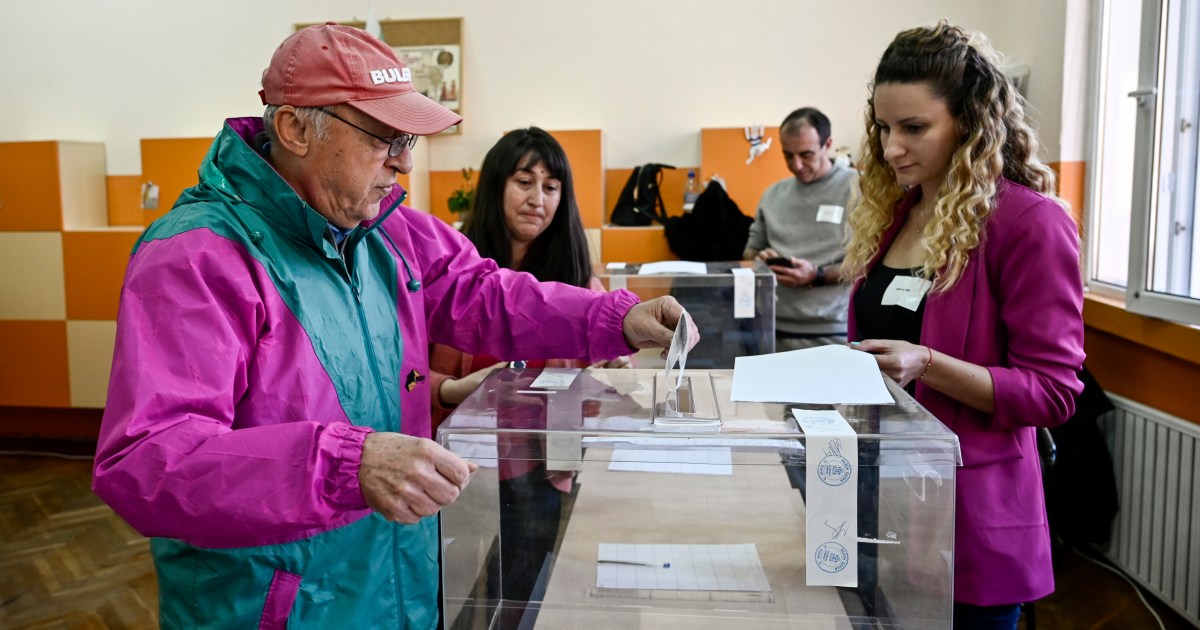

Bulgaria will hold a snap parliamentary election on Sunday, April 19, amid a political crisis in which weak coalitions have failed to thrive and trust in democratic elections has waned.
The election, the eighth in five years for the Black Sea nation of some 6.5 million people on the European Union’s southeastern frontier, comes following the resignation of the previous government in December, following weeks of anticorruption protests.
- list 1 of 3Bulgaria set for another snap election after protests oust government
- list 2 of 3Bulgaria’s President Rumen Radev says he will resign ahead of snap election
- list 3 of 3Bulgaria’s president picks senior central bank official as acting PM
end of list
Here’s what we know about the upcoming polls:
Why is there a snap parliamentary election?
The snap election was announced by former Bulgarian President Rumen Radev in January after leading parties refused a mandate to replace the last government, which resigned amid widespread protests against corruption.
Bulgaria has been racked by political instability for several years, with numerous governments proving unable to muster the support or unity necessary for political survival.
Bulgaria has held seven national elections in the past four years – most recently in October 2024 – amid deep political and social divisions.
The latest political crisis was triggered when Prime Minister Rosen Zhelyazkov announced the resignation of his cabinet last December, minutes before parliament had been due to vote on a no-confidence motion.
Zhelyazkov resigned after weeks of street protests against endemic state corruption and a planned 2026 budget that would have increased social security contributions and some taxes in a bid to plug state financing shortfalls.
When do polls open?
Polls are expected to open at 7am local time (04:00 GMT) and close by 8pm local time (17:00 GMT).
Advertisement
Citing a poll by Bulgarian research firm Alpha Research, the Bulgarian News Agency reported on Friday that more than 3.3 million people are expected at the polls, representing about 60 percent of eligible voters living in the country, compared with 2.57 million who voted in the last parliamentary elections in October 2024.
Alpha Research also reported that after eight elections in five years and unsuccessful coalitions, the prevailing attitude among Bulgarian citizens (49 percent) is that a single party should have a majority and bear full responsibility for governing.
Conversely, just 33 percent believe that any government needs oversight and continue to support a coalition formula.
Who is running?
Radev, a pro-Russian former fighter pilot and Bulgaria’s former president with the Progressive Bulgaria party, is running for prime minister in this election, as is former Prime Minister Boyko Borissov from the conservative centre-right GERB-UDF party.
Other major political parties contesting include Continue the Change-Democratic Bulgaria, Movement for Rights and Freedoms party (MRF), Vazrazhdane, BSP, Siyanie, Velichie, MECH, There Is Such a People and ARF.
According to Alpha research, Radev’s Progressive Bulgaria is currently in the lead with the highest electoral support at 34.2 percent, followed by Borissov’s GERB–UDF with 19.5 percent.
Other polls have predicted the pro-Western bloc, We Continue the Change, which is expected to come in third with 12-14 percent of the votes, is a possible coalition partner for Radev if he wins.
Radev has ruled out an alliance with GERB, run by Borissov, or with the Movement for Rights and Freedoms party, whose leader Delyan Peevski is the subject of US and UK sanctions for corruption.
“All indications point towards … coalition-building,” Tihomir Bezlov, a senior fellow at the Centre for the Study of Democracy in Sofia, told Reuters. He added, however, that it is unclear how long any coalition can survive.
What would a Radev victory mean?
Radev has cast himself as an opponent of the country’s “entrenched mafia” and its ties to high-ranking politicians, according to The Associated Press. At the latest pre-election rally on Wednesday, he pledged to “remove the corrupt, oligarchic model of governance from political power”.
A Radev victory could redefine Bulgaria’s foreign policy, which has been largely dictated by parties loyal to the European Union. Bulgaria joined the eurozone in January this year and last month signed a security agreement with Ukraine, both moves that Radev has opposed.
Advertisement
“The coalition-makers introduced the euro in Bulgaria without asking you. And now, when you pay your bills, always remember which politicians promised you that you would be in the ‘club of the rich’,” Radev said on Wednesday, responding to public frustration at rising bills, according to the Reuters news agency.
But his close ties to the Kremlin could also make his ties with Brussels tense. Radev has officially denounced Russia’s aggression in Ukraine, but has repeatedly opposed military aid for Kyiv and instead favours reopening talks with the Kremlin as a way to end the war.
“We are the only member state of the European Union that is both Slavic and Eastern Orthodox,” he said in an interview with Bulgarian journalist Martin Karbovski.
“We can be a very important link in this whole mechanism … to restore relations with Russia,” he added.

What are the key issues for Bulgarians?
Bulgaria has developed rapidly since communism fell in 1989, and it joined the European Union in 2007.
Life expectancy has shot up, unemployment is the lowest in the EU and the economy has greater safeguards since entering the eurozone. But the country sorely needs political stability to speed up the intake of EU funds into its creaking infrastructure, encourage foreign investment and root out systemic corruption, analysts say.
In rural areas, communities continue to face economic challenges.
In a grassy valley in rural southern Bulgaria, farmer Nikolay Vasiliev told Reuters he is desperate for change. For many like him, Radev is the saviour who can change the country.
“I see a leader who can make this drastic change and provide security for people,” Vasiliev said. “The time has come for us to fundamentally solve the problems in the country.”
For others, there are fears of foreign interference, particularly from Russia, in the elections.
Last month, Bulgaria also requested the assistance of the EU diplomatic service to counter Russian attempts to influence public opinion through social media networks and propaganda websites.
The request was based on warnings from the Center for the Study of Democracy (CSD), an independent think tank, about active networks of Russian influencer accounts seeking to sow division.
“No one from outside can come and tell us who and what to vote for. That is decided here, by us Bulgarians,” Radev said at his campaign rallies, according to Reuters.
Evelina Slavkova, from the research centre Trend, also told AP that if Radev wins, he is unlikely to make any serious effort to reorient Bulgaria more towards Russia, despite his links to Moscow.
“Our country has succeeded, despite all the obstacles, despite disagreements among some politicians, in building a very important set of tools that keeps Bulgaria on the right track,” she said.
Related News
Thousands of Palestinians pray at Al-Aqsa Mosque after Israel’s 40-day ban
Trump says Pam Bondi out as Attorney General
At least seven Palestinians killed in Israeli attacks on Gaza