At The Edge Of Black History Month 2026: A Reflection On Dr. John Henrik Clarke And The Memory, We Owe Ourselves
 28 February 2026
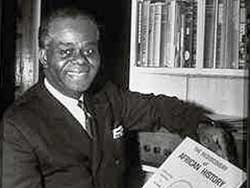

News Americas, NY, NY, Sat. Feb. 28, 2026: As Black History Month 2026 draws to a close, there is always a quiet reflection that follows the celebrations. The posts slow down. The lectures conclude. The banners come down. We return to ordinary days. But before we step into March, before the commemorations fade into memory, there is one name that deserves more than a passing mention: John Henrik Clarke. Not because he needs praise, and not because his résumé demands attention, but because his message, perhaps more than ever, demands reflection.
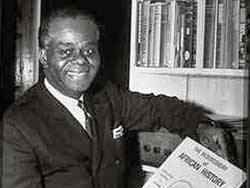
Dr. Clarke was not simply a historian. He was a guardian of memory. He believed that the most dangerous condition a people could fall into was historical amnesia. When history is distorted, diluted, or selectively taught, the consequences ripple across generations. And so, as this month closes, the question is not whether we have celebrated enough. The question is whether we have remembered deeply enough.
Though born in the American South, Clarke’s intellectual maturation took place in Harlem, in conversation with Caribbean thinkers whose influence shaped modern Black consciousness. He was deeply influenced by the legacy of Marcus Garvey, whose call for economic independence and global Black unity echoed across oceans. He studied the archival brilliance of Arturo Alfonso Schomburg, whose preservation of African diaspora history provided a foundation for serious scholarship. He wrestled with the lessons of Haiti, not as a distant observer, but as a student of its triumphs and trials.
Haiti was never simply a country in Clarke’s lectures. It was a declaration that those once enslaved could govern themselves. It was the first successful slave revolt that birthed a Black republic under leaders such as Toussaint Louverture. It was proof that the plantation was not destiny. Yet Haiti also became a cautionary tale, punished economically and politically for its audacity. Clarke understood that the story of Haiti was often told selectively. Its revolution was minimized while its instability was magnified. For the Afro Caribbean reader, this tension is not abstract. The Caribbean has long lived at the intersection of brilliance and burden, cultural influence and economic constraint, pride and vulnerability. Clarke insisted that these contradictions be studied honestly rather than romanticized or dismissed.
He believed that a people disconnected from their historical lineage are easier to mislead. If we do not know where we have been, we cannot accurately interpret where we are. Today, information travels faster than ever. Quotes circulate widely. Names trend briefly. But depth is rare. Serious study is often replaced by aesthetic consumption. We know fragments of our heroes, but not their frameworks. Clarke did not want to be quoted; he wanted to be studied. He did not want history reduced to inspiration; he wanted it understood as infrastructure. The danger of forgetting Clarke is not simply that one man’s name fades. The danger is that the strategic literacy he championed fades with him.
No one can deny the cultural impact of Black and Caribbean communities in the 21st century. From music to fashion, language to sport, the global footprint is undeniable. Caribbean rhythms pulse through international charts. Diasporic slang shapes global youth culture. Our aesthetic is everywhere. Yet, Clarke would have asked a harder question. Who owns the systems through which that culture moves? Who controls distribution platforms, economic policy, educational curricula, and institutional power? He never confused cultural visibility with structural sovereignty. Pride was necessary, but pride alone was insufficient.
For the Afro Caribbean community, this distinction matters deeply. The Caribbean has long exported talent, art, and intellect while importing capital and policy constraints. Migration has offered opportunity, yet it has also introduced new forms of dependency. Clarke’s framework invites us to examine whether patterns have transformed or simply evolved. Are we participating in systems, or are we shaping them? Are we visible within institutions, or do we control them?
Clarke was a Pan African thinker who rejected fragmentation. He did not separate African Americans from Afro Caribbeans or continental Africans. He saw shared history where others saw borders. Today, identity is both celebrated and contested. Diaspora tensions occasionally surface. Debates over who owns certain narratives or who bears particular burdens can overshadow the deeper truth of shared lineage. Clarke would likely caution against this fragmentation. Colonial systems thrived on division, and modern economic systems benefit from competition rather than coalition. For a Caribbean and Black focused audience, his warning resonates. Unity is not about erasing cultural specificity. It is about recognizing common roots and shared futures.
As institutions evolve, they often soften the edges of their founders. Black Studies programs, once born from activism and confrontation, have become established academic departments. Growth brings stability, but stability can also bring containment. Clarke’s critiques were not mild. He challenged Eurocentric historiography. He questioned assimilation without power. He insisted that economic independence and institutional control were prerequisites for lasting freedom. Those conversations can feel intense in contemporary spaces that prize neutrality and broad appeal. And so, sometimes, celebration replaces critique. Inspiration replaces interrogation. Erasure does not always look like removal. Sometimes it looks like dilution.
If young Afro Caribbean students encounter Black history stripped of structural analysis, they inherit pride without blueprint. And pride without blueprint cannot sustain generations. Clarke would measure progress not by individual milestones but by institutional continuity. He would ask whether communities are building structures that endure beyond charismatic leaders. He would examine whether cooperative economic models are expanding and whether historical consciousness is being transmitted to children born in diaspora. He would measure success not only by professional ascent but by collective leverage.
There is something fitting about ending Black History Month with Clarke. He represents the deeper current beneath the celebration. He reminds us that history is not decoration; it is defense. He reminds us that unity is not sentiment; it is strategy. He reminds us that culture without ownership is fragile. He reminds us that memory is inheritance. As February closes, we must ask what we are carrying forward. Are we carrying curated moments, or are we carrying frameworks? Are we teaching our children the names of heroes, or are we teaching them how to think about power? Are we honoring Haiti as revolution, or are we repeating its instability without context? Are we preserving Garvey as a symbol, or are we studying his economic blueprint?
Black History Month will return next year. The banners will rise again. The lectures will resume. But the real work exists in the months between. Continuity requires intentional transmission. It requires disciplined reading and uncomfortable questions. It requires institutional imagination. For the Afro Caribbean community, Clarke’s message is not optional heritage; it is intellectual infrastructure. The Caribbean shaped him. Haiti sharpened him. Harlem amplified him. The diaspora carried him.
If his message drifts underground, it is not because it lacks relevance. It is because relevance demands responsibility, and responsibility demands work. As this month ends, perhaps the most fitting tribute to Dr. John Henrik Clarke is not applause but recommitment. Recommitment to memory, to unity, to structure, and to the long arc of institutional building. The month may end, but the memory must not.
Support NewsAmericas

Related News
Here’s What Marco Rubio Offered CARICOM Leaders At St. Kitts Summit

King Kong And The Island: America’s Moral Collapse And Cuba

Caribbean American Congresswoman Shirley Chisholm’s Legacy Lives On In Brooklyn’s Litt...