Armenians go to polls in test of PM’s pivot to Europe amid Russian pressure
 07 June 2026
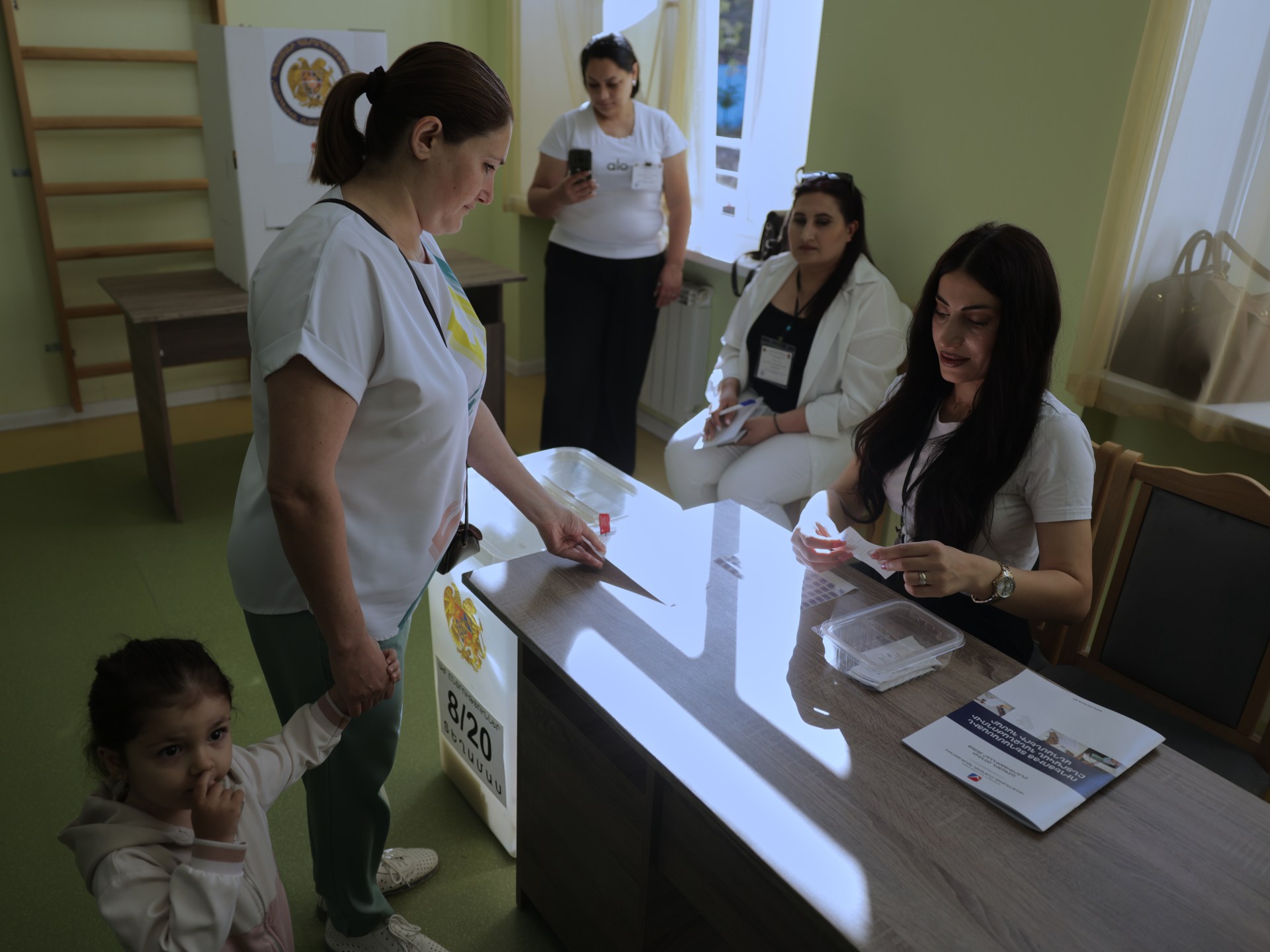

Voting is under way in Armenia’s parliamentary election, seen as a test of the government’s efforts to forge a peace deal with rival Azerbaijan and loosen ties with Moscow.
Prime Minister Nikol Pashinyan and his ruling Civil Contract party are seeking a strong mandate to continue a geopolitical reorientation towards Europe and away from former imperial ruler Russia. The opposition they face includes several parties that are vocally pro-Moscow.
- list 1 of 4Armenia signs strategic partnership deal with US as election approaches
- list 2 of 4Armenian PM rejects Russia’s demand for EU referendum as relations nosedive
- list 3 of 4Why are Armenia’s elections being so keenly watched abroad?
- list 4 of 4Macron sings as Armenia’s leader drums in unusual moment at state dinner
end of list
Casting his vote on Sunday, Pashinyan said Armenia would continue strengthening its independence, statehood, democracy and rule of law. “The European Union is our main partner in democratic reform implementation and we will continue that path,” he said.
He also stressed that there were no tensions between Armenia and Moscow, saying, “our relations with Russia are institutional and based on mutual respect,” the Armenpress news agency reported.
Pashinyan has moved Armenia closer to the West and away from Russia since coming to power in 2018, drawing the ire of Moscow.
Russian officials hit Armenian exports with restrictions in recent weeks, while high-ranking officials, including President Vladimir Putin, have made thinly veiled threats comparing Armenia’s path to that already taken by Ukraine.
A day before the vote, Armenian investigators said they issued six arrest warrants for members of the Strong Armenia party, accusing them of buying votes.
The nation’s Central Election Committee confirmed on Saturday that the party could run after a member of another opposition party, Republic, appealed for Strong Armenia to be barred over corruption allegations.
Advertisement
Armenia’s parliament, the National Assembly, must consist of at least 101 members who are elected for five-year terms. Parties must win at least 4 percent of the vote to take a seat, while blocs made up of three or more parties must hit 8 percent.
Two political blocs and 17 parties are taking part in the election. Most pollsters and experts have predicted Pashinyan, who came to power in 2018 following sweeping street protests, will come out ahead.
Polls opened at 8am local time (04:00 GMT) on Sunday and will close at 8pm (16:00 GMT).
Security and identity top election issues
Pashinyan has framed the vote as a choice between a lasting peace with Azerbaijan or a return to war.
His peace efforts have taken centre stage in his campaign, which includes an agreement he signed at the White House last August with Azerbaijan after an on-and-off war that has raged since the late 1980s. The conflict came to an end in 2023, when the Azerbaijan army seized control of the enclave and most of the Armenian population fled.
Supporters of the incumbent leader, meanwhile, have praised his governance, with the gross domestic product per capita doubling since he took power.
“I really like how Armenia has been growing right before my eyes,” 39-year-old voter Karine Darbinyan told the Reuters news agency at a rally for Pashinyan in Yerevan’s central square on Friday.

The 51-year-old has also sought to loosen Armenia’s dependence on Moscow, after it failed to help during the Karabakh conflict, saying Armenia would pursue a balanced foreign policy after the vote.
Maria Titizian, editor-in-chief of EVN Report, an online news magazine based in Yerevan, said the key issues for voters are related to security and identity.
“It’s about how Armenia should guarantee its security in a profoundly changed, altered regional environment, what kind of relationship it should have with Russia, especially after many of the assumptions that underpinned its post-Soviet security architecture were fundamentally shaken, [and] whether it should continue deepening ties with Europe, the US, and what peace could or should look like with Azerbaijan,” Titizian told Al Jazeera, speaking from the capital.
The campaign has been marked by fear-mongering, she said, with the incumbent party saying that if the pro-Russian opposition wins, we will “definitely have war with Azerbaijan”, and the pro-Russian parties “saying that if we cut ties with Russia, the economic fallout will be catastrophic for the country”.
Pro-Russia opposition
Pashinyan has faced a wave of criticism from the opposition and some sections of the public who have accused him of capitulating to Azerbaijan.
Advertisement
Armenia’s opposition is dominated by the Strong Armenia party, formed last year by Russian-Armenian billionaire Samvel Karapetyan, who is under house arrest on charges of plotting a coup. He wants to keep Armenia close to Russia, a key supplier of energy and buyer of exports.
At a Strong Armenia rally in Yerevan last week, a woman who gave her name only as Gayane said she supported Karapetyan because he would ensure “that our Armenia remains Armenian”.
She said her roots were in Nagorno-Karabakh, the breakaway territory inhabited by ethnic Armenians that was retaken by Azerbaijan in the 2023 war.
“The current authorities have taken away that hope from us. And Samvel Karapetyan has now given us new hope that we can at least preserve our Armenia and our traditions,” Gayane told Reuters.
Pashinyan’s democratic record is also on the ballot paper. Eight years after he swept to power on a promise to dismantle Armenia’s oligarchic system, he faces increasing accusations of democratic backsliding.
The government has broadly defended the actions of law enforcement agencies against individuals whom it says are trying to foment coups.

Related News
Trump says ‘final determination’ to be made on possible Iran deal
Lula says Brazil cannot ‘accept treatment’ after new US tariffs proposed
Greece reopens Syrian and Afghan asylum cases, hoping for returns