Protests held across Europe over wages, services, high living costs
 20 November 2026
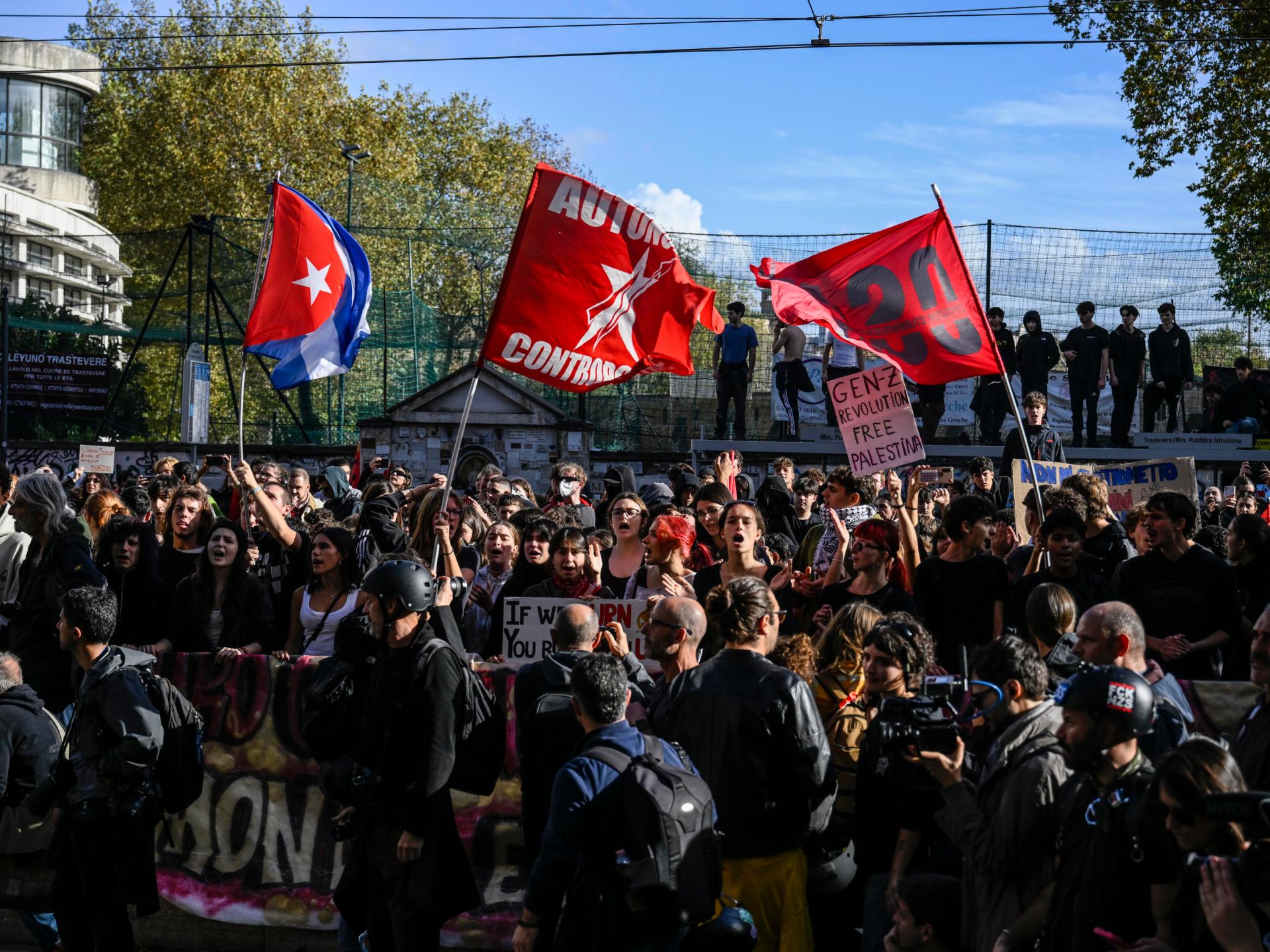

Protesters have rallied across 25 European countries amid a wave of public discontent over issues ranging from high living costs to military spending and the climate crisis, ramping up pressure on political leaders they accuse of ignoring the concerns of young people.
Inspired by demonstrations that have shaken France in recent months, thousands took to the streets in countries including the United Kingdom, Austria, Germany, Spain, Italy, Sweden and Croatia on Friday.
- list 1 of 3More than 1,800 Italian schools targeted by new hoax bomb alerts
- list 2 of 3Piecemeal wars: A new kind of world war is already under way
- list 3 of 3Italy fines Meta $880m over photo privacy
end of list
Tens of thousands of workers and students protested in more than 100 Italian cities to demand higher wages and greater investment in public services.
The rallies coincided with a general strike by Italy’s largest trade union, CGIL, that involved workers in both the private and public sectors, including schools and healthcare.
“Across Europe and among ordinary people, the demand for change is growing,” CGIL leader Maurizio Landini said at a rally in Rome.
Demonstrators in Rome threw objects at the Ministry of Education, while in Bologna some protesters clashed with police, news agency ANSA reported. In Milan, demonstrators set fire to a cardboard tanker as well as cardboard figures depicting Israeli Prime Minister Benjamin Netanyahu and United States President Donald Trump.
The Italian rallies followed a nationwide mobilisation on October 17 that descended into rioting and looting and prompted the right-wing government of Prime Minister Giorgia Meloni to approve sweeping security measures and deploy the army alongside police in subsequent demonstrations.
Advertisement
Student groups have since continued protests and occupations at schools and universities, with opposition to higher military spending also emerging as a rallying cry.
Opposition leaders joining demonstrations on Friday criticised Meloni’s government and its budget policies amid rising living costs. Elly Schlein, leader of the centre-left Democratic Party, said the 2027 Budget Law “does not have a vision for the future of the country” as it does not help industries but slashes funding for public healthcare and education.

Meanwhile, in Germany, campaign group “Gen Z regelt” (German for “Gen Z sorts it”) said it was organising protests in 73 cities and towns.
In Berlin, roughly 4,000 people attended a protest in the city’s Alexanderplatz square.
The Cologne protest drew fewer than the 5,000 people expected, though demonstrators still numbered in the thousands, police said.
Protesters gathered to call for greater education funding and to oppose a possible return to compulsory military service.
In Austria, several hundred people gathered outside the University of Vienna for a youth-led protest calling for more spending on education and less on weapons. Police dispersed the event after reported disturbances, saying officers used pepper spray and made several arrests.
In Croatia, students boycotted classes and staged protests in about a dozen cities, demanding greater investment in education, housing and public services rather than military spending.
Demonstrations across Europe were inspired by much larger protests in France that began in September and descended into violent confrontations with the police and looting.
On Tuesday, France’s Interior Ministry said a total of 146,000 people took part in protests across the country, with 28,000 in Paris alone. The CGT trade union put the nationwide total at just over 500,000 demonstrators.
The prices paid for everyday items such as food, energy, transport and bills have risen by between 59 and 78 percent since 2000 in France, Italy, Spain and Portugal, according to Eurostat – the European Union’s statistics agency.
Once inflation is taken into account, the average full-time wage in Italy fell by almost 5 percent between 2000 and 2025. Over the same period, real wages rose by 7 percent in Spain, 11 percent in France and 20 percent in Portugal, according to OECD wage data adjusted with Eurostat’s price index.
Advertisement
Related News
Qatar official calls for peace and security to boost trade, investment
Iran’s anti-negotiation hardliners turn against President Pezeshkian
US Senate passes bill to speed up energy project approvals