Nearly A Month After The MV Barima Sank, 30 Remain Lost At Sea As The Guyana Govt. Admits It’s Now Getting Its Full Exxon Profits
 14 August 2026


News Americas, GEORGETOWN, Guyana, Fri. Aug. 14, 2026: Nearly a month after the MV Barima capsized off the Essequibo coast of Guyana on July 18, more than 30 people remain lost at the bottom of the sea. Today marks the deadline for companies to submit proposals to salvage the vessel that carries the remains of passengers and crew.
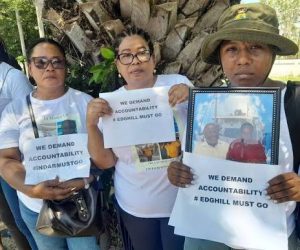
On August 12th, relatives of Neil and Kenrick Cort, two of the still-unrecovered victims, gathered in protest outside the Office of the President, demanding immediate government intervention and accountability. Their loved ones are among more than 30 Guyanese whose families have had no closure for nearly a month, while the government’s own Expression of Interest deadline for a salvage contractor closes today.
The wreck has reportedly settled roughly 10 nautical miles offshore at a depth of 35 to 40 feet. Opposition Leader Azruddin Mohamed has warned that at this pace, actual recovery likely won’t happen until September.

Internal records reviewed by News Source Guyana paint an even more troubling picture. A series of handwritten reports compiled by the Chief Engineer of the Marine Division, spanning five months from November 17, 2025 to March 9, 2026, document a long list of mechanical and electrical defects on the 87-year-old vessel that were repeatedly brought to authorities’ attention well before the July 18 tragedy.
The defects ranged from an out-of-service generator and a defective heat exchanger to deteriorated batteries and burnt wiring. In the earliest report, dated November 17, 2025, engineers requested repairs to a critical switch on the generator that had stopped working. Less than two weeks later, on November 30, four additional reports followed, including one describing a complete loss of power aboard the vessel while docked in Port Kaituma on November 28, after which engine room staff discovered burnt wires connected to the vessel’s change-over switch and electrical panel.
That same November 30 batch included a separate report noting the vessel’s number one generator was entirely out of service, due to a defective water pump and fan sent for repair, defects flagged as “critical” and requiring “urgent” attention. Another report that day requested replacement of a defective heat exchanger, part of the engine’s cooling system, which was “working at a high temperature” at the time, with engineers pleading, “Please treat this development urgently.” A fourth report from the same date flagged a leaking exhaust on the main engine. The warnings continued into the new year: a February 18, 2026 report requested replacement battery lugs, and as recently as March 9, just over four months before the sinking, engineers were still submitting requests to address multiple defects, including a broken pipe in the vessel’s hatch.
The government has maintained since the tragedy that the aging vessel was “seaworthy.” But when Captain Kevin Price appeared in court late last month, he said the boat had been saddled with issues. Price, along with a fellow crew member and the loading superintendent from the Transport and Harbours Department, faces 72 counts of murder in connection with the sinking.
President Irfaan Ali has since launched a Commission of Inquiry mandated to conduct a thorough, independent and comprehensive public investigation into the circumstances surrounding the July 18 capsizing. Nearly a month later, that Commission has still not begun its work.
The delayed accountability isn’t limited to the ferry. On August 12th, a government representative confirmed, after 10 full days of silence, that Guyana is now receiving its complete 50% profit share from ExxonMobil’s Stabroek Block operations, following the company’s own July 31st disclosure to shareholders that its $55 billion investment had been fully recovered.
The government said nothing publicly for over a week. It took a reporter directly asking Michael Munroe, Head of the Local Content Secretariat, at the launch of the 2027 Guyana Energy Conference, to get any confirmation at all. Natural Resources Minister Vickram Bharrat has still not issued the formal statement he promised, with no timeline given.
Under the 2016 Production Sharing Agreement, Exxon was entitled to recover up to 75% of monthly oil production toward its costs, splitting the remaining 25% evenly with Guyana, meaning the country received just 12.5% of total profits for years. With costs now fully recovered, Guyana is entitled to a full 50% split. Opposition figures, including APNU MP Saiku Andrews, have pushed further, arguing Guyana should receive even more than 50% given the scale of historical costs already repaid, and have called for the government to block any new Exxon project approvals until a “ring-fencing” provision is in place, one that would prevent the company from using current profits to fund future developments and effectively resetting the clock on Guyana’s full profit share.
A ferry disaster where the Guyana government stayed quiet about manifest discrepancies until they became impossible to hide; a $12.7 million replacement vessel that sat unused for three years.; millions in disputed Exxon audit money still unresolved and now, ten days of silence on an oil profit milestone worth billions, disclosed to American shareholders before it was disclosed to the Guyanese public.
Whether it’s bodies still missing at sea or profits already earned, the pattern holding steady across this past month is the same: the news reaches the public only after someone forces the Guyana government to say it out loud.
NewsAmericasNow will continue tracking both the MV Barima salvage process and Guyana’s Exxon profit-sharing disclosures.
Related News
CARICOM And The EU Face The Same Global Paradigm Shift
Message To The USA – DO NOT COMPETE FOR THE CARIBBEAN. BUILD WITH IT.
Two Jamaicans Deported To Eswatini Say They Do Not Wish To Return Home, Ministry Says