India’s Bengal pushes out Muslim Bangladeshis, deepening religious tensions
 10 June 2026
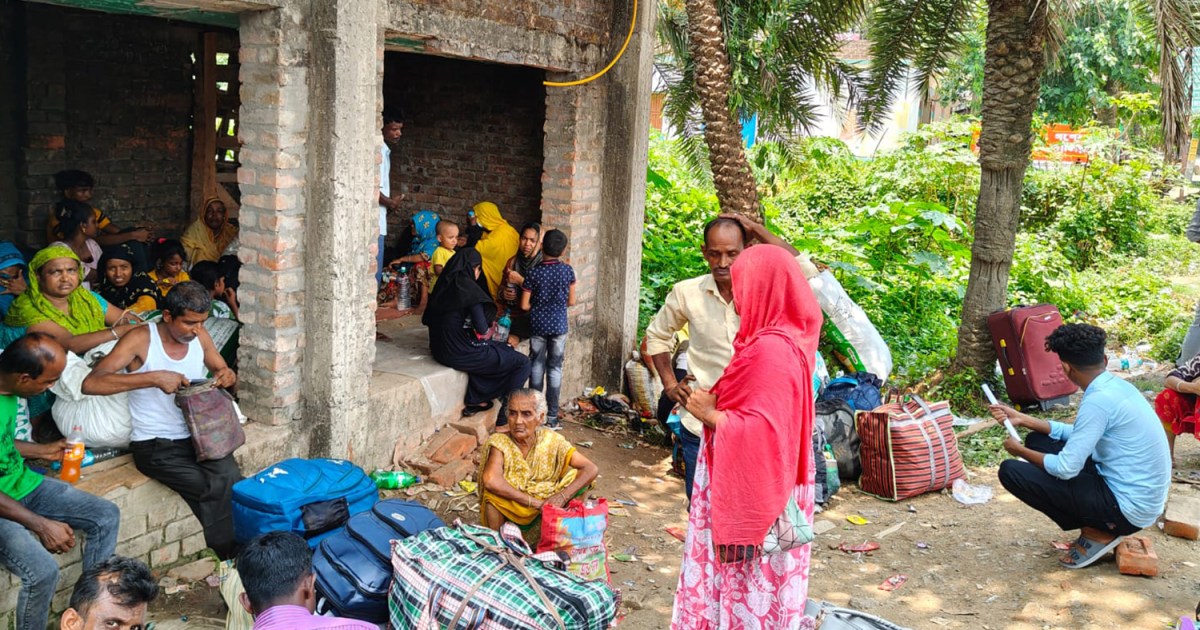

Hakimpur, India – Raisul Islam stands under the scorching sun near a checkpoint in Hakimpur village along the border with neighbouring Bangladesh in the North 24 Parganas district of India’s West Bengal state.
His wife, Rebeka Khatun, 36, and their two sons, Riad, 14, and Jubair, 16, are sitting nearby at an unfinished building erected with raw bricks and cement, as the brutal heat and humidity, coupled with an absence of potable water, turn the cramped waiting room into a furnace.
- list 1 of 4What Modi’s big win in Indian state elections could mean for its democracy
- list 2 of 4Why is India turning to crocodiles and snakes to ‘fence’ Bangladesh border?
- list 3 of 4‘Foreigners for both nations’: India pushing Muslims ‘back’ to Bangladesh
- list 4 of 4Modi is using a cannon to kill a cockroach
end of list
The people crammed into the building are Muslim migrants from Bangladesh, who have been branded “illegal infiltrators” and brought to the border village as part of a “detect, delete and deport” policy launched by the state government headed by Prime Minister Narendra Modi’s Hindu majoritarian Bharatiya Janata Party (BJP), which stormed to power in West Bengal for the first time only a month ago.

India shares a 4,096km (2,545-mile) land border, the world’s fifth-longest, with Bangladesh, a Muslim-majority nation with historical and cultural ties to India, including a common language spoken by millions of Muslims and Hindus on both sides of the border, and a century-long history of migration of mainly impoverished workers between what is now Bangladesh and West Bengal, Assam and other Indian states.
But after its sweeping victory in West Bengal, home to nearly 100 million people, the state’s BJP government ordered a crackdown to trace undocumented Muslim migrants, while it also announced the construction of “holding centres” to detain and eventually deport them back to Bangladesh.
Advertisement
That drive has sparked fears not just among Bangladeshi migrants, but also among sections of Indian Muslims in West Bengal that they too could find themselves victims of a campaign that the government has made clear is driven as much by the religious identity of its targets as by their legal status.
In the summer of 2025, Indian security agencies in the neighbouring state of Assam — also ruled by Modi’s BJP — forcible sent dozens of Indian Muslims across the border into Bangladesh, accusing them of being undocumented immigrants. Bangladesh sent them back, leaving them temporarily stranded in no-man’s land. They were eventually admitted back into India — but never received any explanation, leave along justice, for the ordeal they were put through.
Now, a year later, fears are growing that the same could happen in West Bengal.
Like many at the Hakimpur border checkpost, 38-year-old Islam, who hails from Satkhira district in Khulna division of Bangladesh, had come to India in search of a better livelihood.
“We had come here two years ago for the treatment of my wife, who is suffering from a skin disease, but decided to settle down after finding better wages here as compared to Bangladesh,” he told Al Jazeera.
Islam said he paid nearly $250 – a substantial amount for him – to a tout who arranged the border crossing for him and his family. They arrived in state capital Kolkata, where they rented a room on the city’s outskirts. The couple worked as masons, earning about $10 a day between them.

But their lives changed late last month after West Bengal state’s newly elected Chief Minister Suvendu Adhikari ordered the deportation of undocumented Bangladeshi migrants, an exercise his party, the BJP, has already conducted in several states in the past decade.
Adhikari’s threat came with a caveat, though: The eviction would only target Muslim Bangladeshis, with Hindus and migrants from other faiths exempt under a controversial constitutional amendment that imposed a religious test on asylum seekers for the first time.
The Bengal chief minister also made clear that authorities would not bother to take those detained to court before deporting them. In December 2025, India’s Supreme Court had declared that foreign nationals have almost no rights under the Indian constitution. In effect, under the West Bengal government’s approach, the onus is on those about to be deported to prove why they should not be sent to Bangladesh.
Advertisement
As a result, thousands of people have been rounded up across West Bengal in the past two weeks and either sent to detention centres or driven to the border by security forces to be “pushed back” into Bangladesh.
Islam said he did not wait for the authorities to find him and his family.
“We decided to surrender voluntarily, fearing harassment by the locals and the police for being an immigrant settled illegally here,” he told Al Jazeera.
Several other migrants gathered at the Hakimpur border post narrated similar stories of economic hardships in Bangladesh that forced them to hire touts and cross the border – many without legal documents.
Mirazul Ghazi, 42, told Al Jazeera he entered India, along with his wife Sabina Yasmin, 36, and their son Nayem, 18, five years ago in search of better opportunities. The couple worked as construction workers in Kolkata and earned about $12 a day, until the government crackdown forced them to return home.
“We didn’t face any issue during the past five years till the new government came to power and the landlord asked us to vacate the premises. We decided to return, fearing attacks on us by the locals,” Ghazi told Al Jazeera.

Situated about 80km (50 miles) from Kolkata, Hakimpur and other border checkpoints across West Bengal have been witnessing a regular stream of Bangladeshi migrants since the end of May.
A police officer posted in Hakimpur told Al Jazeera on condition of anonymity because he was not authorised to speak to the media that about 250-300 undocumented refugees and migrants have been arriving daily at the checkpoint, where authorities, besides verifying their citizenship, are also recording their biometric details to create a digital record of the number of migrants.
Speaking to reporters in Kolkata on Sunday, West Bengal’s Chief Minister Adhikari said nearly 5,000 Bangladeshi citizens had been deported, adding that his government has also “established holding [detention] centres in all districts of the state”.
“From these centres, 4,800 Bangladeshi infiltrators have already been deported so far,” he said. “Another 836 people are currently in the holding centres … we are making arrangements to deport the 836 soon.”
Diplomacy strained with Dhaka
Historically robust relations between New Delhi and Dhaka suffered a setback in 2024 when a youth-led revolution in Bangladesh ended the long and autocratic rule of the then-Prime Minister Sheikh Hasina, who was a close ally of India.
The violent uprising forced Hasina to take exile in the Indian capital, while repeated requests by Dhaka to extradite the leader convicted of crimes against humanity have been ignored by New Delhi, adding to the tensions. Earlier this year, a new government led by an anti-Hasina coalition was formed in Bangladesh, which is trying to mend the strained ties.
But the West Bengal crackdown has caused new diplomatic tensions between the neighbours, with Dhaka calling for an adherence to established procedures to verify the nationality of undocumented migrants.
On Monday, Bangladesh’s Foreign Affairs Adviser Shama Obaid told a news conference in Dhaka that they have sent “12 to 13 letters to New Delhi” over the issue.
Advertisement
“There is a mechanism” that Indian authorities should follow, she said, as she warned that the crackdown on Bangladeshi migrants could affect relations between the two countries.
The Border Guard Bangladesh (BGB) also said it thwarted at least 18 attempts by India’s Border Security Force (BSF) to push about 180 migrants across the border into Bangladesh since June 4. On Monday, the two forces began their three-day talks over the West Bengal deportations.
Responding to an earlier criticism by Dhaka of India conducting “illegal push-ins” of Bangladeshi migrants, Indian foreign ministry spokesperson Randhir Jaiswal told reporters last week that a “bilateral mechanism” was already in place between the two countries.
“All foreign nationals in India, if they are here illegally, including from Bangladesh, we have laws to deal with them, and they will be accordingly dealt with,” Jaiswal said on Friday.
“And once we refer these cases to the Bangladeshi side, for them to verify the nationality of these people, and once it is verified, then we take forward the deportation process,” he added.
Jaiswal said New Delhi has sent “several or many of these requests,” which remain pending with the Bangladeshi side. According to media reports, India’s foreign ministry has shared details of more than 2,800 suspected Bangladeshis with Dhaka for nationality verification.

Rights groups, meanwhile, have termed India’s move as “completely unethical”.
Elaine Pearson, Asia director of Human Rights Watch, a global nonprofit, said she was “deeply concerned” about the current situation in West Bengal.
“Even the detainees without any valid documents should be given legal representation so that no Indian citizen is wrongfully expelled from the country,” she told Al Jazeera, calling the deportations “illegal”.
Deportations stoking religious tensions
The deportation of mainly Muslim Bangladeshi migrants is also stoking religious tensions in West Bengal, which erupted after the BJP’s rise to power in a state where 27 percent of its population is Muslim.
For decades, the BJP has campaigned against Bangladeshi migrants, with federal Home Minister Amit Shah, Modi’s closest aide, calling them “termites” during an election rally in Assam, another BJP-governed border state where millions of Bengali-origin Muslims reside, and have faced a similar crackdown.
Though India is home to tens of thousands of Buddhist refugees from Tibet, and Tamil refugees from Sri Lanka, the BJP has consistently singled out Muslim migrants – the Bangladeshis and the Rohingya – over their religion. In 2017, more than 700,000 mainly Muslim Rohingya fled a genocidal campaign by the Myanmar military, with an overwhelming majority of them taking refuge in southern Bangladesh’s Cox’s Bazar district, and a small number of them finding refuge in several Indian cities, including New Delhi.
The BJP’s targeting of Bangladeshi and Rohingya migrants ties in with the party’s larger policy of marginalising and persecuting India’s 200 million Muslims in order to turn a constitutionally secular country into an ethnic Hindu state.
Rights activist Teesta Setalvad said the Indian authorities are “acting only on a preconceived agenda and rhetoric” against a particular community, accusing the government of not following its own guidelines while acting against undocumented migrants.
“Sadly, cops are picking up people randomly and putting them in detention centres and trying to push them back as if they are a commodity. We fear that individuals would be detained illegally in the holding centres,” she told Al Jazeera, demanding the government immediately release data on the undocumented migrants housed in various detention centres in West Bengal as well as on those “pushed out” to Bangladesh.
Advertisement
Meanwhile, in Hakimpur, as dusk falls and the sun begins to disappear behind the tall coconut trees, Islam turns tearful as he stands close to both his sons.
“We took shelter in India just to give a good life to our children. We had no ulterior motive. But the incessant hounding and humiliation by a section of people has forced us to return with bitter memories of a land that teaches non-violence and kindness for all,” he said.
Moments later, a group of security forces bundles the family inside a vehicle and takes them to a detention centre 18km (11 miles) away.
Related News
Thousands protest in Albania against coastal resort linked to Jared Kushner

UN human rights leader calls for Cuba sanctions to be ‘lifted immediately’
N Korea’s Kim Jong Un calls for ‘exponential’ expansion of nuclear arsenal