Fujimori vs Sanchez: What to know about Peru’s presidential run-off election
 05 June 2026

Nearly two months ago, on April 12, Peru held the first round of its presidential elections. But in the eight weeks since, confusion, protests and scandal have engulfed the results.
Now, on Sunday, Peruvians return to the polls to cast their ballots in the hotly contested run-off.
- list 1 of 3Peru presidential candidate charged with financial crimes
- list 2 of 3Peruvian authorities confirm Fujimori and Sanchez advance to runoff
- list 3 of 3Thousands in Peru protest Fujimori presidential run
end of list
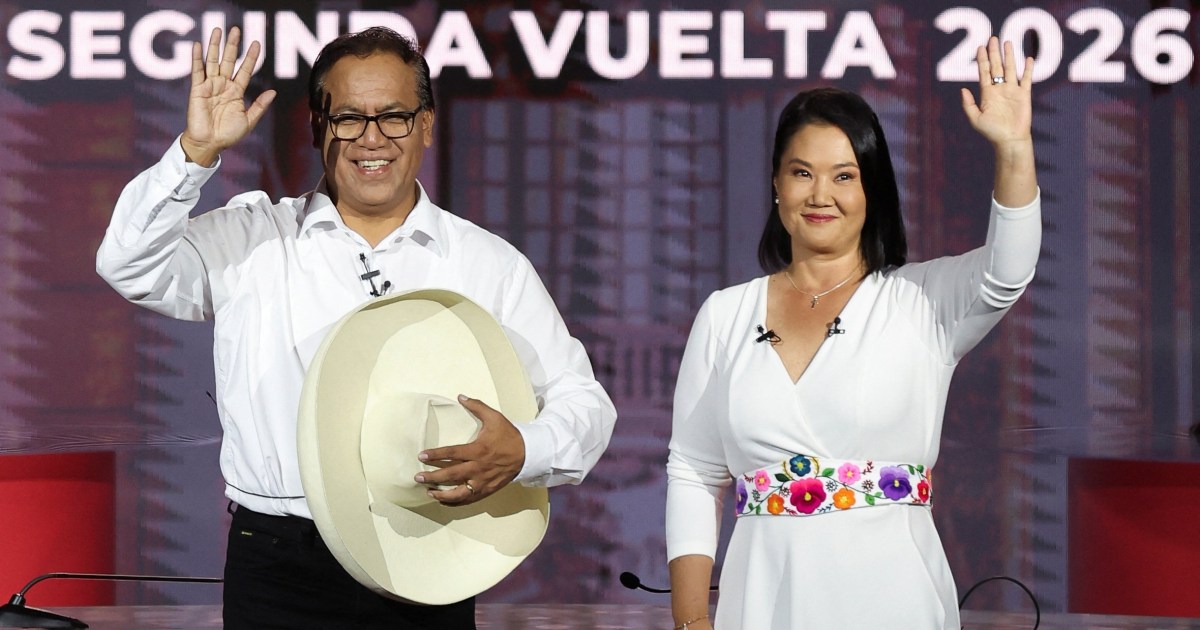
On one side is right-wing candidate Keiko Fujimori, a former first lady who served in the administration of her father, former President Alberto Fujimori.
Though her last name evokes a time of oppression for many Peruvians, she has been a finalist in the last four presidential races, campaigning on a platform to bring order to the country.
In the other corner is Congress member Roberto Sanchez, a former government minister who represents the left.
His path to the run-off has been tumultuous. Sanchez narrowly eked out a second-place finish in round one of the presidential election, prompting the third-place finisher to cry foul.
And since the results were announced, prosecutors have filed charges against Sanchez, accusing him of falsifying campaign finance disclosures, which he denies.
That’s just the latest chapter in an ongoing battle for Peru’s presidency. Over the past decade, nine different presidents have governed the country, many of them forced into resignation or toppled by impeachment.
What’s in store for round two of the 2026 presidential race? Let’s break it down.

When is the run-off happening?
The run-off takes place on Sunday, June 7.
Advertisement
All Peruvians are required to vote, even if they are abroad, or else face the possibility of a fine.
Peru’s government has announced that 2,506 polling stations will be available across 63 countries, from Cuba to the United States to Qatar. A total of 411,077 Peruvians voted from abroad in the first round, out of a total of more than 20 million votes cast.
What happened in the first round?
A record 35 candidates were in the running to be president during the first round of the election on April 12.
But as election day unfolded, problems emerged. Ballots were not delivered on time to multiple voting sites, and polling stations opened hours late. The result was long lines that impeded approximately 52,000 people from voting.
To rectify the situation, election authorities granted an extension for voting in the affected areas, including the capital Lima and overseas sites like Paterson, New Jersey.
Early election results showed Keiko Fujimori far enough in the lead to secure a spot in the run-off. Who would join her, however, was less clear.
Left-wing candidate Roberto Sanchez and far-right former mayor Rafael Lopez Aliaga were closely matched in the race for second place.
But the vote count dragged on longer than expected. Election officials pointed to the need to review nearly 15,000 contested ballots. The final results were ultimately released more than a month later, in mid-May.
Lopez Aliaga, who fell to third place in the completed tally, repeatedly denounced the outcome as fraudulent, though election monitors found no evidence of malfeasance.
Frustration with the monthlong vote count also prompted the head of the National Office of Electoral Processes (ONPE) to resign his post, though he denied any wrongdoing.

What was the result of the first round?
The first round concluded with Keiko Fujimori far in the lead, with 17 percent of the vote. That amounts to 2,877,678 ballots cast.
Next in line was Roberto Sanchez, who netted 12 percent of the vote, or 2,015,114 ballots.
Closely behind, in third place, came Rafael Lopez Aliaga. He earned 11.9 percent of the vote, or 1,993,905 ballots.
But only the top two contenders proceed to the final round of the election. Roughly 21,200 votes separated Sanchez from Lopez Aliaga.
What can the initial vote count tell us?
Fujimori has long been a favourite in the presidential race. But the first round results reveal a wild card: a large number of disaffected voters.
Advertisement
The absentee rate, for instance, was relatively high. Of the more than 27 million eligible voters, 7.16 million did not cast a ballot.
That means that only 20 million Peruvians participated in the election. And of that group, a large proportion was not counted. More than 11.7 percent of voters cast a blank ballot, and another 5 percent cast a spoiled ballot, nullifying their vote.
The absentee and protest voters could have the power to shift the outcome of the second round, should they choose to do so.

Keiko Fujimori
One of the most recognisable figures in Peruvian politics, Fujimori began her career as a teenager.
Her father was former President Alberto Fujimori, a divisive right-wing leader accused of steering Peru towards authoritarianism in the 1990s. Keiko was only 19 years old when her father named her Peru’s first lady, amid a bitter divorce from his wife.
Keiko has largely defended her father’s government since his decade in power ended.
While some Peruvians perceive Alberto as a strong but steady hand, his detractors point to his administration’s history of human rights abuses, including the forced sterilisation of Indigenous people and extrajudicial killings carried out by “death squads”.
As president of the right-wing Popular Force party, Keiko has become a political power in her own right. For years, the party controlled Peru’s Congress, leading Keiko’s critics to accuse her of using the legislature to sabotage left-wing presidents.
Keiko has also been a leading candidate in four consecutive presidential elections, advancing to the final round of voting in 2011, 2016, 2021 and 2026.
This time around, she has campaigned under the slogan “Peru with order”, and she promises to “defeat terrorism” and “stabilise the economy”. Part of her strategy, if elected, is to implement a 60-day state of emergency to “combat citizen insecurity”.
But the final days of her campaign have seen thousands of protesters denounce her bid, marching to the slogan, “Keiko no va” or “Keiko won’t make it”.
Roberto Sanchez
The candidate for the centre-left political movement Together for Peru (JP), Sanchez was a psychologist before making the leap to politics. He has served in Congress as a representative for Lima since 2021.
During that time, he also took a post in the short-lived cabinet of former President Pedro Castillo.
Sanchez’s term as foreign trade and tourism minister, however, ended abruptly in 2022 when Castillo attempted to dissolve Congress — and instead was impeached and arrested.
But Sanchez has adopted Castillo’s trademark style on the campaign trail, most notably wearing a tall, wide-brimmed “Chota” hat, typical of Peru’s rural north.
The sartorial choice is meant to signal Sanchez’s allegiance with Peru’s marginalised groups, namely Indigenous, Andean and rural voters.
From the beginning of his campaign, Sanchez promised anti-poverty measures, police reform and a new constitution “built collectively, through dialogue and citizen participation”.
Advertisement
He has also called for reparations for the victims harmed under Alberto Fujimori’s government and a repeal of amnesty laws designed to shield military and law enforcement from accountability.
In the final days of his presidential bid, though, he overhauled his policy platform to moderate his economic message. The new platform backs away from its harsher criticisms of capitalism, instead embracing an “open-market economy, respectful of international free-trade agreements”.
The move has widely been seen as a final push to appeal to centrist voters, as the political right attempts to paint Sanchez as “radical”.

What do the polls say?
In Peru, the government bars polling agencies from releasing results in the days immediately leading up to an election.
The last poll issued by the research firm Ipsos, though, showed Keiko Fujimori in the lead.
Released on May 31, the poll shows Fujimori with 38 percent support. But Sanchez is close behind, with 35 percent.
Then, there are the undecided voters, who comprise another 15 percent. The rest plan to cast a null or blank vote.
What does this election mean for Latin America?
Should Fujimori win the election, she would continue a trend across Latin America of right-wing leaders winning the presidency.
They include Javier Milei in Argentina, Jose Antonio Kast in Chile, Daniel Noboa in Ecuador and Rodrigo Paz in Bolivia.
Fujimori has received notable support from the region’s right flank. On June 3, with only days to go until the final vote, 14 former presidents — among them, Ivan Duque of Colombia and Felipe Calderon of Mexico — issued a letter praising her “defence of the market economy” and “respect for individual liberties”.
But noticeably silent is US President Donald Trump, who has frequently issued statements endorsing right-wing candidates in Latin America.

What does this mean for Peru’s democracy?
Peru has experienced a profound degree of political tumult, with nine presidents exiting power over the span of a decade.
The turnover has exacerbated distrust in the government.
An Ipsos poll released in May found that 62 percent of voters identified corruption as the top election issue, second only to crime, which ranked at 63 percent.
The winner of Sunday’s vote will be tasked with restoring stability to the presidential palace, though whether that can be accomplished remains uncertain. Many of the recently impeached presidents have faced congressional charges of “moral incapacity”, a vague term in Peru’s constitution frequently invoked to oust leaders.
The next president will be sworn in for a five-year term on July 28, Peru’s independence day.
Related News
Gas explosion at Chinese coal mine kills at least 90
Israel claims head of Hamas military wing killed in Gaza strike
The kingmakers of Makerfield: English town braces for crucial by-election