Trump’s threat: Why cutting US troops in Europe won’t be easy
 01 May 2026

Donald Trump has, over the past 48 hours, said that he is considering withdrawing American troops stationed in Germany, Italy and Spain, amid mounting tensions with European nations over their criticism of his handling of the war with Iran.
Earlier in the week, German Chancellor Friedrich Merz said that the US was being “humiliated” by Iran in the ongoing war, adding the Trump administration had “no truly convincing strategy” to bring the conflict to an end.
Speaking to students in the German town of Marsberg on Monday, Merz said: “It is costing us a great deal of money. This conflict, this war against Iran, has a direct impact on our economic output”.
On Tuesday, Trump posted on his Truth Social platform that Merz “thinks it’s OK for Iran to have a Nuclear Weapon. He doesn’t know what he’s talking about!”
The next day, Trump followed up with another Truth Social post: “The United States is studying and reviewing the possible reduction of Troops in Germany, with a determination to be made over the next short period of time”.
When Trump was asked on Thursday if he would also consider pulling US troops out of Italy and Spain, two countries similarly critical of the Iran war, he said: “Probably … Look, why shouldn’t I? Italy has not been of any help to us and Spain has been horrible, absolutely horrible”.
Reuters reported on April 10, citing an unnamed senior White House official, that Trump had discussed with his advisers whether to remove some US troops from Europe.
Germany, Italy and Spain collectively host nearly 53,000 US troops.
Advertisement
How many troops does the US have in Europe?
As of December 2025, the US had around 68,064 active-duty military personnel in Europe, according to data from the Pentagon’s Defense Manpower Data Center (DMDC).
Where are these US troops in Europe?
Forces are spread across 31 permanent bases and 19 military sites across Europe.
US European Command (USEUCOM) directs US military operations in Europe, in coordination with NATO allies, comprising six service component commands: the Army, Navy, Air Force, Marine Corps, Special Operations Forces and the newer Space Force.
Germany
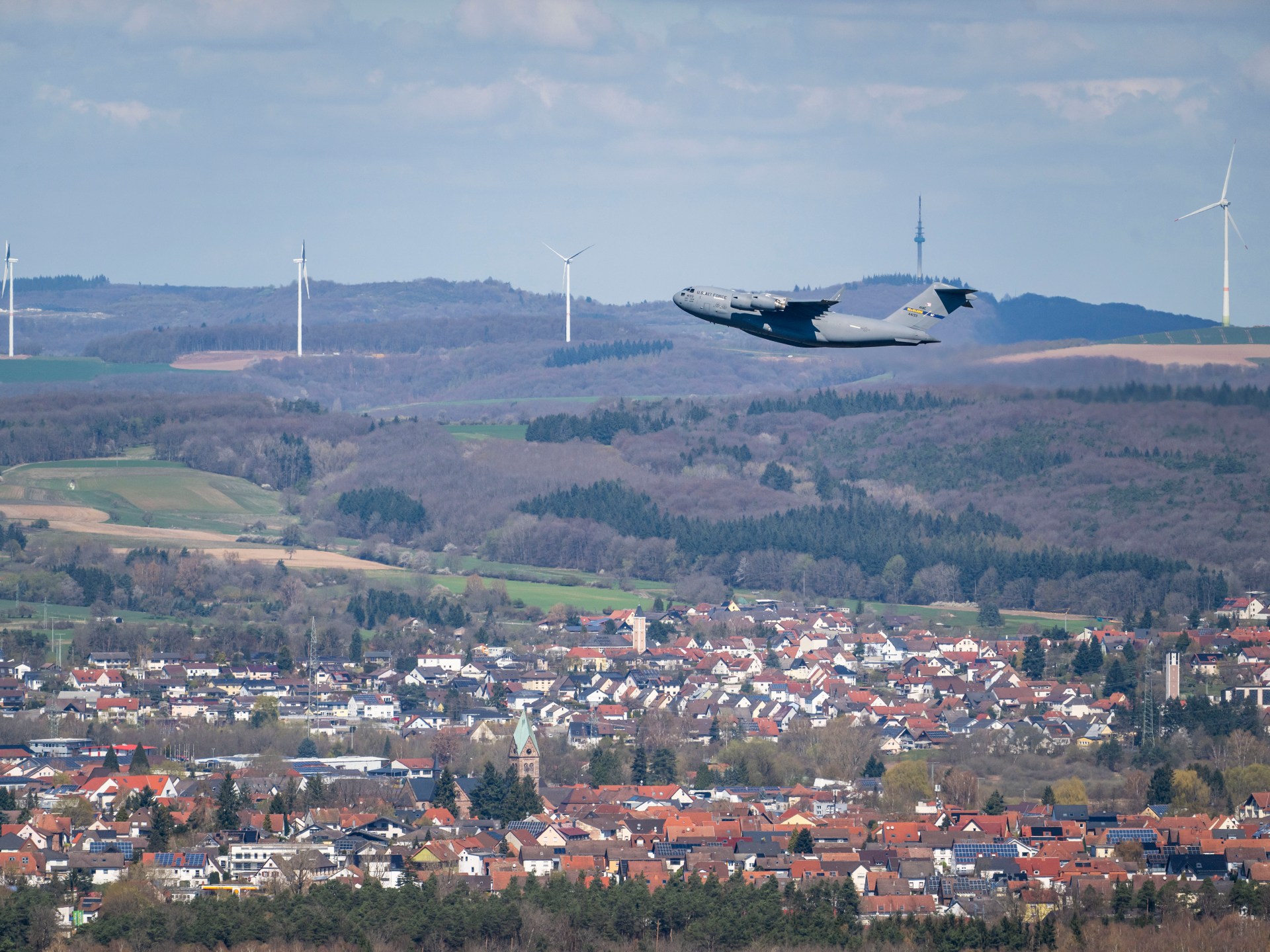
The largest US base in Europe is Ramstein Air Base in Germany, where forces have been stationed since 1952. According to DMDC data, as of December 2025, 36,436 active service members were stationed in Germany in five garrisons.
United Kingdom
The US forces in the United Kingdom comprised 10,156 service members as of last December, garrisoned in three bases, hosting mainly Air Force personnel.
Italy
US military personnel have been stationed in Italy since the end of World War II and comprise Army, Navy and Air Force divisions. DMDC data shows that Italy hosted 12,662 active-duty soldiers at the end of 2025 at bases in Vicenza, Aviano, Naples and Sicily.
Spain
The country hosts US Navy and Air Force bases near the Strait of Gibraltar. DMDC data shows that as of December 2025, 3,814 personnel were permanently assigned to Spain.
Poland
Poland hosts 369 permanently assigned active-duty service members, as well as about 10,000 personnel of rotational forces funded through the European Deterrence Initiative – a US programme to bolster NATO’s Russia-facing eastern flank – data from the DMDC and Congressional Research Service shows. The personnel are garrisoned in four bases.
Romania
Similar to Poland and other ex-communist bloc countries, Romania hosts a rotational presence of US forces on top of 153 permanently assigned service members, according to the DMDC and the Congress Research Service. The bases to which the US has access include Mihail Kogalniceanu Air Base, Camp Turzii and Deveselu.
Hungary
The US conducts rotational deployments and exercise missions in Hungary. DMDC said in December that the Hungarians hosted 77 permanently assigned service members stationed in two bases, Kecskemet and Papa Air.
Who decides how many troops the US has in Europe?
The president and the Department of Defence typically decide how many troops the US has based in European countries.
However, Congress has a role to play and can block or complicate major withdrawals by law and by controlling funding.
Advertisement
In 2020, during his first term, Trump threatened to pull about 12,000 US troops out of Germany after lashing out at Berlin over its low defence spending and backing for the Nord Stream 2 gas pipeline. However, Congress pushed back and former US President Joe Biden overturned the decision.
Additionally, the 2026 National Defense Authorization Act (NDAA), passed by the Senate last year, includes a provision that bars US troop levels in Europe from being permanently reduced below 75,000.
Why is Trump threatening to remove US troops from Europe?
Trump’s latest threats come against the backdrop of recent tensions over the Iran war.
The US–Israeli war on Iran began on 28 February and remains unresolved. The Strait of Hormuz has been effectively choked by competing Iranian restrictions and a US blockade, severely disrupting shipping and battering the global economy.
Trump has lashed out at leaders in Europe for not supporting the US in the war.
Trump continues to publicly criticise British Prime Minister Keir Starmer over his stance on the war on Iran, accusing him of not assisting Washington in the fight and for failing to help the US reopen the Strait of Hormuz.
Days after the war began – and after Starmer initially refused to allow US forces to use UK military bases for strikes on Iran – Trump described the British leader as “not Winston Churchill”.
Trump also blasted Italian Prime Minister Giorgia Meloni – once his favourite European leader – after she criticised the Iran war.
Last year, US tariffs, Trump’s push to acquire Greenland and a cut in US aid to Ukraine also deeply unsettled transatlantic relations.
Who do these bases serve?
The US military presence in Europe dates back to the Second World War.
By the time the Cold War had started, the military presence had reduced, and the US mission shifted to strengthen European defence against the Soviet Union.
However, the bases haven’t only served to safeguard Europe’s security: They have also been critical for US military and foreign policy goals beyond Europe.
The bases are major logistical hubs for the US. They have allowed the US to launch its wars in the Middle East, including in Iraq, Afghanistan and now Iran.
To support the bases, host countries typically provide rent‑free land, as well as local staff whose salaries are paid by the host government. In this way, host nations shoulder a share of the overall costs of stationing US forces on their soil.
The Landstuhl Regional Medical Center (LRMC), minutes from the Ramstein base in Germany, is the largest American hospital outside the US. It serves as the primary evacuation and treatment centre for US forces in Europe, the Middle East and Africa.
Related News
Why is piracy rising off Somalia again — and is the Iran war responsible?
South Africa president suspends police chief over $21m contract
Italy extradites alleged Chinese cyber-espionage suspect to US