‘Not an easy process’: How is Ukraine, and Zelenskyy, tackling corruption?
 27 January 2026
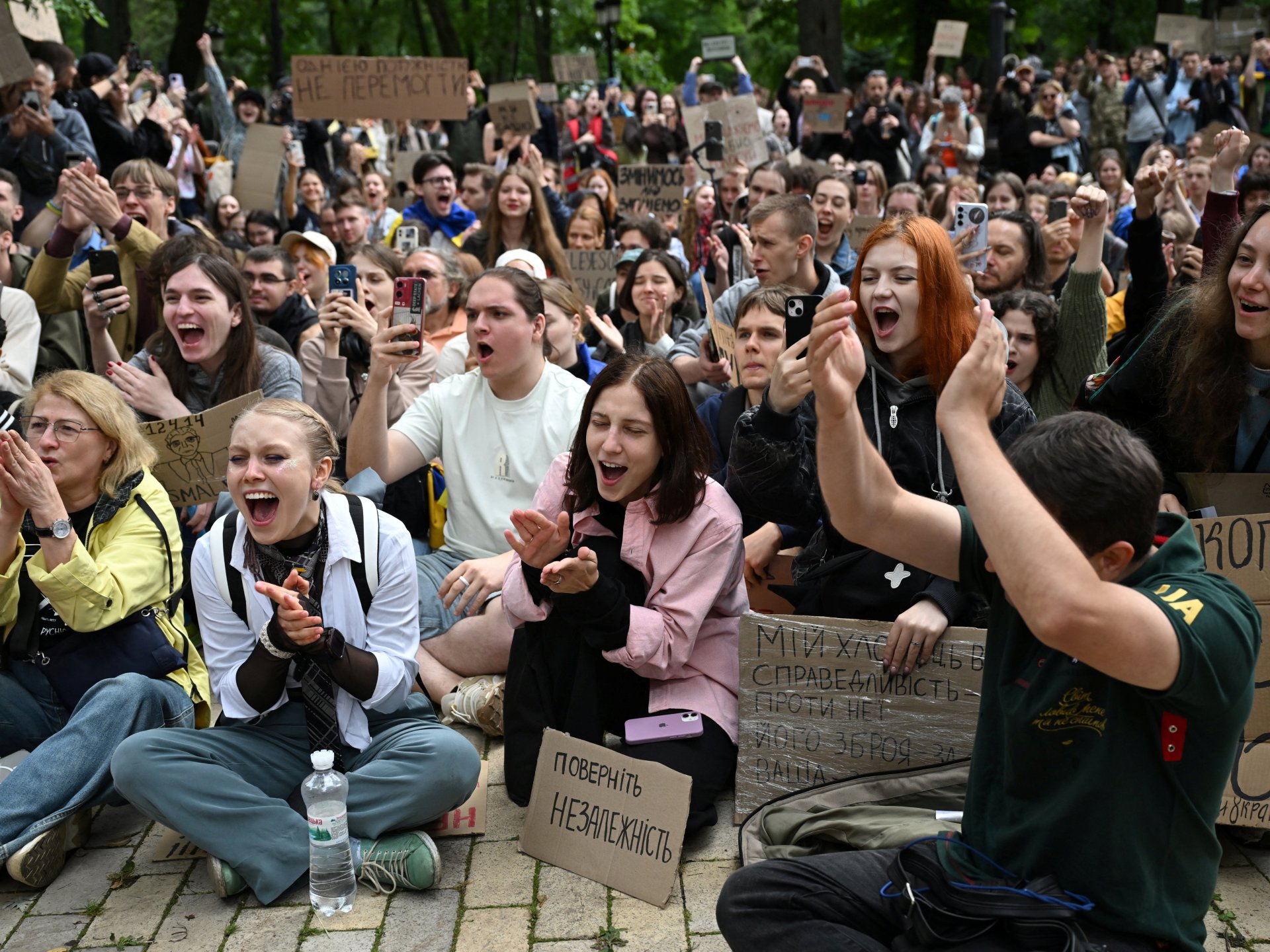

Kyiv, Ukraine – In late 2025, Ukraine was shaken by a major corruption scandal centred on the state energy sector, raising uncomfortable questions for President Volodymyr Zelenskyy as the country fights Russia’s invasion.
The investigation – often referred to as Operation Midas and led by Ukraine’s anticorruption agencies, the National Anti-Corruption Bureau (NABU) and the Specialised Anti-Corruption Prosecutor’s Office (SAPO) – focused on allegations that senior figures and business associates linked to the president were involved in a scheme to siphon off tens of millions of dollars through inflated contracts and kickbacks tied to Energoatom, the state company that oversees Ukraine’s nuclear power plants.
- list 1 of 4Tymoshenko vs Zelenskyy: Political clash over graft rocks wartime Ukraine
- list 2 of 4‘Psychological war on society’: Russia plunges Ukraine into darkness
- list 3 of 4‘Not optimistic’: In Ukraine, scepticism surrounds peace talks
- list 4 of 4Ukraine’s security guarantees: What are they and why might they fall short?
end of list
The case quickly moved beyond the energy sector, prompting searches and arrests involving senior figures and fuelling scrutiny of Zelenskyy’s inner circle, including longtime chief of staff Andriy Yermak, who resigned.
The probe dealt a political blow to the president’s administration and undermined his longstanding image as a reformer committed to tackling graft.
Beyond the domestic fallout, the case rattled Ukraine’s Western backers, many of whom have linked continued financial and military support to progress on anticorruption reforms.
Al Jazeera spoke to Tetiana Shevchuka, a lawyer with the Anti-Corruption Action Centre in Kyiv, about what has happened since.
Al Jazeera: Where does the corruption investigation stand now?
Tetiana Shevchuka: These investigations are now in their working phase. NABU does not report anything to the public because it says it needs time to work on charges against top-level people allegedly involved in the corruption scheme.
Advertisement
From the investigation’s perspective, this is the correct method because they don’t want to be accused of politicising this. They want to get this evidence, and this is not a very easy process.
Al Jazeera: Have you seen any concrete legal or institutional developments?
Shevchuka: Unfortunately not a lot.
There were primary charges made against the people allegedly involved in the scheme.
We know that Mindich, for instance, was charged in absentia because he’s not in the country. [Timur Mindich is the suspected mastermind of the Energoatom scheme.]
Most of the hearings were public, … so everything we know about this theme comes from these court hearings. Nothing else has happened.
So we anticipate in a few weeks there will be a renewal of this court hearing.
Al Jazeera: Who, if anyone, is now facing real legal jeopardy rather than just political consequences?
Shevchuka: We think the former minister of justice, German Galushchenko, could still be charged as he appears on recordings and there are indications he is part of this.
We expect he will be charged in the next few months or that the courts will find nothing against him.
We understand that it usually takes time to obtain all the testimonies and bank records.
For instance, just to compare, Rostyslav Shurma, former deputy chief of staff in the Presidential Office, was charged with involvement in a corruption scheme in the energy sector.
This process began in 2022, and we knew he had been dismissed from his position because of rumours of his involvement in 2024. Only now has he been charged because investigators gathered enough evidence. So we understand it takes a long time to get formal charges against people of such power.
Al Jazeera: So this could take years?
Shevchuka: At least months.
On the other hand, there is significant pressure on the NABU to complete its work more quickly due to public interest.
There is this investigative logic, of course, because it wants to gather as much as possible, yeah, but there is a lot of pressure not just from politicians but from the general public.
Al Jazeera: How independent are the NABU and SAPO in practice today?
Shevchuka: They really show they don’t have any party allegiance and are independent. I think, at least at the moment, that is for sure.
Al Jazeera: Has President Zelenskyy demonstrated political will beyond personnel changes?
Shevchuka: I think he wanted to show that he’s doing everything he can from his side.
He has also tried to distance himself from the scandal, saying he is independent and not involved.
He wants to show that he lets the agencies do their work.
This is his message. Otherwise, he’s busy with everything related to [US President Donald] Trump, the war and negotiations.
Al Jazeera: Does the removal of senior figures risk that it becomes a politically closed chapter even if the cases remain unresolved?
Shevchuka: I think the bigger question is for Ukrainians. OK, we just stopped one scheme involving an energy company, but if you change the people [from those implicated in the corruption scandal], and new people come, will those schemes just return?
Advertisement
Al Jazeera: What message do you feel that the current situation sends to Western partners and donors?
Shevchuka: First of all, despite the war, corruption-related schemes remain in Ukraine. Unfortunately, even in the event of a war, the country can’t stop bad actors from benefitting from it.
But it also shows that systematic changes are happening in Ukraine at the same time, that change is possible. There are people and groups who are acting in good faith and capable of prosecuting and preventing corruption.
There is a huge push from people across Ukraine that actually generates the political will to do something and create change.
Criminal justice is a slow process.
Al Jazeera: The energy sector is being targeted by Russia and people are suffering from a lack of heating. Does the corruption scandal, therefore, anger Ukrainians further?
Shevchuka: We are mad at Russia because we don’t have heating or electricity right now, but people are also asking questions about what the people in charge of our energy sector were busy with. It looks like they are not doing what they were mandated to do.
They didn’t act or consider the public benefit because they were busy stealing money.
So it’s beyond the term of political responsibility, which would mean firing someone from their position of power. Now people demand justice.
Al Jazeera: Where does the money seized in these anticorruption cases eventually end up?
Shevchuka: It goes to the state budget, but it also goes directly to the military.
In recent years, the state developed a scheme that collected money through plea bargaining, where the convict pays a certain amount to the state budget, showing goodwill by paying Ukrainian charity funds working directly with the military.
In recent years, a few hundred million dollars have been sent to the Ukrainian armed forces this way.
Note: This interview was edited for clarity and brevity.
Related News
RSF drone attack kills 27 in southeast Sudan: Report
‘You’ll find out’: Trump speaks on Greenland’s fate and the future of NATO

US seizes sixth tanker as Venezuela’s interim leader vows oil sector reform