US military moves Navy, Air Force assets to the Middle East: What to know
 25 January 2026
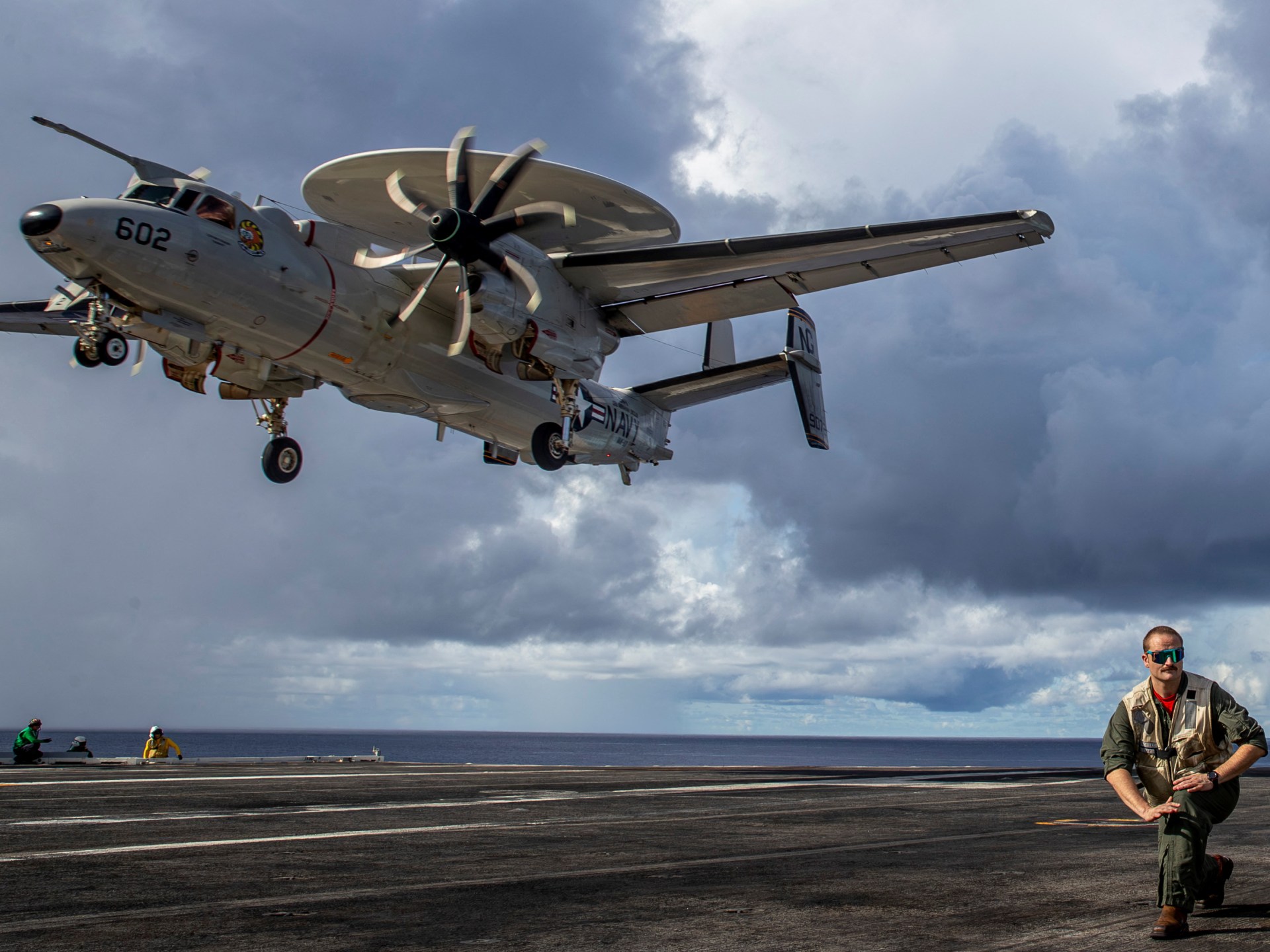

A United States aircraft carrier strike group is heading towards the Gulf as tensions build with Iran.
The US military last staged a major build-up in the Middle East in June – days before striking three Iranian nuclear sites during Israel’s 12-day war with Tehran.
- list 1 of 4Why Qatar is betting on diplomacy with Iran
- list 2 of 4Turkiye’s FM Fidan says Israel ‘looking for opportunity’ to attack Iran
- list 3 of 4‘Change is inevitable’: What is next for Iran?
- list 4 of 4Iran rejects UN rights resolution condemning protest killings
end of list
This month, US President Donald Trump backed antigovernment protesters in Iran. “Help is on its way,” he told them as the government cracked down. But last week, he dialled down the military rhetoric. The protests have since been quashed.
So what are the US military assets moving to the Gulf? And is the US preparing to strike Iran again?

Why is the US moving warships?
Trump said on Thursday that a US “armada” is heading towards the Gulf region with Iran being its focus.
US officials said an aircraft carrier strike group and other assets are to arrive in the Middle East in the coming days.
“We’re watching Iran. We have a big force going towards Iran,” Trump said.
“And maybe we won’t have to use it. … We have a lot of ships going that direction. Just in case, we have a big flotilla going in that direction, and we’ll see what happens,” he added.
The aircraft carrier Abraham Lincoln changed its path from the South China Sea more than a week ago towards the Middle East. Its carrier strike group includes Arleigh Burke-class destroyers equipped with Tomahawk cruise missiles capable of striking targets deep inside Iran.
The US military vessels en route to the Middle East are also equipped with the Aegis combat system, which provides air and missile defence against ballistic and cruise missiles and other aerial threats.
Advertisement
When Washington hit Iran’s nuclear sites, US forces reportedly launched 30 Tomahawk missiles from submarines and carried out strikes with B-2 bombers.
When asked on Thursday if he wanted Iranian Supreme Leader Ali Khamenei to step down, Trump replied: “I don’t want to get into that, but they know what we want. There is a lot of killing.”
He also reiterated claims that his threats to use force stopped authorities in Iran from executing more than 800 people who had taken part in the protests, a claim denied by Iranian officials.
An unnamed US official told the Reuters news agency that additional air defence systems were being considered for the Middle East, which could be critical to guard against an Iranian strike on US bases in the region.
Iranian state media said the protests killed 3,117 people, including 2,427 civilians and members of the security forces.

The US has operated military bases in the Middle East for decades and has 40,000 to 50,000 soldiers stationed there.
According to the Council on Foreign Relations, the US operates a broad network of military sites, both permanent and temporary, at at least 19 locations in the region.
Of these, eight are permanent bases, located in Bahrain, Egypt, Iraq, Jordan, Kuwait, Qatar, Saudi Arabia and the United Arab Emirates.
The first US deployment of soldiers in the Middle East was in July 1958 when combat troops were sent to Beirut. At its height, almost 15,000 Marines and Army soldiers were in Lebanon.
The US naval movement towards Iran was ordered despite a new National Defense Strategy being released on Friday. The document is drawn up every four years by the Department of Defense, and the latest security blueprint outlines a pullback of US forces in other parts of the world to prioritise security in the Western Hemisphere.

How has Iran responded?
Ali Abdollahi Aliabadi, who heads coordination between Iran’s army and its Islamic Revolutionary Guard Corps, warned on Thursday that any military strike on Iran would turn all US bases in the region into “legitimate targets”.
General Mohammad Pakpour, the commander of the Revolutionary Guard, said two days later that Iran is “more ready than ever, finger on the trigger”.
He warned Washington and Israel “to avoid any miscalculation”.
This month, Washington had withdrawn some personnel from its bases in the Middle East after Tehran threatened to hit them if Washington launched strikes on its territory.
Advertisement
In a piece in The Wall Street Journal newspaper on Tuesday, Foreign Minister Abbas Araghchi also said Tehran would be “firing back with everything we have” if attacked.
“An all-out confrontation will certainly be ferocious and drag on far, far longer than the fantasy timelines that Israel and its proxies are trying to peddle to the White House,” he said.

Has air traffic stopped?
Not completely, but the build-up of tensions between the US and Iran has led to the suspension of some flights.
Over the weekend, Air France cancelled two flights from Paris to Dubai. It said it “continuously monitors the geopolitical situation in the territories served and overflown by its aircraft in order to ensure the highest level of flight safety and security”. It has since resumed its flights.
Luxair postponed its flight on Saturday from Luxembourg to Dubai by 24 hours “in light of ongoing tensions and insecurity affecting the region’s airspace, and in line with measures taken by several other airlines”, the carrier said in a statement to The Associated Press news agency.
Arrivals at Dubai International Airport showed the cancellation of Saturday’s flights from Amsterdam by the Dutch carriers KLM and Transavia. Some KLM flights to Tel Aviv, Israel, were also cancelled on Friday and Saturday.

Did the US impose new sanctions on Iran?
In line with its continuing effort to ramp up pressure on Tehran, the US imposed sanctions on Friday on a fleet of nine ships and their owners whom Washington accused of transporting hundreds of millions of dollars in Iranian oil to foreign markets in violation of sanctions.
US Treasury Secretary Scott Bessent said the sanctions were imposed because of Iran’s “shutdown of internet access to conceal its abuses” against its citizens during its crackdown on the nationwide protests.
The sanctions “target a critical component of how Iran generates the funds used to repress its own people”, Bessent said.
US officials said the nine targeted vessels – sailing under the flags of Palau, Panama and other jurisdictions – are part of a shadow fleet that smuggles sanctioned goods, notably from Russia and Iran.
Protests began in Iran on December 28, triggered by the collapse of Iran’s currency, the rial, and intensified over the next two weeks
On Friday, the United Nations Human Rights Council passed a resolution that condemned Iran for the deadly protest crackdown.
Ali Bahreini, Iran’s envoy at the meeting in Geneva, reiterated his government’s claim that 3,117 people died during the unrest, 2,427 of whom were killed by “terrorists” armed and funded by the US, Israel and their allies.
“It was ironic that states whose history was stained with genocide and war crimes now attempted to lecture Iran on social governance and human rights,” he said.
Advertisement
The US-based Human Rights Activists News Agency said it has confirmed at least 5,137 deaths during the protests and is investigating 12,904 others.
Related News
Israel bulldozes UNRWA buildings in occupied East Jerusalem
Trump warns Cuba to make a deal with the US ‘before it is too late’
Brazil’s Lula says Trump is attempting to ‘create a new UN’