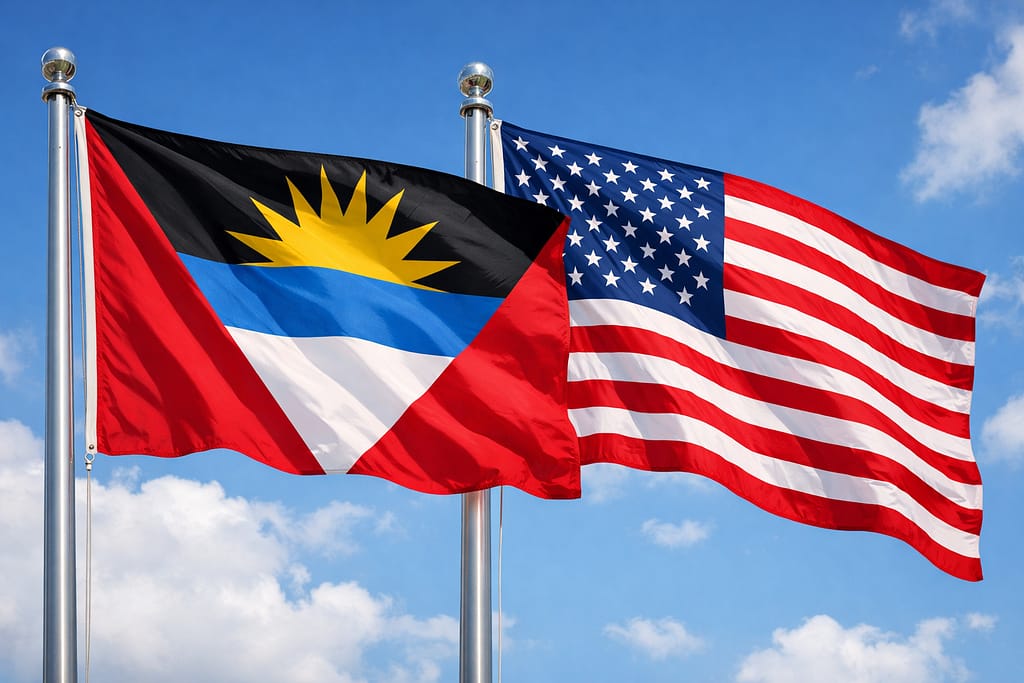
Greene says shifting global trade environment has made stronger Africa Union-CARICOM economic relations an urgent necessity
 21 January 2026






Africa Union Exports to CARICOM Could Surpass US$1 Billion

Exports from the Africa Union to CARICOM could cross the US$1 billion mark, according to a CARICOM Private Sector Organization (CPSO) Study unveiled this week, signalling a major opportunity to rewire CARICOM import supply chains.
Honourable E.P. Chet Greene, Minister of Foreign Affairs, Trade and Barbuda Affairs of Antigua and Barbuda, highlighted the findings of the CPSO Study, “Africa Union-CARICOM Trade in Goods: Scope and Potential”, at the opening of the AfriCaribbean Private Sector Webinar Series, “Unlocking AfriCaribbean Trade and Investment: Opportunities, Ecosystems and Private Sector Leadership” onTuesday, 20th January, 2026.

The webinar is the first in a four-part series designed to unlock concrete trade, investment, and business-to-business opportunities between the Africa Union and the Caribbean Community (CARICOM). Jointly organized by the International Trade Centre (ITC), the African Export-Import Bank (Afreximbank), the CARICOM Private Sector Organization (CPSO), and the Africa Business Council (AfBC), the virtual forum brought together Ministers, development institutions and over 200 business leaders and private sector firms from across Africa and the Caribbean, to explore pathways for expanding commercial ties between the two regions.

In delivering the keynote address, Minister Greene emphasized that a shifting global trade environment has made stronger Africa Union-CARICOM economic relations an urgent necessity. He pointed out that rising protectionism, geopolitical uncertainty, and supply-chain disruptions are placing increasing pressure on CARICOM economies, where micro, small, and medium enterprises (MSMEs) account for the vast majority of businesses.
The Minister also emphasised that strengthening Africa-CARICOM commercial ties is a strategic imperative, noting that successive Africa-CARICOM Summits and the AfriCaribbean Trade and Investment Forum (ACTIF) have established an important political foundation. Minister Greene stressed, however, that the next phase must be driven by business.

“Political leadership establishes the framework, but it is businesses that drive innovation, generate trade volumes, mobilize investment, and create employment,” Minister Greene said. “If AfriCaribbean integration is to succeed in practical terms, it must now be carried forward by the private sector.”
Also citing the results of research conducted by the CARICOM Private Sector Organization, Minister Greene highlighted data showing that the Africa Union has the capacity to supply a wide range of goods competitively. The analysis indicates that deeper sourcing from the Africa Union could strengthen supply-chain resilience and reduce the Region’s vulnerability to external policy shocks.

Minister Greene also acknowledged persistent constraints to expanding trade, including limited transport connectivity, high logistics costs, and fragmented payment systems. He issued the call for innovative approaches to financing, shipping and digital payments to unlock the full potential of the partnership.
While Minister Greene framed Africa-CARICOM engagement as a strategic imperative, CPSO Chief Executive Officer and Technical Director Dr. Patrick Antoine grounded the discussion in market data and commercial execution.
Dr. Antoine presented findings from the recent CPSO Study, which identified up to USD 1.6 billion in potential competitive opportunities for Africa Union exports to CARICOM. The analysis also demonstrated that at least 13 Africa Union countries are each capable of supplying more than USD 58 million in CSME non-mineral fuel imports at prices typically averaging 60% of current benchmarks. Importantly, across the 579 product lines identified as competitively priced, the Study found that for most products there are typically 4 Africa Union countries from which CARICOM can source imports at competitive prices, underscoring both the depth and diversity of available supply options.
Dr. Antoine also reinforced the importance of proactive private sector engagement, warning that shifting global policies in major markets require CARICOM firms to seek new commercial pathways and diversify trade relationships.
“At moments like these, the role of the private sector becomes even more vital,” Dr. Antoine stated. “We must be prepared to respond with agility and seize opportunities wherever they emerge.”
Beyond the data, Dr. Antoine issued a call to action to CARICOM businesses, declaring, “We in the CARICOM Private Sector have no option but to explore and execute on opportunities to navigate this ‘collective turbulence’. We in the CARICOM Private Sector choose not to whither; we choose not to retreat. Instead, we choose to engage, and to keep on engaging. We choose to relentlessly confront the persistent challenges: challenges of ‘affordability’, trade concentration, and surmounting the inefficiencies of scale and size, with cooperation, integration and a laser sharp focus on ‘doing business’.”
Mr. Anthony Ali, Chief Executive Officer of Goddard Enterprises Limited and a member of the CPSO Executive Committee, shared practical lessons from his company’s direct engagement with Africa Union markets. While acknowledging challenges, Mr. Ali indicated that substantial opportunities existed for local production partnerships in order to establish CARICOM brands in Africa, and Africa brands in CARICOM.
In concluding his remarks, Mr. Ali also emphasized that successful entry into the markets in the Africa Union requires flexible models such as local production partnerships, licensing arrangements, and stronger institutional support to address financing and logistics gaps.
Also speaking at the event were Pamela Coke-Hamilton, Executive Director of the International Trade Centre; Okechukwu Ihejirika, Chief Operating Officer of Afreximbank’s Caribbean Office; and Dr. Amany Asfour, President of the Africa Business Council. Each underscored the need for stronger business-to-business linkages and data-driven collaboration.
The webinar series will continue over the coming weeks with focused sessions on agribusiness, fashion and creative industries, cosmetics and wellness, and medical and health technologies.
Advertise with the mоѕt vіѕіtеd nеwѕ ѕіtе іn Antigua!
We offer fully customizable and flexible digital marketing packages.
Contact us at [email protected]

Related News
VIDEO: Nearly 200 Ghanaian Nurses applied to work in Antigua

COMMENTARY: What Price Are You Willing To Pay For A US Visa

COMMENTARY: The Caribbean’s greatest export is talent. It’s time to stop giving it away