Syria decree grants Kurds new rights, formally recognising Kurdish language
 17 January 2026
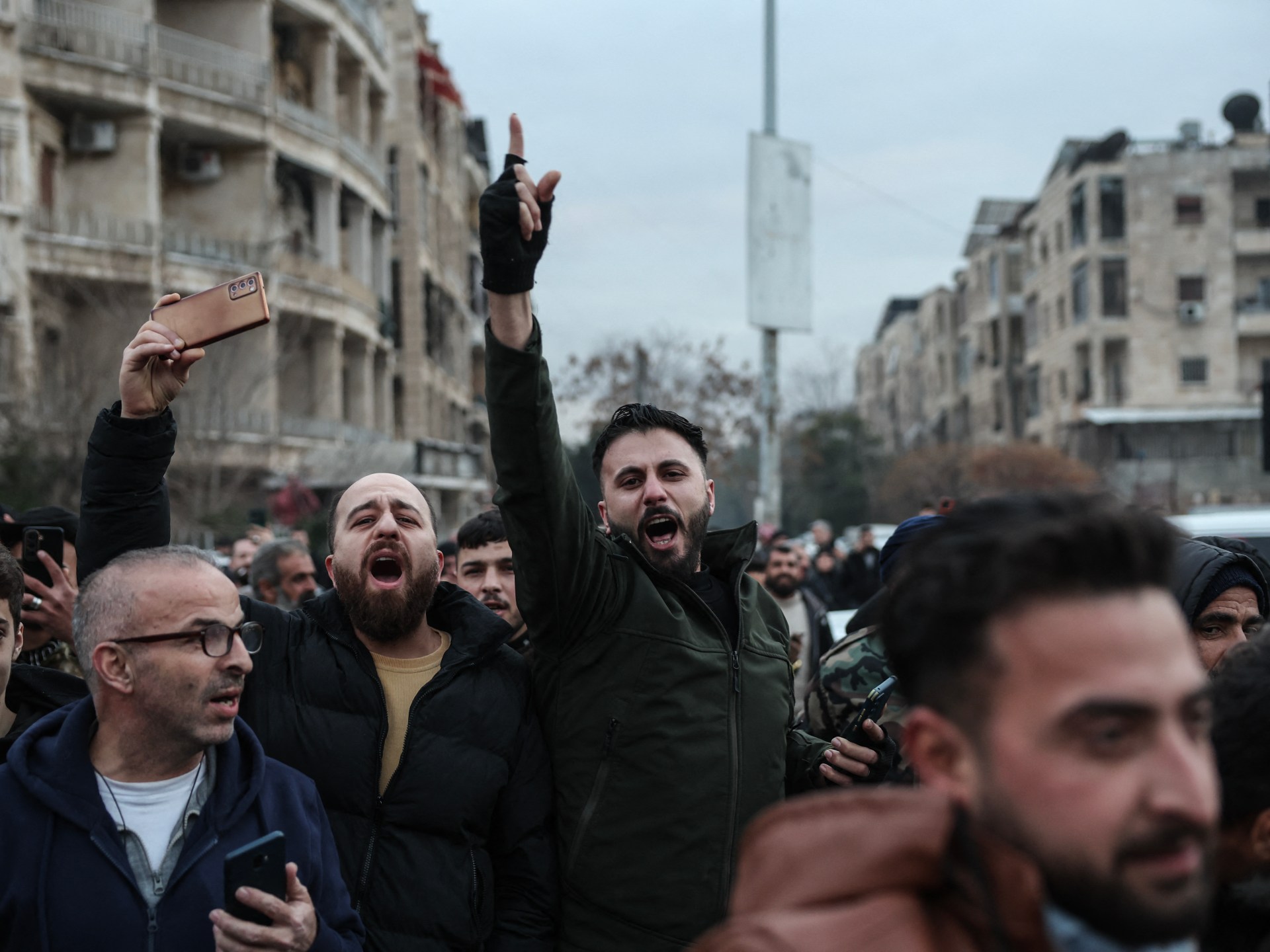

Syria’s President Ahmed al-Sharaa has issued a decree formally recognising Kurdish as a “national language” and restoring citizenship to all Kurdish Syrians.
Al-Sharaa’s decree on Friday came after fierce clashes that broke out last week in the northern city of Aleppo, leaving at least 23 people dead, according to Syria’s health ministry, and forcing tens of thousands of people to flee the two Kurdish-run pockets of the city.
- list 1 of 4Syrian army announces full control of Deir Hafer after SDF withdrawal
- list 2 of 4Syrian army tells civilians to evacuate new front with SDF east of Aleppo
- list 3 of 4Clashes in Aleppo highlight challenge of SDF integration for Syria
- list 4 of 4The upcoming elections will not help stabilise Syria
end of list
The clashes ended after Kurdish fighters withdrew and the Syrian army assumed full control over the city of Deir Hafer in the governorate of Aleppo.
The violence in Aleppo has deepened one of the main faultlines in Syria, where al-Sharaa promised to unify the country under one leadership after 14 years of war against former President Bashar al-Assad, who was overthrown in December 2024.
The decree for the first time grants Kurdish Syrians rights, including recognition of Kurdish identity as part of Syria’s national fabric. It designates Kurdish as a national language alongside Arabic and allows schools to teach it.
It also abolishes measures dating to a 1962 census in Hasakah province that stripped many Kurds of Syrian nationality, granting citizenship to all affected residents, including those previously registered as stateless.
The decree declares Newroz, the spring and new year festival, a paid national holiday. It bans ethnic or linguistic discrimination, requires state institutions to adopt inclusive national messaging and sets penalties for incitement to ethnic strife.
Army takes control of Deir Hafer
Meanwhile, the Syrian army on Saturday took control of the town of Deir Hafer outside Aleppo city, a day after Kurdish forces agreed to withdraw from the area following recent clashes.
Advertisement
In a statement to state television, the army said it had established “full military control” of Deir Hafer and other areas previously held by the Kurdish-led Syrian Democratic Forces (SDF) in the governorate of Aleppo.
The forces entered Deir Hafer after the SDF announced it would start withdrawing from their strongholds in the city.
Al Jazeera’s Zein Basravi, reporting on Saturday from Zaalanah, just east of Aleppo on the way to Deir Hafer, said the Syrian forces, who were building up around Deir Hafer for days, have started entering the town.
“And what we are likely to see in the next hours and days are the clearing operations,” he said.
“In many ways, this is really a best-case scenario – a short, sharp military operation overnight and then in daylight hours securing that agreement for a withdrawal from the SDF and then now moving in to try to clear the area,” Basravi added.
SDF leader Mazloum Abdi (also known as Mazloum Kobani) announced on X on Friday that “based on calls from friendly countries and mediators … we have decided to withdraw our forces tomorrow morning at 7am (04:00 GMT)” east of Aleppo “towards redeployment in areas east of the Euphrates”.
Power struggle
Syria’s government is seeking to extend its authority across the country following the removal of al-Assad.
The SDF controls swaths of Syria’s oil-rich north and northeast, much of which it captured during the country’s civil war and the fight against the ISIL (ISIS) group over the past decade – a war the SDF fought as the main regional ally of the United States.
The Syrian government and the SDF engaged in months of talks last year to integrate the Kurdish People’s Protection Units (YPG), which leads it, and its political wing, the Kurdish Democratic Union Party (PYD), into Syrian state institutions by the end of 2025, but there has been little progress, which eventually led to the fighting in Aleppo.
Millions of Kurds live across Syria, Iraq, Iran and Turkiye, with about one to 1.5 million estimated to live in northeastern Syria, controlled by the SDF.
Ankara, a main ally of the Syrian government, considers the SDF, the YPG and the PYD to be “terrorist groups” with ties to the banned Kurdistan Workers’ Party (PKK) in Turkiye, which has waged a decades-long fight inside the country against the state, leading to the deaths of tens of thousands of people.
Related News
Far-right pro-Israel group Betar US to end activity in New York: NY AG says

US Republicans back Trump on Venezuela amid faint MAGA dissent
Thousands of supporters of Yemen’s separatist STC rally in Aden