Handshake in Dhaka: Can India and Pakistan revive ties in 2026?
 02 January 2026
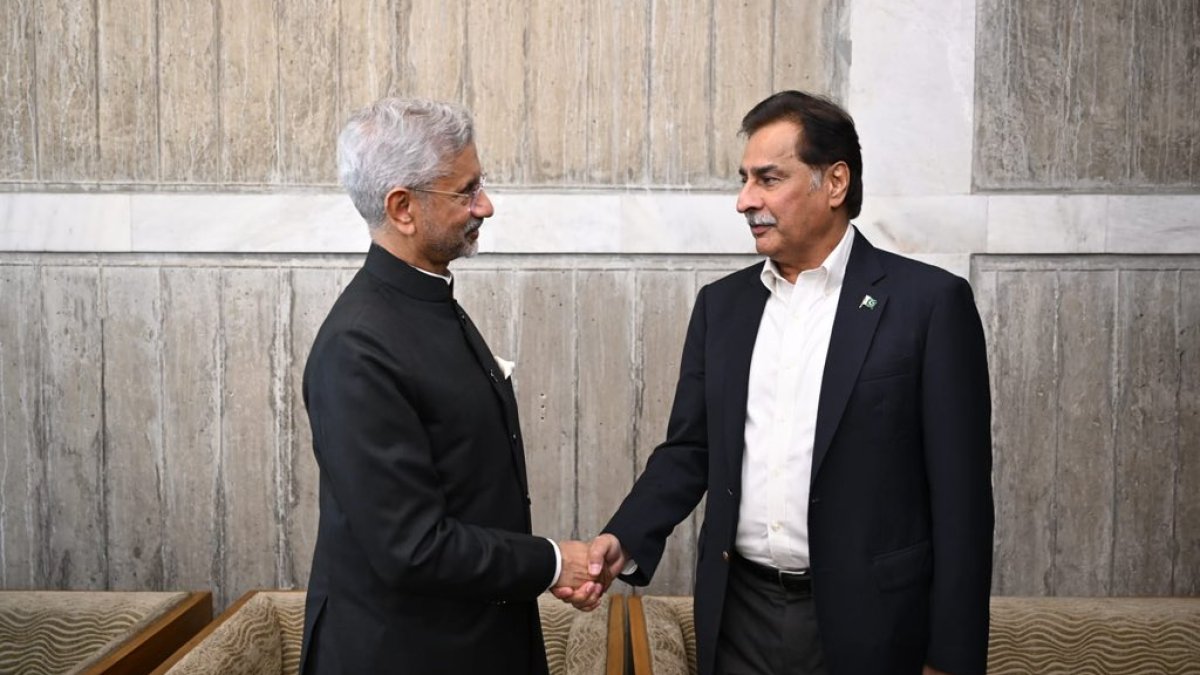

Islamabad, Pakistan – On December 31, the final day of 2025, India’s Foreign Minister Subrahmanyam Jaishankar did what India’s men, women’s and Under-19 cricket teams had only recently refused to do.
He shook hands with a Pakistani representative in public.
- list 1 of 4Huge crowds for Khaleda funeral as Bangladesh bids farewell to ex-leader
- list 2 of 4Why has Pakistan launched a new rocket command after India conflict?
- list 3 of 4‘Operation Sindoor’: How cricket became latest India-Pakistan weapon of war
- list 4 of 4Can India stop Pakistan’s river water — and will it spark a new war?
end of list
Jaishankar and Ayaz Sadiq, the speaker of Pakistan’s National Assembly, were among a gathering of regional leaders that had descended in Dhaka earlier this week to attend former Bangladesh Prime Minister Khaleda Zia’s funeral ceremony.
With Sadiq present in a waiting room at Bangladesh’s parliament in Dhaka, Jaishankar walked over and shook his hand in the presence of diplomats from several South Asian countries.
“He walked up to me and said hello, at which I stood up, and he introduced himself and shook hands with a smile. As I was about to introduce myself, he said, ‘Excellency, I recognise who you are and no need to introduce yourself’,” Sadiq, a veteran politician from Pakistan’s ruling Pakistan Muslim League-Nawaz (PMLN), recounted the interaction to a private news channel on Wednesday night.
Once Jaishankar entered the room, Sadiq said, the Indian minister first met delegations from Nepal, Bhutan and the Maldives before approaching him.
“He knew what he was doing. He realised the presence of other people in the room, but he had a smile on his face, and he was well aware,” the Pakistani politician added.
Images of the handshake were shared by Sadiq’s office and were also posted on the X account of Muhammad Yunus, chief adviser of Bangladesh’s interim government.
Advertisement
This was in stark contrast from September, when the Indian men’s cricket team captain Suryakumar Yadav and his players refused to shake hands with their Pakistani counterparts during an Asia Cup clash last year. The tournament, played in the United Arab Emirates and won by India after beating Pakistan in a thrilling final, underscored how deeply resentful relations between the two neighbours had become.
A bitter four-day aerial conflict in May, in which both nuclear-armed countries declared themselves victorious, marked the latest and most serious chapter in an antagonism that stretches back to their violent partition from British rule in 1947.
As the fighting spilled over into sport, it reinforced how political tensions had seeped into nearly every public interaction when it comes to these two nations – until Jaishankar’s handshake on Wednesday.
While some Indian commentators viewed the interaction negatively, voices in Pakistan saw it as a possible signal of a modest thaw in an otherwise icy relationship.
“I think that the interaction between Jaishankar and Ayaz Sadiq is a welcome development for the new year,” Mustafa Hyder Sayed, an Islamabad-based foreign policy analyst, told Al Jazeera.
“I think basic normalcy of relations in which respect is accorded to officials and hands are shaken, it is the bare minimum which unfortunately was absent after the war between India and Pakistan,” he said.
Rivalry hardens
Relations between the nuclear-armed neighbours have deteriorated for years and plunged further this April after an attack in Pahalgam in Indian-administered Kashmir, when gunmen killed 26 civilians.
India blamed Pakistan for the killings and, among other measures, withdrew from the six-decade-old Indus Waters Treaty (IWT), which governs the use of six rivers in the Indus basin, which the neighbours share.
Pakistan denied responsibility, but in early May, the two countries fought an intense four-day air war, targeting each other’s military bases with missiles and drones in their most serious confrontation in nearly three decades.
The fighting ended after intervention by the United States, for which Pakistan later nominated US President Donald Trump for the Nobel Peace Prize.
India, however, insisted the ceasefire was achieved through direct communication between officials of the two countries, in line with its longstanding opposition to third-party mediation.
Since then, ties have remained tense, with fears of renewed conflict never far from the surface.
Leaders on both sides have exchanged sharp rhetoric. Both countries have also tested ballistic missiles and conducted military exercises.
Advertisement
Against that backdrop, some analysts say the handshake in Dhaka could be significant.
Sardar Masood Khan, a former Pakistani envoy to the US, described the handshake as a pleasant diplomatic gesture.
“One can’t imagine that the Indian foreign minister would greet Pakistan’s speaker spontaneously without the explicit permission of the Indian prime minister and senior leadership of the Bharatiya Janata Party,” Khan told Al Jazeera, referring to India’s Hindu-majoritarian ruling party.
Khan, who has also served as Pakistan’s envoy to the United Nations and China, referred to how the US – while announcing the ceasefire between New Delhi and Islamabad in May – had “nudged” the two sides towards talks in a neutral country.
India had rejected those calls at the time: New Delhi insists that there is no point in talking to Pakistan until it stops cross-border fighters from entering India for attacks. India has accused Pakistan of sponsoring “terrorism” on its soil for decades – and in recent times, Pakistan has reciprocated those allegations, accusing New Delhi of backing separatists against Islamabad.
Each side rejects the other’s accusations, though Pakistan has, at times, accepted that the perpetrators of some of the biggest attacks on Indian soil in recent years – such as in Mumbai in 2008 – did come from Pakistan.
If there were to be any diplomatic breakthrough between India and Pakistan, Bangladesh would be an unlikely setting: Bangladesh was once part of Pakistan as its eastern wing, before it achieved independence in 1971, with India’s help, after Pakistani troops surrendered and thousands of its soldiers were taken as prisoners of war.
“Whatever prompted it [the handshake] is good for the region, but there are many ifs and buts down the road,” Khan said.
Rezaul Hasan Laskar, foreign affairs editor at India’s Hindustan Times newspaper, played down the significance of the interaction.
“The two happened to be in the same room and did what senior leaders of two countries would do when they find themselves in such a situation. They shook hands and exchanged pleasantries,” Laskar told Al Jazeera.
He said it was “significant” that all photographs of the encounter emerged from Bangladeshi and Pakistani official social media accounts – rather than from India.
Laskar noted that India and Pakistan have not held sustained official dialogue since the 2008 Mumbai attacks, when gunmen linked to Pakistan killed 166 people.
“It is hard to see the two sides coming together in any way, given the growing trust deficit,” he said.
Hydro politics
Arguably, the most consequential fallout of the May conflict was India’s decision to put the Indus Waters Treaty (IWT) in abeyance.
Pakistan says the move poses an existential threat to its population, which depends heavily on the Indus, Chenab and Jhelum rivers, all of which flow from India or Indian-administered Kashmir.
Khan, the former diplomat, said that if India were to rethink its position and return to the IWT, it would “be a big confidence-building measure and a harbinger for a semblance of rapprochement”.
Advertisement
But Laskar wasn’t optimistic.
“For anyone following India-Pakistan tensions in recent years, the suspension of the IWT should not have come as a surprise,” he said.
“This has the potential for becoming a new permanent hurdle between the two sides, especially since there are virtually no official contacts between them.”
Uncertain thaw
The past year has seen Pakistan’s geopolitical standing rise, with analysts arguing it is the first time in decades the country has been viewed as a major international player.
In South Asia, following the ouster of Indian ally Sheikh Hasina, the former Bangladesh prime minister, it has revived its ties with Bangladesh as well, with several high-profile visits between the two countries.
Islamabad has also deepened ties with the US, China and Middle Eastern states. Trump, in fact, has on several occasions publicly praised Pakistani leadership and recently called Pakistan’s army chief Asim Munir his “favourite field marshal”.
Pakistan is expected to be part of a controversial US-led international stabilisation force proposed to oversee security in Gaza, and it also signed a defence agreement with Saudi Arabia in September.
India, meanwhile, has faced diplomatic pressure from Washington. Trump has repeatedly referred to the May conflict and appeared to endorse Pakistani claims of shooting down several Indian fighter jets.
The US president has also imposed tariffs of nearly 50 percent on India, while Pakistan received a lower rate of 19 percent.
With Pakistan seemingly enjoying diplomatic momentum, could 2026 bring a detente between New Delhi and Islamabad?
Sayed, the foreign policy analyst, said it was in the “national interest” of both countries to maintain at least minimal engagement.
“They can have a very basic, minimal agenda, in which they should define the rules, red lines and set guardrails. Once that is done, they can have a basic level of dialogue that is agreed upon with consent of both, and bring it to the table,” he said.
But Khan was sceptical, given the bitterness of the May conflict.
Laskar said India has steadily escalated its responses to attacks since 2019 and that the May 2025 conflict showed how far both sides were prepared to go.
As a result, he said, reviving back-channel contacts between India’s national security adviser and Pakistani intelligence officials was essential, as the mechanism had worked in the past.
“The consolidation of power by Field Marshal Asim Munir, his ability to strike a personal rapport with US President Donald Trump and the Pakistan-Saudi Arabia mutual defence pact are all factors that have implications for the region, which will be factored into New Delhi’s approach,” Laskar said.
Sayed agreed, saying a “pre-determined and mutually agreed mechanism” to handle incidents of violence, rather than immediate blame, would be a significant step forward.
“I think India has also understood that it cannot get away with not acknowledging Pakistan’s existence or pretending that it is not there,” he said.
“Pakistan has emerged as a very important regional player, and India is now compelled to have a bare-minimum level of engagement.”
Related News
A year on, Israel still holds Gaza doctor Hussam Abu Safia without charge

Palestinian actor and filmmaker Mohammad Bakri dies at 72
‘We will not wait’: Mamdani kicks off housing plans after inaugural party