Starvation, ‘ghost towns’ plague Sudan as al-Burhan demands RSF surrender
 29 December 2025

The head of the government-aligned Sudanese Armed Forces (SAF) has insisted the war, now deep into its third year, will only end with the “surrender” of the Rapid Support Forces (RSF).
General Abdel Fattah al-Burhan’s maximalist stance against the rival paramilitary forces comes as the war-torn nation faces a collapsing humanitarian response, with starvation and displacement under fire rife, and intensifying battles that are turning villages into “ghost towns”.
- list 1 of 3UN renews Sudan ceasefire appeal over ‘unimaginable suffering’ of civilians
- list 2 of 3RSF says Sudan’s army launches air strikes on paramilitary stronghold Nyala
- list 3 of 3‘No negotiation, no truce’ with RSF, says senior Sudan official
end of list
Speaking during an official visit to Ankara on Sunday, al-Burhan summarily dismissed the possibility of a political solution that does not involve the disarmament of the RSF.
“We are not talking about a military solution … we said the military solution does not necessarily have to end with fighting; it can end with surrender,” al-Burhan told members of the Sudanese community in Turkiye. “The war will end after … arms are laid down,” he added.
United Nations Secretary-General Antonio Guterres called on Friday for an immediate ceasefire in Sudan’s brutal civil war, which the UN says has created the world’s worst humanitarian crisis.
‘Stomachs are empty’
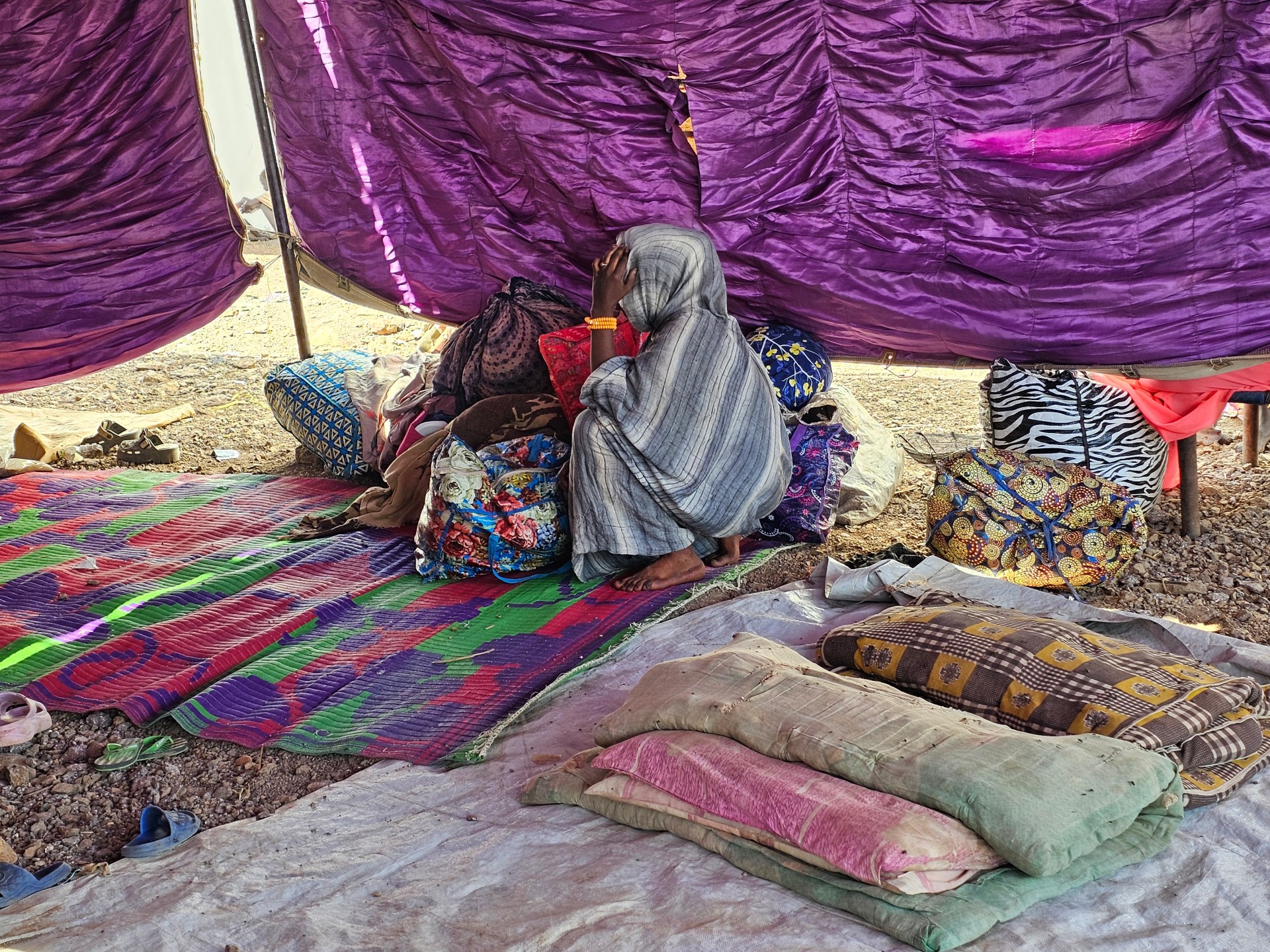
Al-Burhan’s comments come as the civilian population faces a catastrophic and brutal reality on the ground. In the city of Kosti, south of Khartoum, thousands of families are sleeping rough, surviving on little more than bread and boiled lentils.
Al Jazeera’s Mohammed Val, reporting from White Nile state, described a grim situation where nearly 12 million people across Sudan are “living in limbo”.
Advertisement
“Some say they feel safe here in Kosti, but their stomachs are empty,” Vall reported.
Ahmed Adam, from the Sudanese Red Crescent, told Val that the influx of displaced people has overwhelmed local capacities, creating critical gaps in essential supplies.”We have a real shortage of food items, medicine, especially medication for children,” Adam said. “We need help from charity organisations,” he added.
The crisis is exacerbated by a collapse in international funding. The United Nations has more than halved its appeal for 2026 to $23bn following major reductions in support from key donors, including the United States, the United Kingdom and Germany.
The World Food Programme (WFP) warns that rations in Sudan, where 21 million people face starvation, will be cut by up to 70 percent.
Lamia Abdulla, the humanitarian aid commissioner for White Nile state, warned that the impact is already being felt.”The WFP gives food for the displaced, but the biggest part of their assistance goes to refugees, so the aid cuts will pose a real challenge for us,” Abdulla told Al Jazeera.
‘Ghost towns’ and hit-and-run warfare
While hunger spreads, new military escalations are emptying vast swaths of the country. Al Jazeera Arabic’s correspondent, Hassan Razzaq, reported that the humanitarian exodus is a direct result of expanding military operations, particularly in North Darfur and North Kordofan.
“There are towns now completely empty of their inhabitants, which can be described as ghost towns due to the continuation of battles,” Razzaq said.
In North Kordofan, the RSF is attempting to advance on the strategic city of el-Obeid. SAF has been expanding its defensive perimeter around the city, leading to volatile battles in the surrounding countryside.
Razzaq highlighted the instability in areas such as al-Dankouj, a town 40 kilometres (25 miles) from el-Obeid.
Control of the town has fluctuated, seized first by the RSF and then retaken by SAF, illustrating the “hit-and-run” nature of the conflict in the region.
Siege warfare and drones
The situation is equally dire in South Kordofan, where Razzaq reported that the RSF has maintained an “airtight siege” on the cities of Kadugli and Dilling for more than a year and a half.
“This continuous siege … has placed the residents in a deplorable state,” Razzaq said, noting that there is “no escape from displacement” as living conditions collapse.
The geography of South Kordofan has complicated the fighting. Razzaq explained that due to the rugged, mountainous terrain surrounding Kadugli and Dilling, the RSF and its ally, the Sudan People’s Liberation Movement-North (SPLM-N), are resorting to specific tactics to breach defences.”The RSF is attempting to penetrate these cities using drones and long-range heavy artillery,” he reported.