Why are Nigeria-South Africa tensions rising amid xenophobic attacks?
 09 June 2026
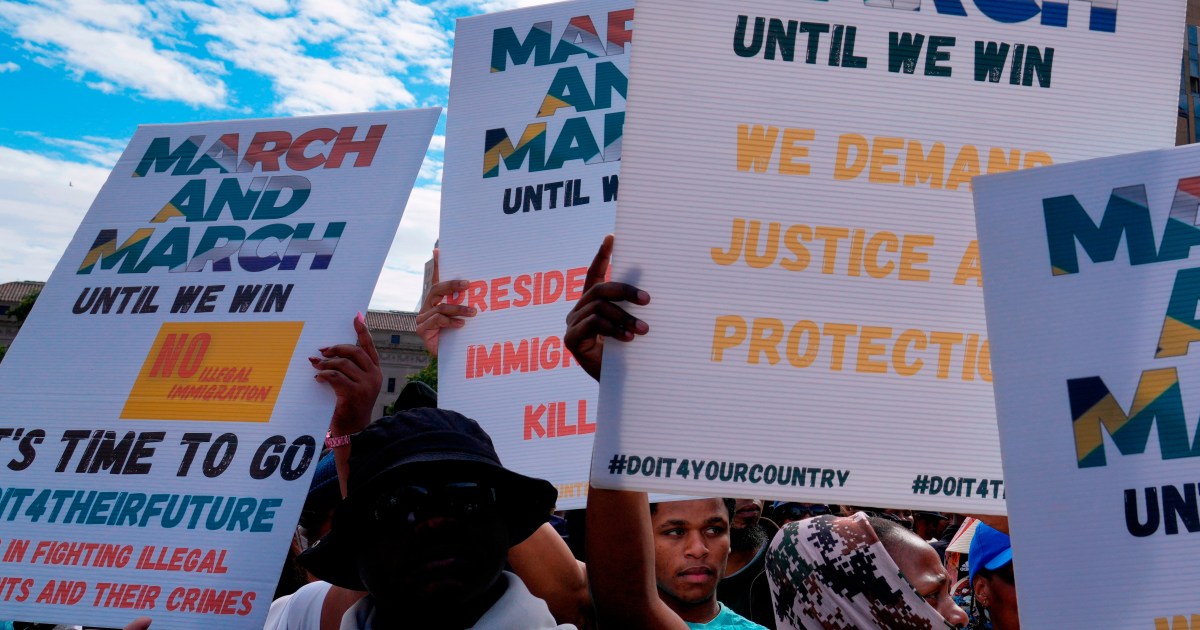

Nigeria has threatened retaliatory measures against South Africa after Abuja began repatriating hundreds of Nigerians from South Africa this week amid alleged xenophobic attacks by South African protesters.
Diplomatic tensions between the two countries have spiked since the latest wave of violent anti-immigration protests by thousands of South Africans calling for strict, mass deportation measures.
- list 1 of 4Violence against foreign-owned shops in South Africa
- list 2 of 4Mozambique says 5 citizens killed in ‘xenophobic attacks’ in South Africa
- list 3 of 4Fearful foreign nationals in South Africa forced out of their homes
- list 4 of 4How Mexican cartels turned South Africa’s farms into meth production hubs
end of list
South Africa has long attracted migrants from across the continent, entering the country both legally and illegally. Statistics South Africa put the number of foreign nationals at 2.4 million in 2022, about 3.7 percent of the total population of 65 million.
However, many South Africans claim that high numbers of undocumented migrants contribute to unemployment and place pressure on public services.
There have been three waves of anti-immigration protests since 2008, all turning violent and resulting in casualties and the looting of shops and other property.
Much of the anger has targeted, in particular, nationals from Zimbabwe, Mozambique and Malawi, as well as Nigeria and Ghana.
Here’s what we know about the tensions and Nigeria’s plans to take retaliatory steps:

Why is Nigeria’s government angry?
On Monday, Nigerian Foreign Minister Bianca Odumegwu-Ojukwu accused South Africa’s government of failing to forcefully denounce violence against Nigerian nationals in South Africa. She said this had damaged the bond the two countries have enjoyed since the solidarity Nigeria showed during South Africa’s fight against apartheid.
Advertisement
At least two Nigerian men died in April during the latest wave of violence.
One of the men, Amaramiro Emmanuel, was killed after being beaten by officers from the South African National Defence Force (SANDF) on April 20, according to a statement by the Nigerian consul-general, Ninikanwa Okey-Uche. The other, Ekpenyong Andrew, was arrested in Pretoria before being found dead at a mortuary.
Odumegwu-Ojukwu said Nigerians are being “harassed” in South Africa despite having legal status, countering claims by South African citizen groups that attacks have targeted only undocumented residents.
Legitimate businesses are being “looted” while children are forced to stay away from school, she said.
“The police refused to do anything,” the minister added.
“Nigeria is not happy because Nigeria has sacrificed much for the South African independence struggle,” Odumegwu-Ojukwu told journalists on Monday.
“My own generation, we carried placards, we demonstrated in front of South African assets, sometimes we even got arrested.”
At least 1,000 Nigerians were initially scheduled for repatriation this week, but Abuja says the number of people wishing to return home is rising.
What has the South African government said?
In a national address on Sunday evening, South African President Cyril Ramaphosa announced new measures to tackle irregular migration amid the rising anger.
Ramaphosa said employers who hire undocumented workers, who often work for lower wages, will now be subject to imprisonment, rather than just fines.
He added that dedicated courts would be established to help speed up deportations of those in the country illegally. A new register holding the biometric data of “every person in the country” would also be established to combat identity theft.
“Many South Africans are asking difficult but legitimate questions,” Ramaphosa said in his address.
“Yet we must recognise that illegal immigration is not the cause of all our economic challenges … Our country, like many others throughout history, is a product of migration. It is the reason for our diversity and contributes to our vibrancy.”
Ramaphosa warned South Africans against taking action on their own, saying the responsibility for enforcing immigration laws “rests with the state and the state alone”.
A South African High Court, in November 2025, blocked Operation Dudula from blocking migrants’ access to healthcare facilities.
How has the Nigerian government responded?
Nigeria is repatriating citizens from South Africa.
Minister Odumegwu-Ojukwu said retaliatory measures against South Africa were being “considered” in response to the attacks on Nigerians.
Advertisement
“This is a decision that has to be taken at the highest level of government, but it is not off the table,” she said, without elaborating.
In the past, angry mobs have responded to attacks on Nigerians by targeting South African businesses in Nigeria. Some Nigerians have also called for South African businesses to be shut or nationalised.
On May 31, Nigerian police spokesman Aliyu Giwa warned against attacks on South Africans in Nigeria amid the latest bout of tensions, saying “reprisal attacks against South African nationals, businesses, or interests in Nigeria will not be tolerated”.
Why are anti-immigration attacks on the rise in South Africa?
High levels of unemployment, crime and social inequality, which are a lingering consequence of years of apartheid rule, have long frustrated South Africans.
Analysts say those frustrations are now being directed at foreigners who are seen as taking economic opportunities away from struggling South Africans. Immigrants are also accused of involvement in crime.
The rise of vigilante-style movements like Operation Dudula and March and March, which have emerged amid mass anger, has further fuelled anti-immigration sentiment, experts say.
Politics is also a factor. Right-wing political groups like Patriotic Alliance, which is led by Sports Minister Gayton McKenzie, are among those which frame migrants in a negative light. In his campaign ahead of the 2024 elections, McKenzie, a convicted criminal who was seeking the position of home affairs minister, campaigned on a promise to launch mass deportations of “illegal” foreigners.
The latest waves of protests were ignited in late April by the March and March group. Thousands of South Africans took to the streets for days across several cities, including Johannesburg, Pretoria and Durban.
Anti-immigration activists have rejected accusations of xenophobia and say they are only protesting against undocumented residents.
However, groups advocating against xenophobic attacks report that verbal threats and physical assaults are taking place against foreign nationals regardless of their status.

Which other nationals have been repatriated from South Africa?
Ghana was the first to begin bringing its citizens home amid xenophobic violence in late May. At least 1,000 of its nationals have been repatriated and are being provided with psychosocial support, according to government reports.
Speaking to evacuees at the weekend, Foreign Minister Samuel Okudzeto Ablakwa disputed claims that Ghanaians were involved in crimes. “Not a single Ghanaian so far has been arrested,” he said.
According to South Africa’s Border Management Authority, 663 Ghanaians were repatriated over the weekend alone. Of those, 321 were found to have “overstayed” their visas for 30 days or more, the agency said.
Mozambique has also repatriated more than 700 of its citizens from South Africa’s Western Cape amid a surge in violence. Thousands of others have returned voluntarily.
Advertisement
Authorities in Mozambique said five of its citizens had been killed as a “direct consequence of the xenophobic attacks”. Two others were killed in a road accident as they were fleeing to Mozambique, the government’s media office said.
Is there a deadline for people to leave South Africa?
June 30 is the deadline, set by some anti-immigration activists, by which all irregular foreign nationals are to leave South Africa, according to videos spreading on social media.
Some on social media have threatened “bloodshed” if foreigners do not leave by that date.
The government has not given any deadline by which people must leave.

No, there have been previous waves of anti-immigration protests in South Africa, which have provoked diplomatic spats with other African countries.
In 2008, mobs began attacking African immigrants from Mozambique, Malawi and Zimbabwe in Alexandra, Johannesburg, before the violence spread. At least 62 people were killed, including 21 South Africans, 11 Mozambicans, five Zimbabweans and three Somalis, according to Human Rights Watch.
Attacks again took place in 2015, killing seven people, including South African nationals, after Zulu King Goodwill Zwelithini remarked that foreigners “should pack their bags and go” because they were taking jobs from South Africans. He later claimed he had been misquoted.
In 2019, attacks against foreigners in Johannesburg killed 12 people.
Nigerian businesses, alongside others, were also targeted, prompting Abuja to summon the South African high commissioner and to close its South African embassy.
South African telecom company MTN, satellite television service Multichoice and popular retailer Shoprite shut their branches temporarily to avoid attacks.